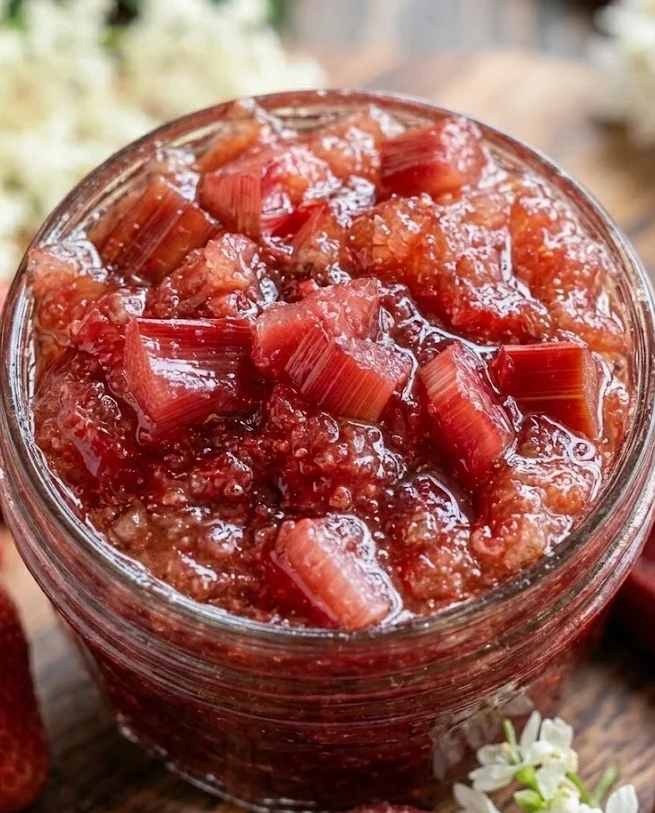
There is a moment every spring when the rhubarb and the strawberries overlap — when the last of the rhubarb stalks are still firm and the first truly ripe strawberries have arrived at the market. It is a brief window, a few weeks at most, and the people who know what to do with it make jam.
This strawberry rhubarb jam without pectin is one of the most essential strawberry rhubarb recipes for anyone who wants to preserve the flavor of that moment and extend it across the entire year. Three core ingredients — rhubarb, strawberries, and sugar — and a saucepan is all you need. No canning experience required. No trips to a specialty store for pectin packets. No water bath if you would rather freeze it. Just fruit, sugar, heat, time, and patience, and you end up with jars of something so vivid and alive with flavor that store-bought jam immediately feels irrelevant.
Why You’ll Love This Strawberry Rhubarb Jam
Among all the strawberry rhubarb recipes that celebrate this beloved pairing, jam occupies a unique position because it lasts. A rhubarb crisp disappears at dinner. A strawberry rhubarb pie is gone by the next morning. But a jar of jam travels with you through October, November, December — spread on toast on a gray Tuesday morning in February, it is a concentrated reminder that spring exists and will return.
The no-pectin approach produces a jam that tastes more purely and directly of its fruit than pectin-based jams typically do. Commercial pectin recipes often require large quantities of sugar to activate the pectin properly, which can overwhelm the natural tartness of the rhubarb and the delicate sweetness of the strawberries. Without pectin, you use only as much sugar as the fruit actually needs — enough to sweeten, enough to preserve, enough to create the chemistry that makes the jam set — and the result is a jam where the fruit is the undeniable lead flavor.
It is also, practically speaking, one of the most accessible savory rhubarb recipes adjacent options you can make: no special equipment, no canning jar seals required if you are freezing it, and a recipe that scales up or down effortlessly.
Common Mistakes (And How to Avoid Them)
Not cooking to the right temperature. This is the single most important technical detail in pectin-free jam making. Without added pectin to accelerate the setting process, the jam must reach 220°F (104°C) — the gel point at which the natural pectin in the fruit activates fully and the sugar concentration reaches the level needed for the jam to set properly. Pulling the pot off the heat at 200°F or 210°F produces a jam that is pleasant but runny, more of a syrup than a spread. Use a candy thermometer and cook until you hit 220°F. The temperature will crawl in the last few degrees — this is normal. Be patient.
Using underripe or overly watery strawberries. Overripe strawberries that have been sitting in the refrigerator for several days are high in water content and low in flavor. They will make the jam harder to set and will dilute the final flavor. Ideally, use fresh market strawberries at peak ripeness — firm, deeply red, and intensely fragrant. Grocery store strawberries, which are often picked before full ripeness, can be used successfully but may result in a slightly looser set and a milder flavor.
Skipping the lemon juice. Lemon juice is not optional in this recipe. Its role is chemical: the citric acid it contains lowers the pH of the jam mixture, which neutralizes the negative charges on the pectin molecules in the fruit and allows them to bind together into a gel. Without that acid, the jam’s natural pectin cannot link up properly regardless of how long you cook it. Lemon juice also contributes natural pectin of its own — the peel and pith are particularly rich in it — giving the jam additional setting power. One tablespoon per batch is the minimum; some recipes use two for a more reliable set.
Cooking over too high heat. Jam burns. Sugar scorches. Fruit sticks to the bottom of the pan and turns bitter in a way that permeates the entire batch. Cook this jam over medium to medium-low heat throughout, stirring every five to ten minutes, and reduce the heat further if the mixture begins to spatter aggressively. A heavy-bottomed saucepan — stainless steel or enameled cast iron — distributes heat evenly and dramatically reduces the risk of scorching.
Not skimming the foam. As the jam cooks, a layer of pinkish foam will form on the surface. This foam is mostly air and fruit protein — it does not affect the flavor significantly but it can affect the clarity and texture of the finished jam. Skim it off with a spoon just before jarring. This step takes 30 seconds and produces a noticeably cleaner, more jewel-like jam.
Chef’s Notes
The plate test is the oldest and most reliable method for checking jam doneness without a thermometer: place two or three small ceramic plates in the freezer before you begin cooking. When you think the jam may be ready — around the 45-minute mark — drop a teaspoon of jam onto a frozen plate and return it to the freezer for one minute. Push the edge of the jam with your fingertip. If it wrinkles and holds its shape, the jam has reached gel point. If it runs back together like a liquid, continue cooking.
A wide, shallow pan cooks jam more efficiently than a tall, narrow stockpot. The greater surface area allows moisture to evaporate more quickly, which means the jam reaches gel temperature faster and the fruit flavors concentrate more rapidly. A 10 to 12-inch wide, heavy-bottomed saucepan or a wide Dutch oven is ideal.
For anyone who wants to extend the jam beyond the refrigerator’s two to four weeks without undertaking the full canning process, freezer jam is the simplest preservation method. Once the jam has cooled completely — and this means genuinely cooled to room temperature, at least an hour — ladle it into clean freezer-safe jars or containers, leaving about half an inch of headspace to allow for expansion. Seal and freeze for up to one year. Thaw in the refrigerator overnight before using.
Key Ingredients
Fresh rhubarb is what makes this jam genuinely special among all strawberry rhubarb recipes. Its aggressive tartness — similar in intensity to cranberry — gives the jam the backbone and complexity that straight strawberry jam lacks. Rhubarb also contributes a certain structural quality to the finished jam, breaking down into soft, jammy threads that give the spread body and a slightly more complex texture than a pure strawberry jam. Choose firm, brightly colored stalks without soft spots or browning. Remove the leaves entirely before using — they are toxic and should never be consumed.
Fresh strawberries provide the sweetness, the color, and the floral fragrance that softens rhubarb’s intensity into something approachable and deeply delicious. They break down completely during cooking, melding with the rhubarb into a unified, glossy spread with no distinct chunks of strawberry remaining. The more ripe and flavorful your strawberries, the more vibrant and bright-tasting the final jam will be.
Granulated sugar does three things simultaneously in this recipe: it sweetens the jam to palatability, it draws moisture from the fruit during the initial macerating period, and it acts as a preservative by creating the high-sugar environment that inhibits bacterial growth in sealed jars. Do not significantly reduce the sugar without understanding that you are affecting both the set and the shelf life of the finished jam.
Lemon juice activates the natural pectin in both the strawberries and the rhubarb and contributes its own pectin from the citrus pith. It is the chemical trigger that allows a no-pectin jam to gel reliably. Fresh lemon juice is preferable to bottled for flavor, but bottled lemon juice is acceptable for food safety purposes if you are canning rather than just refrigerating or freezing.
How to Make Strawberry Rhubarb Jam Without Pectin
- Wash and sterilize your jars. Clean them with hot soapy water, rinse thoroughly, and place upside-down on a clean dish towel to dry. If you plan to can the jam in a water bath, sterilize the jars by boiling them for 10 minutes.
- Wash and trim the rhubarb, removing the leaves and any discolored ends. Chop into half-inch pieces. Wash, hull, and halve or quarter the strawberries depending on their size. You want roughly equal weights of rhubarb and strawberries.
- Combine the rhubarb, strawberries, sugar, and lemon juice in a large, heavy-bottomed saucepan. Stir gently to combine. Allow the mixture to macerate at room temperature for 20 to 30 minutes, stirring once or twice. During this time the sugar will begin to draw liquid from the fruit.
- Place the saucepan over medium heat. Stir regularly as the mixture comes to a boil, ensuring the sugar fully dissolves before the mixture reaches a full boil.
- Once boiling, reduce the heat to medium-low — the jam should bubble steadily but not spatter aggressively. Stir every five to ten minutes and watch for sticking on the bottom.
- Insert a candy thermometer and cook until the jam reaches 220°F (104°C). This will take between 45 and 75 minutes depending on the water content of your fruit and the width of your pan. The temperature will rise slowly in the final degrees — be patient.
- Perform the plate test if desired: place a teaspoon of jam on a frozen plate, wait one minute, then push the edge with your finger. If it wrinkles and holds, the jam is ready. If it runs, continue cooking.
- Remove from heat. Skim any foam from the surface with a spoon.
- Ladle the hot jam into clean jars, leaving a quarter-inch headspace. Seal with lids. For refrigerator storage, allow to cool completely before refrigerating. For freezer storage, cool completely to room temperature before freezing. For traditional canning, process in a boiling water bath for 10 minutes.
- Allow sealed jars to cool undisturbed on a clean towel for 24 hours before moving. Check the seals before storing.
Looking for more ways to bake with rhubarb this spring? Our ultimate rhubarb recipe roundup collects 20 of the best rhubarb desserts in one place — including easy rhubarb recipes, strawberry rhubarb pie, rhubarb cake, rhubarb crisp, sourdough rhubarb bread, healthy rhubarb muffins, and much more. Whether you have fresh rhubarb from the garden or a bag of frozen stalks in the freezer, this guide has the perfect recipe waiting for you. Explore all 20 rhubarb recipes here.
Variations and Tips
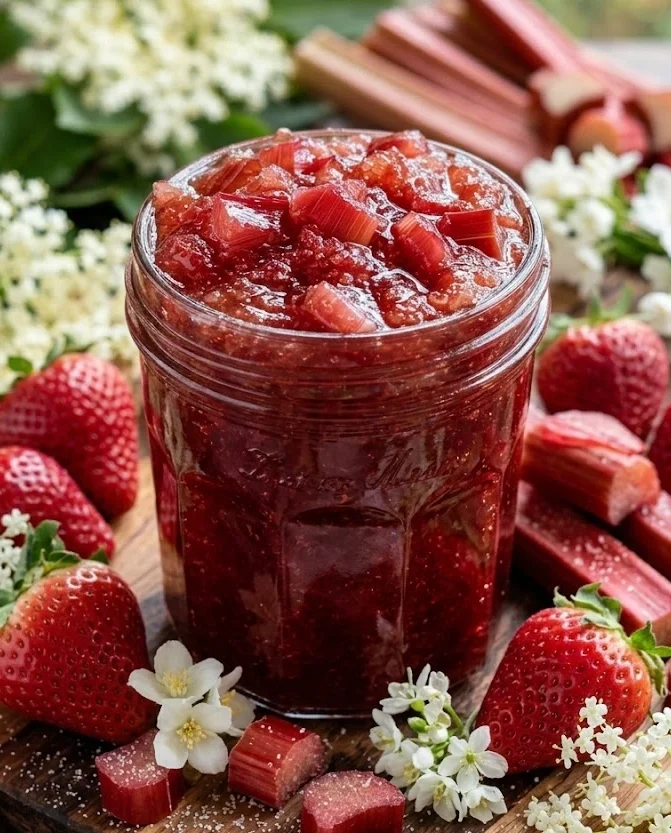
Classic strawberry rhubarb jam with vanilla: Add one teaspoon of pure vanilla extract to the jam after removing it from the heat. Stir it in just before jarring. The vanilla adds a warm, floral depth that rounds out the tartness of the rhubarb in a way that makes the finished jam taste like something considerably more complex than its four ingredients.
Rhubarb raspberry jam without pectin: Replace the strawberries with an equal weight of fresh raspberries. This produces a darker, more intensely tart jam with a beautiful deep red color. Raspberries are also low in pectin, so the cooking time and temperature guidelines remain the same.
Spiced rhubarb jam: Add a cinnamon stick and two cardamom pods to the fruit as it cooks, removing them before jarring. This produces a warm, aromatic jam that is particularly suited to pairing with aged cheeses and serving on a charcuterie board — one of the more compelling savory rhubarb recipes applications for this preserve.
Low-sugar rhubarb jam for diabetics: The sugar in this recipe can be partially reduced — by no more than a quarter to a third of the total quantity — without completely preventing a set, though the jam will be looser and will need to be refrigerated rather than shelf-stable canned. Replacing the sugar with a 1:1 granulated erythritol or monk fruit sweetener is a more reliable approach for rhubarb recipes for diabetics, producing a jam that sets reasonably well and can be refrigerated for two to three weeks.
Freezer jam shortcut: For a quicker result that skips the extended cooking, cook the jam only until the fruit is broken down and the mixture has thickened slightly — about 20 to 25 minutes — then allow it to cool, jar it, and freeze immediately. This produces a softer, more sauce-like consistency rather than a firm jam set, but the flavor is fresher and brighter since the fruit spends less time over heat.
How to Meal Prep
Strawberry rhubarb jam is fundamentally a meal prep and preservation recipe — its entire purpose is to make something delicious available well beyond the moment when the fruit is fresh. A single batch made during peak rhubarb and strawberry season in late spring or early summer can provide jars of jam through the following winter with the right storage approach.
Refrigerator jam keeps well for three to four weeks in sealed jars. Freezer jam lasts up to one year and retains its bright, fresh flavor remarkably well — thaw in the refrigerator overnight before using. Properly water-bath-canned jars keep for twelve to eighteen months in a cool, dark pantry.
The jam can be made in large batches without any adjustment to the recipe — simply multiply all quantities proportionally and use a wider pot to accommodate the larger volume. Working in multiple smaller batches is also practical: each batch takes 45 to 75 minutes of simmering time and produces a more reliable set than very large batches, which can have difficulty cooking evenly.
For anyone managing a surplus of rhubarb at the end of the season, chopped rhubarb freezes perfectly in measured quantities — two cups per bag, for example — so that jam can be made throughout the year even after fresh rhubarb is no longer available.
Cultural Context
Fruit preserves have been a cornerstone of home food culture in temperate climates for centuries, born from the practical necessity of capturing the abundance of summer and extending it through winter. Before refrigeration, preserving fruit with sugar was one of the most effective methods of preventing spoilage and maintaining access to sweetness and vitamins during the cold months when nothing grew.
Strawberry rhubarb jam has a particularly deep root in the home preservation traditions of northern North America and northern Europe. Both fruits arrive in the same brief seasonal window — late May through June — which made them natural preserving companions in the same way they became natural baking companions. By the late 19th century, strawberry rhubarb jam was a standard entry in county fair competitions, church cookbook collections, and homesteading guides across the northern United States and Canada.
The no-pectin approach is actually the older tradition. Commercial pectin, derived from apple and citrus by-products, only became widely available to home cooks in the 1930s and 1940s. Before that, home jam-makers relied entirely on natural fruit pectin activated by acid and sugar and extended cooking time — exactly the method used in this recipe. In that sense, making strawberry rhubarb jam without pectin is not a modern simplification but a return to the original version of one of the most enduring rhubarb recipes in the home kitchen canon.
Strawberry Rhubarb Jam Without Pectin
Equipment
- medium saucepan
- wooden spoon
- knife and cutting board
- measuring cups
- glass jars
Ingredients
- 2 cups fresh rhubarb, cut into 1/2-inch pieces
- 2 cups fresh strawberries, hulled and halved
- 1.5 cups granulated sugar
- 2 tbsp fresh lemon juice
Instructions
- Place two small plates in the freezer to prepare for testing the jam later.
- In a saucepan, combine rhubarb, strawberries, sugar, and lemon juice. Stir to coat evenly.
- Let the mixture sit for 20–30 minutes until juices release from the fruit.
- Bring the mixture to a gentle boil over medium heat, stirring frequently.
- Reduce heat to medium-low and simmer for 25–45 minutes, stirring occasionally, until thickened.
- Test the jam by placing a spoonful on a frozen plate. If it holds shape when pushed, it is ready.
- Remove from heat and let cool slightly.
- Transfer to clean jars and let cool completely before sealing and refrigerating.