
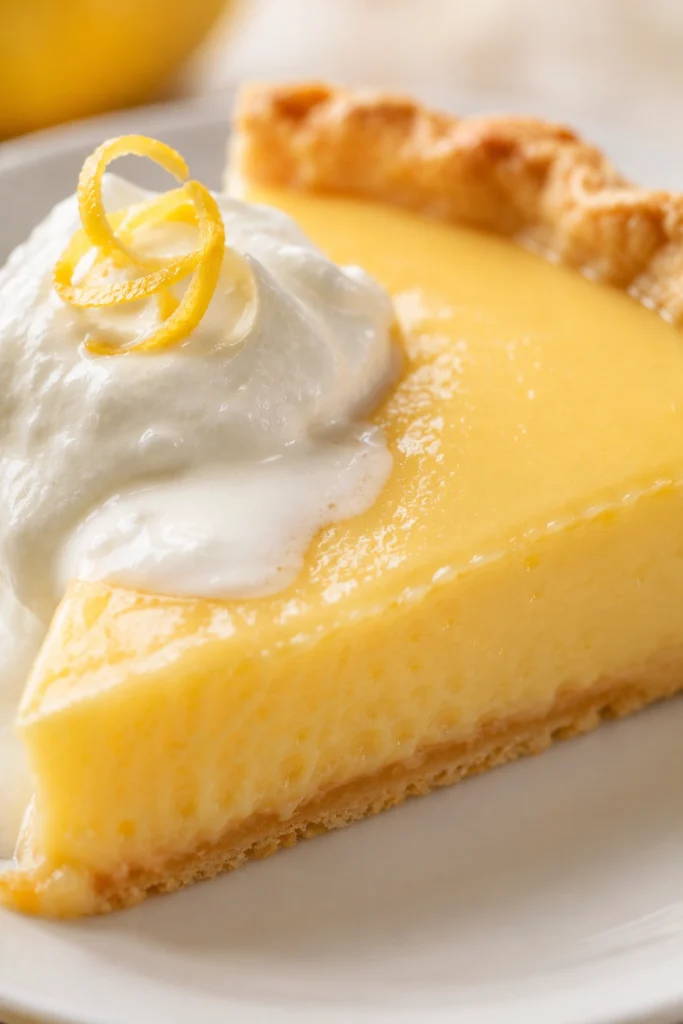
Some desserts announce themselves the moment they hit the table. The color alone stops conversation. That pale, golden, trembling custard sitting inside a crisp pastry shell, catching the light like something that belongs in a bakery window rather than a home kitchen – that is Lemon Custard Pie.
This is summer desserts with fruit flavor at its most refined. No chunks, no layers, no components competing for attention. Just pure, concentrated lemon flavor suspended in a custard so silky it barely holds its shape when the fork goes in, and a buttery crust that shatters cleanly with every slice.
If you have been searching through summer desserts ideas for something that feels genuinely special without demanding professional technique, this is the recipe that delivers on that promise completely.
Why You’ll Love This Lemon Custard Pie
This pie belongs at the top of summer desserts recipes lists for reasons that go beyond flavor. It is the kind of dessert that works at every occasion – casual backyard dinners, formal summer entertaining, birthday celebrations, or simply a Tuesday when you want something extraordinary waiting in the refrigerator.
It is one of the most naturally elegant summer desserts for a crowd options because it slices cleanly, holds its shape beautifully on the plate, and can be made entirely the day before serving. No last-minute assembly, no delicate components that need to be handled carefully. Just remove from the refrigerator, slice, and serve.
The bright lemon flavor makes it one of those summer desserts cold options that actually benefits from being served chilled. The cold temperature firms the custard to the perfect texture and amplifies the citrus in a way that a warm slice simply cannot achieve.
Parents will find this one of the most reliable summer desserts for kids in the citrus category. It is smooth, not too sharp, and sweet enough to be universally appealing without crossing into cloying territory. Top it with a small spoonful of whipped cream and a few fresh berries and it becomes one of the most beautiful summer desserts with fruit presentations on any table.
Common Mistakes (And How to Avoid Them)
Skipping the blind bake. A custard filling is liquid when it goes into the shell, and a raw pastry crust will absorb that liquid before it has a chance to bake properly, leaving you with a soggy, undercooked bottom. Blind baking – pre-baking the empty shell with weights before adding the filling – is a non-negotiable step for any custard pie, and skipping it is the number one reason home bakers end up disappointed with this style of dessert.
Overheating the custard on the stovetop. If the lemon custard base is cooked over heat that is too high, the eggs will scramble rather than thicken smoothly. Low and slow is the rule. Keep the heat at medium-low and stir constantly. The mixture should thicken gradually over eight to ten minutes. As soon as it coats the back of a spoon, remove it from the heat immediately.
Adding lemon juice to hot eggs without tempering. Pouring hot liquid directly into eggs causes them to cook and curdle instantly. Always temper the eggs by adding a small amount of the hot mixture to the beaten eggs first, whisking constantly, then slowly adding the tempered egg mixture back into the pan. This gradual temperature equalization is what gives the custard its perfectly smooth, lump-free texture.
Not straining the custard before pouring. No matter how carefully you make the custard, there will always be small bits of cooked egg or zest that affect the final texture. Pouring through a fine mesh strainer before filling the shell removes all of these and guarantees a silky, flawless result every single time.
Rushing the cooling process. Lemon custard pie needs to cool at room temperature first, then chill in the refrigerator for a minimum of four hours. Moving it directly from the oven to the refrigerator causes condensation to form on the surface and can crack the custard. Patience in the cooling stage is rewarded with a perfectly smooth, crack-free top.
Key Ingredients
Fresh Lemons
Everything in this recipe depends on the quality and freshness of the lemons. You need both the juice and the zest. The juice provides the sharp, clean acidity that defines the custard, and the zest carries the aromatic oils that give the pie its intensely bright lemon character. Never use bottled lemon juice here – the flavor is flat and one-dimensional compared to fresh, and it will produce a noticeably inferior custard.
Whole Eggs and Egg Yolks
The combination of whole eggs and additional yolks is what gives lemon custard pie its characteristic richness and that deep golden color. Whole eggs provide structure and set the custard firmly enough to slice. The extra yolks add fat, richness, and the silky mouthfeel that separates a great custard pie from a mediocre one. Do not be tempted to reduce the egg count – every one of them is doing important structural work.
Heavy Cream and Whole Milk
Using a combination of heavy cream and whole milk gives the custard the right balance of richness and lightness. All cream produces a filling that is too dense and almost pudding-like. All milk produces something thinner and less satisfying. The combination hits the exact texture point that makes lemon custard pie so compulsively eatable as one of the best summer desserts cold options going.
Granulated Sugar
Sugar does more than sweeten here. It also affects the texture of the custard by interfering with protein bonding in the eggs, which keeps the custard tender and smooth rather than firm and rubbery. The amount of sugar in this recipe is calibrated to balance the acidity of the lemon without masking it – the lemon should always be the dominant flavor.
Butter
A small amount of cold butter whisked into the finished custard just before pouring adds a glossy richness and rounds out any remaining sharpness in the lemon flavor. It is a small step with a noticeable impact on the final texture and sheen of the pie.
Pastry Shell
A well-made, fully blind-baked shortcrust pastry shell is the ideal home for this custard. The butteriness and crunch of the pastry contrast beautifully with the silky filling. For a summer desserts gluten free version, a gluten-free shortcrust made with a 1:1 flour blend works extremely well and the flavor difference is minimal.
How to Make Lemon Custard Pie
Yield: 8 to 10 servings Prep time: 30 minutes Bake time: 45 minutes total (including blind bake) Chill time: 4 hours minimum
Ingredients:
For the shortcrust pastry:
- 190 g (1.5 cups) all-purpose flour
- 1 tablespoon powdered sugar
- 1/4 teaspoon fine salt
- 115 g (1/2 cup) cold unsalted butter, cut into small cubes
- 2 to 3 tablespoons ice cold water
For the lemon custard filling:
- 4 large whole eggs
- 3 large egg yolks
- 200 g (1 cup) granulated sugar
- Zest of 3 large lemons
- 180 ml (3/4 cup) fresh lemon juice (approximately 4 to 5 lemons)
- 240 ml (1 cup) heavy cream
- 120 ml (1/2 cup) whole milk
- 2 tablespoons cold unsalted butter, cut into small pieces
- 1/4 teaspoon fine salt
- 1 teaspoon vanilla extract
To serve:
- Lightly sweetened whipped cream
- Fresh berries or thin lemon slices
- Powdered sugar for dusting (optional)
Instructions:
- Make the pastry. Combine the flour, powdered sugar, and salt in a large bowl. Add the cold cubed butter and use your fingertips or a pastry cutter to work it into the flour until the mixture resembles coarse breadcrumbs with some pea-sized pieces of butter remaining.
- Add ice cold water one tablespoon at a time, mixing gently with a fork after each addition, until the dough just comes together. It should hold when pressed but not feel wet or sticky.
- Shape the dough into a flat disc, wrap in plastic wrap, and refrigerate for at least 30 minutes.
- Preheat your oven to 190C (375F). Roll the chilled dough on a lightly floured surface into a circle approximately 30cm (12 inches) in diameter and about 3mm thick.
- Carefully transfer the dough to a 23cm (9 inch) pie dish. Press gently into the base and sides without stretching. Trim the overhang to about 2cm and crimp or fold the edges decoratively.
- Line the pastry shell with parchment paper and fill with ceramic baking weights or dried beans. Blind bake for 15 minutes.
- Remove the weights and parchment and bake for a further 8 to 10 minutes until the base is dry, golden, and cooked through. Remove from the oven and reduce the temperature to 160C (325F).
- Make the lemon custard. In a medium heavy-bottomed saucepan, whisk together the whole eggs, egg yolks, and sugar until combined.
- Add the lemon zest, lemon juice, heavy cream, whole milk, salt, and vanilla extract. Whisk until smooth and uniform.
- Place the saucepan over medium-low heat and cook, stirring constantly with a silicone spatula or wooden spoon, for eight to ten minutes until the mixture thickens enough to coat the back of a spoon. Do not allow it to boil.
- Remove from the heat and whisk in the cold butter pieces one at a time until fully melted and incorporated.
- Pour the custard through a fine mesh strainer into a large measuring jug or bowl to remove any cooked egg bits or zest.
- Place the blind-baked pastry shell on a baking sheet. Carefully pour the strained custard into the shell, filling it to just below the rim.
- Bake at 160C (325F) for 25 to 30 minutes until the edges are set but the center still has a gentle wobble when the pan is lightly shaken. It will continue to set as it cools.
- Remove from the oven and cool at room temperature for one full hour before transferring to the refrigerator.
- Refrigerate for at least four hours, or overnight, until fully set and cold.
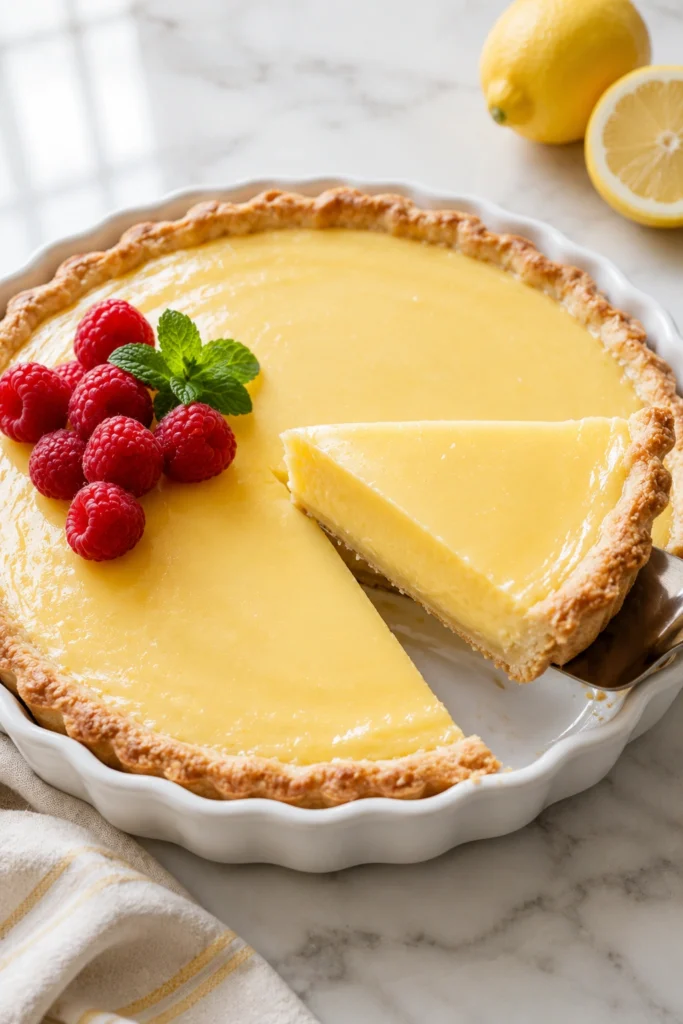
- Slice with a sharp knife warmed under hot water and dried between cuts. Serve cold with whipped cream, fresh berries, and a light dusting of powdered sugar if desired.
Variations and Tips
Summer desserts gluten free version. Use a 1:1 gluten-free all-purpose flour blend with xanthan gum for the pastry shell. Handle the dough gently as it will be slightly more fragile than a wheat pastry, and refrigerate the lined pie dish for ten minutes before blind baking to help it hold its shape. The custard filling is naturally gluten free and requires no adjustments.
Summer desserts no bake shortcut. Skip the homemade pastry entirely and use a store-bought graham cracker crust or a pre-made shortcrust shell. The lemon custard filling can also be set with a small amount of gelatin instead of baking – dissolve one teaspoon of unflavored gelatin in two tablespoons of cold water, let it bloom, then whisk it into the hot cooked custard before straining and pouring into the crust. Refrigerate to set completely for a fully no-bake version.
Summer desserts healthy lighter swap. Replace the heavy cream with full-fat coconut milk for a dairy-free version that is naturally lighter. The coconut adds a subtle tropical note that actually complements the lemon beautifully. Reduce the sugar by 20 grams and rely on the brightness of extra lemon zest to keep the flavor vivid and forward.
Summer desserts with fruit topping. A thin layer of fresh raspberry coulis spooned over each slice just before serving is one of the most stunning flavor pairings with lemon custard. Simply blend fresh raspberries with a tablespoon of sugar and a squeeze of lemon, strain, and drizzle. The tartness of the raspberry and the richness of the custard create something genuinely spectacular.
Meyer lemon version. Swap regular lemons for Meyer lemons, which are sweeter, more floral, and less sharp. The resulting custard is gentler and more perfumed, which makes it one of the most elegant summer desserts ideas for formal dinner party settings where a softer citrus note is preferred.
Pro tip: For the cleanest, most professional-looking slices, chill the pie overnight rather than for the minimum four hours. A fully set overnight custard slices with a precision that a four-hour pie cannot quite match. Wipe the knife clean and warm it between every single cut.
How to Meal Prep Lemon Custard Pie
Lemon Custard Pie is one of the most practical summer desserts for a crowd options in the entire citrus dessert category because it is genuinely better when made ahead. The custard needs time to set completely, and the flavor of the lemon deepens and mellows beautifully after a full night in the refrigerator.
Make the complete pie up to two days before serving. Store it loosely covered with plastic wrap – do not press the wrap directly onto the custard surface as it will leave marks. A tent of plastic wrap that touches only the edges of the pie dish keeps the surface pristine.
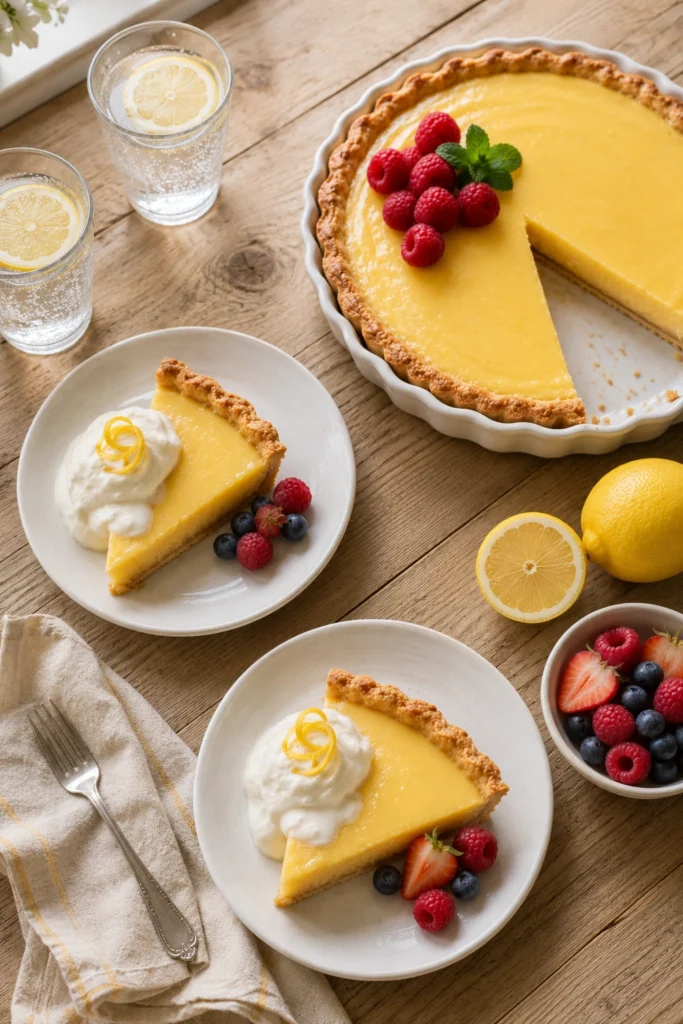
The whipped cream topping and any fresh berry garnish should always be added just before serving. Both will deteriorate in quality if left on the pie for more than an hour or two, and the contrast of the cold, fresh cream against the set custard is one of the best elements of this dessert.
For large events, make two pies and store them stacked in the refrigerator on separate shelves. Each pie yields eight to ten clean slices, making two piessufficient for a gathering of sixteen to twenty people with no additional dessert needed.
FAQs
Why does my lemon custard have lumps? Lumps in custard are almost always caused by the eggs cooking too quickly from heat that was too high, or from adding hot liquid to cold eggs without tempering. Always cook over medium-low heat, stir constantly, and strain the finished custard through a fine mesh sieve before pouring it into the shell. Straining catches any cooked egg bits and guarantees a smooth result.
Can I make lemon custard pie without blind baking the crust? Technically you can pour the raw custard into an unbaked shell and bake everything together, but the result will almost always have a soggy, undercooked bottom crust. The liquid custard saturates the raw dough before it has time to bake and set. Blind baking takes an extra fifteen minutes but is the difference between a good pie and a great one.
How do I know when the custard is done baking? The edges should be fully set and the center should have a gentle, uniform wobble when you lightly shake the pan – similar to a cheesecake. If the center looks liquid and moves in waves rather than as a single unit, it needs more time. If it does not wobble at all, it is slightly overbaked but will still taste good. The wobble test is your most reliable indicator.
Can I freeze lemon custard pie? Freezing is not recommended for custard pies. The egg-based custard becomes grainy and weeps liquid when thawed, losing the silky texture that makes this one of the best summer desserts cold options in the first place. Make it fresh and store refrigerated for up to three days for the best result.
Cultural Context
Custard pies have a history that stretches across centuries and continents. In medieval England, custard tarts were among the most common baked goods sold by street vendors and served at banquets. The Portuguese pastel de nata, the French tarte au citron, the English custard tart, and the American lemon chess pie all share a common ancestor in the simple idea of setting sweetened egg and cream in a pastry shell.
The specifically American lemon custard pie occupies a place between the French tarte au citron – which is sharper and more intensely citrus-forward – and the Southern lemon chess pie, which uses cornmeal in the filling for a denser, slightly gritty texture that is beloved in its own right.
This version sits closest to the French tradition in its technique and texture, while using the accessible ingredients and straightforward approach that defines American home baking at its best. It is the kind of recipe that has been made in home kitchens for generations, passed between friends and neighbors on handwritten cards, and requested by name at every summer gathering it has ever appeared at.
There is something enduring about the combination of lemon and custard that resists trend cycles and seasonal shifts. It was a great summer dessert a hundred years ago. It is a great summer dessert now. And it will still be showing up on tables long after the current wave of summer desserts ideas has moved on to something new.

Lemon Custard Pie
Equipment
- 9-inch pie dish
- mixing bowls
- Rolling Pin
- pastry cutter Optional for cutting butter into flour
- heavy-bottomed saucepan
- fine-mesh strainer
- whisk
- baking weights or dried beans
Ingredients
- 190 g all-purpose flour
- 1 tbsp powdered sugar
- 0.25 tsp fine salt
- 115 g cold unsalted butter, cubed
- 3 tbsp ice cold water
- 4 large whole eggs
- 3 large egg yolks
- 200 g granulated sugar
- 3 zest of 3 large lemons
- 180 ml fresh lemon juice
- 240 ml heavy cream
- 120 ml whole milk
- 2 tbsp cold unsalted butter
- 0.25 tsp fine salt (for filling)
- 1 tsp vanilla extract
- 1 lightly sweetened whipped cream for serving
- 1 fresh berries or thin lemon slices for garnish
- 1 tbsp powdered sugar for dusting (optional)
Instructions
- Combine the flour, powdered sugar, and salt in a large bowl. Cut in the cold butter until the mixture resembles coarse breadcrumbs.
- Add ice cold water one tablespoon at a time until the dough just comes together.
- Shape the dough into a disc, wrap tightly, and refrigerate for at least 30 minutes.
- Preheat the oven to 190C (375F). Roll the dough into a 30cm circle about 3mm thick.
- Transfer the dough into a 23cm pie dish and crimp the edges decoratively.
- Line the pastry with parchment paper and baking weights. Blind bake for 15 minutes.
- Remove the weights and parchment, then bake for another 8 to 10 minutes until golden. Reduce oven temperature to 160C (325F).
- Whisk together the eggs, egg yolks, and sugar in a saucepan until combined.
- Add lemon zest, lemon juice, heavy cream, milk, salt, and vanilla extract. Whisk until smooth.
- Cook over medium-low heat, stirring constantly, until the custard thickens enough to coat the back of a spoon.
- Remove from the heat and whisk in the cold butter pieces until smooth and glossy.
- Strain the custard through a fine mesh sieve into a bowl or jug.
- Pour the strained custard into the blind-baked pastry shell.
- Bake for 25 to 30 minutes until the edges are set and the center still gently wobbles.
- Cool the pie at room temperature for 1 hour before refrigerating.
- Refrigerate for at least 4 hours or overnight until fully chilled and set.
- Slice with a warm knife and serve cold with whipped cream, berries, and powdered sugar if desired.