
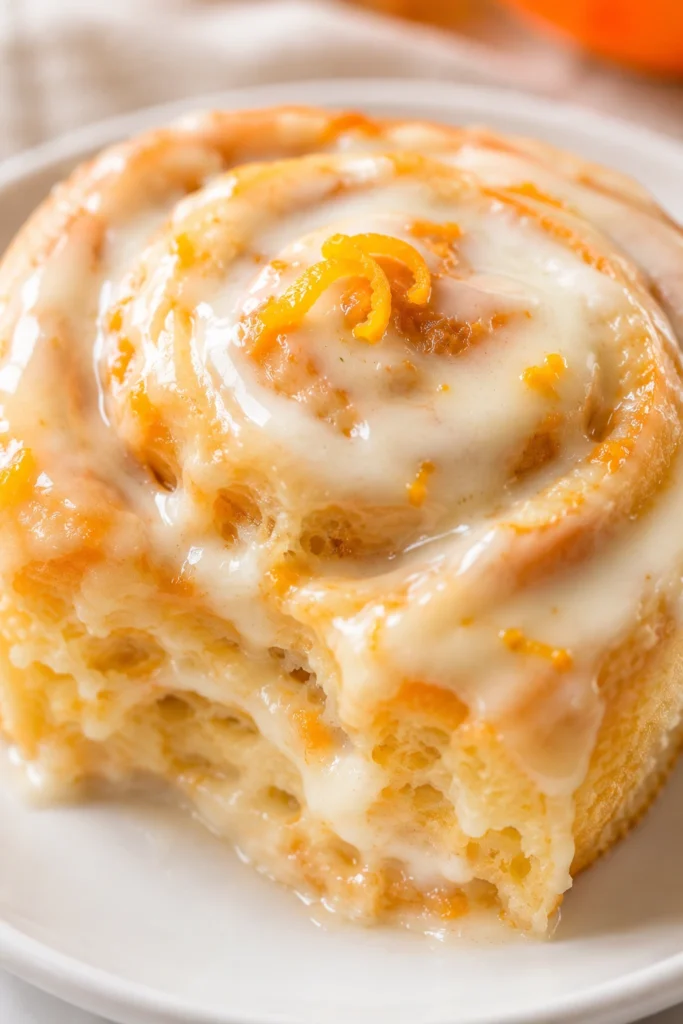
There is a flavor combination that belongs entirely to summer, and it is the one that lives inside every orange creamsicle that has ever melted down a child’s hand on a hot afternoon. Bright, cold orange. Rich, sweet vanilla cream. Together they create something that is more than a flavor – it is a feeling.
These Orange Creamsicle Rolls take that feeling and put it inside a soft, pillowy, pull-apart roll with a cream cheese glaze that melts into every swirl. This is summer desserts ideas territory that is genuinely exciting – familiar enough to feel nostalgic, unexpected enough to stop people in their tracks when you set them on the table.
Whether you are making them for a lazy weekend breakfast, a summer brunch, or a showstopping summer desserts for party spread, these rolls deliver on every level. The orange flavor is real and bright. The cream is rich and tangy. And the whole thing comes together in a way that feels like far more effort than it actually is.
Why You’ll Love These Orange Creamsicle Rolls
These rolls occupy a rare category in summer desserts recipes – they are impressive enough to serve to guests but approachable enough to make on a weekday morning without any special equipment or advanced baking skills.
The creamsicle flavor profile is one of the most universally loved in all of summer desserts ideas. It appeals equally to children and adults, which makes these rolls among the most reliably crowd-pleasing summer desserts for a crowd you can put on a brunch or dessert table.
They are also naturally adaptable. The dough can be made ahead and refrigerated overnight for a same-morning bake, which makes them one of the more practical summer desserts easy options for hosts who want to serve something warm and special without waking up at five in the morning.
For summer desserts for kids specifically, these rolls hit every mark. The orange flavor is bright and fun. The glaze is sweet and creamy. And the pull-apart format means kids can grab a roll without needing plates or utensils, which matters enormously at outdoor summer gatherings.
Common Mistakes (And How to Avoid Them)
Killing the yeast with liquid that is too hot. The milk used to activate the yeast must be warm but not hot – between 38C and 43C (100F to 110F). Liquid above this temperature will kill the yeast before it has a chance to activate, and your dough will not rise. If you do not have a thermometer, test the milk on your wrist – it should feel comfortably warm, like bathwater, not hot.
Not zesting enough orange. The orange flavor in these rolls comes primarily from fresh zest, not juice. Zest contains the essential oils from the orange peel and delivers a concentrated, bright citrus flavor that juice alone cannot provide. Use a microplane grater and zest firmly until you have reached the white pith, which is bitter. More zest means more flavor – do not be shy with it.
Rolling the dough unevenly. If the dough is thicker in some places and thinner in others, the rolls will bake unevenly. Some will be doughy in the center while others are overdone at the edges. Take the time to roll to a consistent thickness of about 6mm (quarter inch) across the entire rectangle before adding the filling.
Cutting rolls with a sawing motion. Using a serrated knife and sawing back and forth compresses the rolled dough and distorts the spiral shape. Instead, use unflavored dental floss or a very sharp knife and cut with a single downward press. The result is clean, round rolls with defined swirls that bake evenly and look beautiful.
Adding the glaze while the rolls are too hot. A cream cheese glaze applied to rolls straight from the oven will melt completely and pool at the bottom of the pan. Allow the rolls to cool for ten to fifteen minutes before glazing so the glaze melts into the swirls in a controlled, beautiful way rather than disappearing entirely.
Key Ingredients
Fresh Orange Zest and Juice
This is the ingredient that makes or breaks the entire recipe. Fresh orange zest is non-negotiable – it carries the essential oils that give the rolls their vibrant, bright citrus flavor. Bottled orange juice or orange extract can supplement but cannot replace the complexity that fresh zest provides. Use navel oranges for the best flavor balance, or blood oranges for a more visually dramatic filling.
Full-Fat Cream Cheese
Cream cheese appears in two places in this recipe – the filling and the glaze – and it is the ingredient that creates the creamsicle effect. In the filling it adds a rich, tangy creaminess that balances the brightness of the orange. In the glaze it provides body and that signature tang that makes a cream cheese frosting so much more interesting than a simple powdered sugar glaze.
Active Dry Yeast
The yeast gives these rolls their soft, pillowy, pull-apart texture. Instant yeast can be substituted in equal amounts and does not require proofing in liquid first, which saves a step. Either works well, but do not skip the yeast in favor of baking powder – the resulting texture will be closer to a scone than a roll and the characteristic pull-apart softness will be lost.
Whole Milk
Full-fat whole milk produces a richer, more tender dough than low-fat or skim alternatives. The fat in the milk coats the gluten strands and keeps the crumb soft and pillowy rather than chewy or tough. It is also used to warm and activate the yeast, so its temperature matters as much as its fat content.
Softened Unsalted Butter
Butter is present in the dough, the filling, and contributes to the overall richness that makes these rolls feel indulgent. Softened butter incorporates smoothly into the filling without tearing the rolled dough. Make sure it is genuinely at room temperature – butter that is too cold will not spread and butter that is melted will make the filling too liquid and cause it to leak during baking.
Powdered Sugar
Powdered sugar is used in both the filling and the glaze. Its fine texture dissolves completely without any graininess, keeping every element of the recipe perfectly smooth. It is what allows the cream cheese glaze to achieve that pourable, silky consistency that settles into every swirl of the warm rolls.
How to Make Orange Creamsicle Rolls
Yield: 12 rolls Prep time: 30 minutes Rise time: 1.5 to 2 hours total Bake time: 22 to 25 minutes
Ingredients:
For the dough:
- 180 ml (3/4 cup) whole milk, warmed to 38-43C (100-110F)
- 7 g (2.25 teaspoons / 1 packet) active dry yeast
- 50 g (1/4 cup) granulated sugar
- 2 large eggs, room temperature
- 115 g (1/2 cup) unsalted butter, softened
- 1 teaspoon vanilla extract
- 1 teaspoon fine salt
- 480 g (4 cups) all-purpose flour, plus more for dusting
- Zest of 1 large orange
For the orange cream filling:
- 115 g (1/2 cup) unsalted butter, softened
- 150 g (3/4 cup) granulated sugar
- 225 g (8 oz) full-fat cream cheese, softened
- Zest of 3 large navel oranges
- 2 tablespoons fresh orange juice
- 1 teaspoon vanilla extract
- 1/4 teaspoon fine salt
For the cream cheese glaze:
- 115 g (4 oz) full-fat cream cheese, softened
- 240 g (2 cups) powdered sugar, sifted
- 3 to 4 tablespoons fresh orange juice
- Zest of 1 orange
- 1 teaspoon vanilla extract
- Pinch of salt
Instructions:
- In a large bowl or the bowl of a stand mixer, combine the warm milk and yeast. Sprinkle the granulated sugar over the top and stir gently. Let it sit for five to eight minutes until the mixture is foamy and fragrant. If it does not foam, the yeast is not active – start again with fresh yeast.
- Add the eggs, softened butter, vanilla extract, salt, and orange zest to the yeast mixture. Mix on low speed with the dough hook attachment, or stir well with a wooden spoon.
- Add the flour one cup at a time, mixing between each addition, until a soft dough forms. The dough should be slightly tacky but not sticky – it should pull away from the sides of the bowl cleanly.
- Knead the dough with the dough hook on medium speed for six to eight minutes, or by hand on a lightly floured surface for ten minutes, until smooth and elastic.
- Shape the dough into a ball, place in a lightly greased bowl, cover with a clean kitchen towel or plastic wrap, and let rise in a warm place for one to one and a half hours until doubled in size.
- While the dough rises, make the orange cream filling. Beat the softened butter and cream cheese together until completely smooth. Add the granulated sugar, orange zest, orange juice, vanilla extract, and salt and beat until fluffy and well combined. Set aside at room temperature.
- Once the dough has doubled, punch it down gently and turn it out onto a lightly floured surface.
- Roll the dough into a rectangle approximately 45cm x 30cm (18 x 12 inches) and about 6mm (quarter inch) thick.
- Spread the orange cream filling evenly across the entire surface of the dough rectangle, going all the way to the edges.
- Starting from the long edge closest to you, roll the dough tightly and evenly away from you into a log shape. Pinch the seam firmly to seal.
- Using unflavored dental floss or a sharp knife, cut the log into 12 equal rolls, each approximately 4cm (1.5 inches) wide.
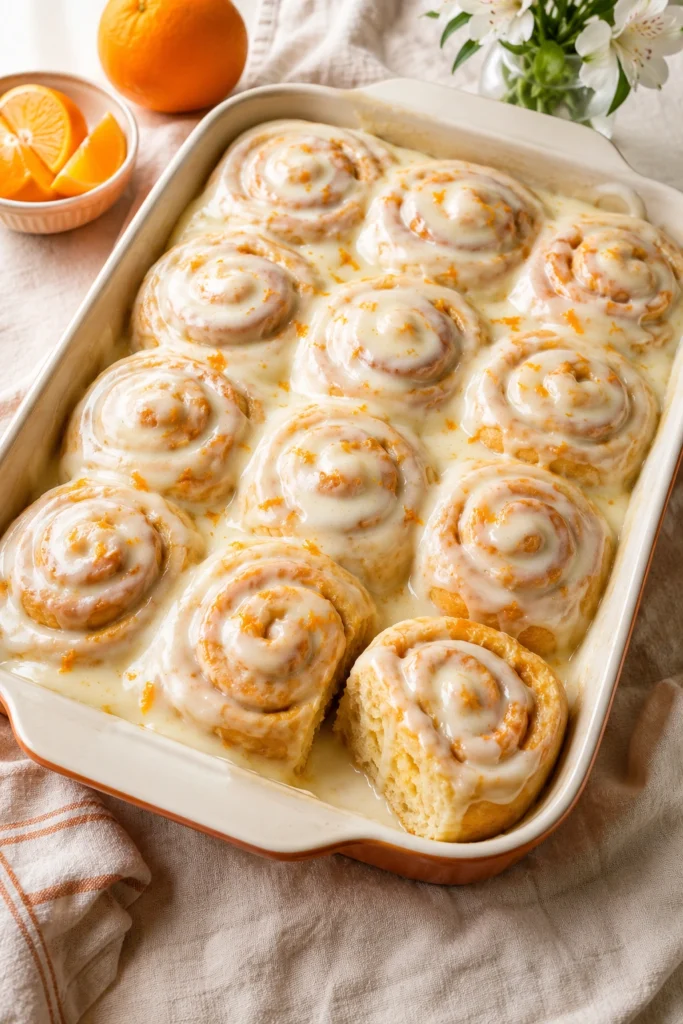
- Arrange the rolls cut-side up in a lightly greased 9×13 inch baking dish with a small amount of space between each one. Cover and let rise for 30 to 45 minutes until puffed and touching each other.
- Preheat your oven to 175C (350F) during the second rise.
- Bake for 22 to 25 minutes until the tops are golden and the centers are cooked through. A thermometer inserted into the center roll should read 88C (190F).
- Remove from the oven and allow to cool for ten to fifteen minutes.
- While the rolls cool, make the glaze. Beat the cream cheese until smooth, then add the sifted powdered sugar, orange juice, orange zest, vanilla, and salt. Beat until completely smooth and pourable, adding more orange juice one teaspoon at a time to reach a thick but flowing consistency.
- Pour the glaze generously over the warm rolls, allowing it to flow into the swirls and pool between the rolls.
- Serve warm or at room temperature. For a summer desserts cold option, refrigerate and serve chilled – the glaze firms up and the flavors deepen beautifully overnight.
Variations and Tips
Summer desserts gluten free version. Use a 1:1 gluten-free all-purpose flour blend with xanthan gum in place of regular flour. The dough will be slightly stickier and may not rise as dramatically, but the result is a genuinely good gluten-free roll with all the creamsicle flavor intact. Handle the dough gently and refrigerate briefly if it becomes too sticky to roll.
Summer desserts no bake shortcut. Use store-bought crescent roll dough or refrigerated sweet roll dough as the base. Spread the homemade orange cream filling over the unrolled dough, re-roll, slice, and bake according to the package directions. You get all the signature flavor with a fraction of the prep time, making this one of the most summer desserts easy adaptations possible.
Summer desserts healthy lighter swap. Reduce the butter in the filling by half and replace with whipped ricotta for a lighter but still creamy filling. Use a Greek yogurt-based glaze by combining plain Greek yogurt, powdered sugar, and orange zest in place of the cream cheese glaze. The rolls are noticeably lighter while keeping the essential creamsicle character.
Blood orange version. Swap all the navel oranges for blood oranges. The filling and glaze turn a stunning deep pink-red color that makes these some of the most visually striking summer desserts ideas you can serve, and the blood orange flavor is slightly more complex and berry-adjacent than navel orange.
Mini roll version for parties. Roll the dough slightly thinner and cut into 24 smaller rolls. Reduce the bake time to 15 to 18 minutes. These bite-sized versions are ideal summer desserts for party trays and for summer desserts for kids settings where smaller portions work better.
Pro tip: For the softest rolls possible, do not overbake. Pull them from the oven when the tops are just golden and the center roll reads 88C (190F) on an instant-read thermometer. Rolls that are slightly underdone in appearance are almost always perfectly baked inside, and they continue to cook from residual heat after coming out of the oven.

How to Meal Prep Orange Creamsicle Rolls
These rolls are exceptionally well suited to make-ahead preparation, which is exactly what you need in summer desserts for a crowd situations where morning prep time is limited.
The overnight method is the most practical. Complete the recipe through step twelve – arrange the cut rolls in the baking dish, cover tightly with plastic wrap, and refrigerate overnight instead of doing the second rise at room temperature. In the morning, remove the dish from the refrigerator and allow the rolls to sit at room temperature for 45 minutes to one hour before baking. They will puff and rise during this time and bake exactly as the recipe directs.
The glaze can be made up to three days ahead and stored in an airtight container in the refrigerator. Bring it to room temperature and stir well before pouring over the warm rolls.
Fully baked and glazed rolls store well in the refrigerator for up to four days. Cover the dish tightly with plastic wrap. They can be served cold directly from the refrigerator as summer desserts cold portions, or warmed individually in the microwave for 20 to 30 seconds to restore that fresh-baked softness.
For freezing, bake the rolls without glazing, cool completely, and freeze in an airtight container for up to two months. Thaw overnight in the refrigerator, warm in a 160C (325F) oven for ten minutes, and glaze just before serving.
FAQs
Can I make these without a stand mixer? Absolutely. Mix the dough by hand with a wooden spoon until it comes together, then knead on a lightly floured surface for ten full minutes until the dough is smooth and elastic. It requires more physical effort but produces an identical result. The key is kneading long enough to develop the structure that makes the rolls soft and pillowy.
Why did my rolls not rise? The most likely cause is inactive yeast. Always proof your yeast in warm milk before adding the other ingredients and confirm it is foamy and active before proceeding. Other factors include a dough that was too cold during the rise, or a kitchen environment that was too cold. Place the covered dough near a warm oven or in a slightly warmed oven turned off for the most reliable rise.
Can I use orange extract instead of fresh orange zest? Orange extract can supplement the fresh zest but should not replace it entirely. Fresh zest carries aromatic oils that extract simply cannot fully replicate, and the brightness and complexity it adds to summer desserts with fruit flavor is significant. If you are short on oranges, use one orange plus half a teaspoon of pure orange extract to make up the difference.
How do I know when the rolls are fully baked? The tops should be golden and the edges of the rolls should look set and not doughy. The most reliable method is an instant-read thermometer inserted into the center of the middle roll – it should read 88C (190F). The center roll always takes the longest to bake, so if that one is done, all the others are too.
Cultural Context
The creamsicle – that orange sherbet and vanilla ice cream bar on a stick – was invented in the 1920s and has been a defining flavor of American summer ever since. Its combination of bright citrus and cool vanilla cream occupies a specific place in collective food memory that very few other flavor profiles can claim.
For decades it existed purely as a frozen treat. But in the era of nostalgic flavor-driven baking that has dominated food culture through the late 2010s and into the 2020s, home bakers and professional pastry chefs alike began translating the creamsicle into cakes, cookies, cheesecakes, and rolls. The flavor combination proved to be just as compelling in baked form as it was frozen.
Orange Creamsicle Rolls sit within a broader cultural moment where summer desserts ideas are increasingly driven by nostalgia and the desire to transform beloved childhood flavors into something new and shareable. The roll format in particular has become one of the most popular vehicles for creative flavor combinations in home baking, offering a familiar, comforting structure that welcomes almost any filling.
Making these rolls is, in the best possible way, an act of edible memory-keeping. The orange hits first. Then the cream. And for a moment, it is summer again in the best way it has ever been.

Orange Creamsicle Rolls
Equipment
- stand mixer Optional but helpful for kneading dough
- Large Mixing Bowl
- Rolling Pin
- 9×13 inch baking dish
- microplane grater For orange zest
- instant-read thermometer Optional for checking doneness
Ingredients
- 180 ml whole milk, warmed to 38-43C (100-110F)
- 7 g active dry yeast
- 50 g granulated sugar
- 2 large eggs, room temperature
- 115 g unsalted butter, softened
- 1 tsp vanilla extract
- 1 tsp fine salt
- 480 g all-purpose flour, plus more for dusting
- 1 zest of 1 large orange
- 115 g unsalted butter, softened (for filling)
- 150 g granulated sugar (for filling)
- 225 g full-fat cream cheese, softened
- 3 zest of 3 large navel oranges
- 2 tbsp fresh orange juice
- 1 tsp vanilla extract (for filling)
- 0.25 tsp fine salt (for filling)
- 115 g full-fat cream cheese, softened (for glaze)
- 240 g powdered sugar, sifted
- 4 tbsp fresh orange juice (for glaze)
- 1 zest of 1 orange
- 1 tsp vanilla extract (for glaze)
- 1 pinch salt
Instructions
- In a large bowl or stand mixer bowl, combine the warm milk and yeast. Sprinkle the sugar over the top and stir gently. Let sit for 5 to 8 minutes until foamy.
- Add the eggs, softened butter, vanilla extract, salt, and orange zest to the yeast mixture. Mix until combined.
- Add the flour one cup at a time, mixing between each addition until a soft dough forms.
- Knead the dough for 6 to 8 minutes with a dough hook or 10 minutes by hand until smooth and elastic.
- Shape the dough into a ball and place in a greased bowl. Cover and let rise in a warm place for 1 to 1.5 hours until doubled.
- Make the filling by beating the butter and cream cheese until smooth. Add sugar, orange zest, orange juice, vanilla, and salt. Beat until fluffy.
- Punch down the risen dough and turn it onto a lightly floured surface.
- Roll the dough into a 45cm x 30cm rectangle about 6mm thick.
- Spread the orange cream filling evenly over the dough all the way to the edges.
- Roll the dough tightly into a log starting from the long edge. Pinch the seam closed.
- Cut the log into 12 equal rolls using dental floss or a sharp knife.
- Arrange the rolls in a greased 9×13 inch baking dish. Cover and let rise for 30 to 45 minutes until puffed.
- Preheat the oven to 175C (350F).
- Bake the rolls for 22 to 25 minutes until golden and cooked through.
- Allow the rolls to cool for 10 to 15 minutes before glazing.
- Beat the cream cheese until smooth, then add powdered sugar, orange juice, orange zest, vanilla, and salt. Mix until pourable.
- Pour the glaze generously over the warm rolls.
- Serve warm, at room temperature, or chilled for a refreshing summer dessert.