
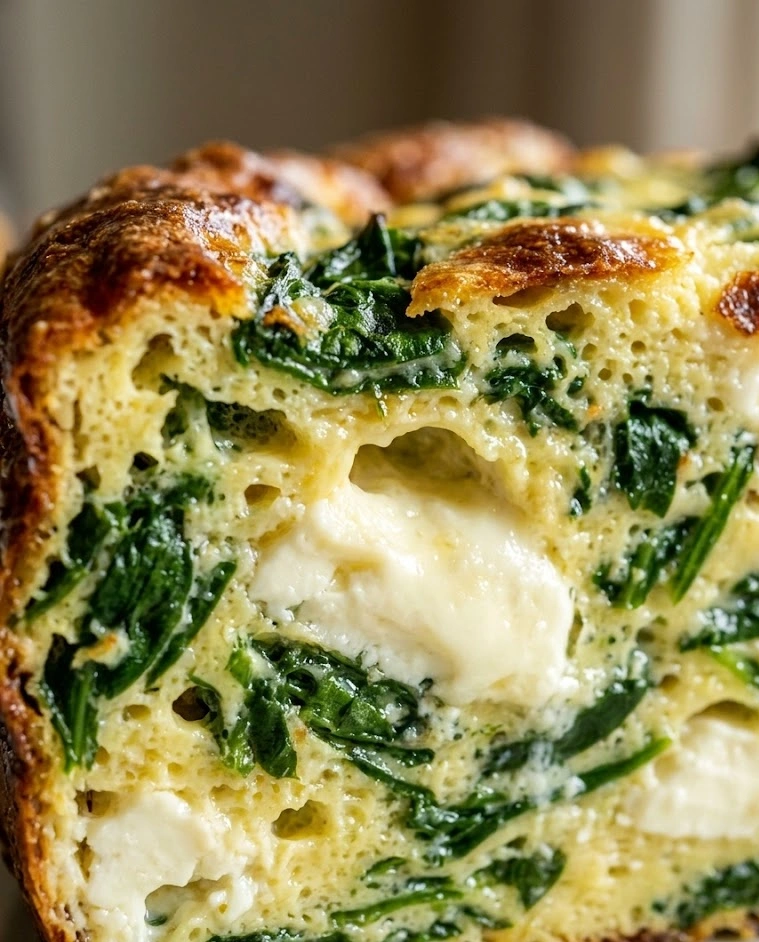
There is a particular kind of cook’s confidence that comes from mastering a dish that is simultaneously simple, elegant, endlessly adaptable, and genuinely delicious at any time of day. The Spinach Frittata With Feta Cheese is that dish. It is the spring dinner idea that works on a Tuesday night when you have twenty-five minutes and very little energy, and it works equally well on a Sunday morning when you want something that looks like effort without being effort.
The frittata is Italy’s answer to the question of what to do with eggs, a good pan, and whatever happens to be fresh and available. Unlike a French omelette — which demands split-second timing, a practiced wrist, and a certain anxiety — the frittata is forgiving, patient, and structurally generous. It starts on the stovetop and finishes in the oven, meaning the heat comes from two directions simultaneously and the eggs set evenly, gently, and without the risk of a rubbery scramble.
Spinach and feta is one of the great flavor pairings of the Mediterranean kitchen — a combination rooted in Greek spanakopita tradition that brings together the mineral earthiness of wilted greens, the creamy tang of brined cheese, and the richness of egg into something that tastes far more sophisticated than its ingredients alone would suggest. This is the spring dinner idea that proves simple food, done with intention, is almost always the most satisfying food of all.
Why You’ll Love This Spring Dinner Idea
The first reason is the time. Twenty-five minutes from a cold pan to a golden, puffed frittata on the table — and most of that time is hands-off oven time during which you can set the table, pour a glass of wine, or simply stand back and let the kitchen smell incredible. Active cooking time is closer to ten minutes.
The second reason is the one-pan reality. Everything happens in a single oven-safe skillet — the spinach wilts in it, the egg mixture sets in it, it goes directly into the oven in it, and it comes to the table in it. Cleanup is a single pan and a mixing bowl. For a spring dinner idea that looks this good on the table, that ratio of effort to impression is almost unfairly favorable.
The third reason is its complete flexibility with what goes inside it. The egg-and-dairy base is a formula that welcomes almost any vegetable, cheese, or herb you have on hand. Once you understand the technique, the frittata becomes less a specific recipe and more a reliable framework — a spring dinner idea that adapts to your fridge rather than demanding a specific shopping trip.
Common Mistakes — And How to Avoid Them
Mistake 1: Using a Pan That Can’t Go in the Oven
This seems obvious until it isn’t. A frittata requires an oven-safe skillet — cast iron or stainless steel are ideal. A pan with a plastic or rubber handle will survive exactly one trip into a 375°F oven before it becomes a problem. Check your pan before you begin, not halfway through cooking when the eggs are already set on the bottom.
Mistake 2: Overcrowding the Pan With Wet Vegetables
Spinach releases an enormous amount of water when it wilts — far more than its pre-cooked volume suggests. If you add the eggs before this water has been driven off, the liquid dilutes the egg mixture and produces a frittata that is watery, dense, and struggles to set properly. Cook the spinach fully, press out all visible moisture with the back of a spoon, and let any remaining steam escape before the eggs go in. Patience here is rewarded with a frittata that sets clean and slices beautifully.
Mistake 3: Whisking the Eggs Insufficiently
A frittata’s characteristic light, custardy texture comes from air incorporated into the eggs during whisking. Lazy whisking — a few half-hearted turns of a fork — produces flat, dense eggs. Whisk vigorously for a full 60 seconds until the mixture is uniformly pale yellow, slightly frothy, and has visibly increased in volume. Those incorporated air bubbles are what give you the gentle puff and soft interior that make a great frittata worth eating.
Mistake 4: Cooking the Stovetop Phase Over High Heat
The stovetop phase of a frittata — when the egg mixture first goes into the pan — should happen over medium-low heat, not high. High heat sets the bottom quickly while leaving the top completely raw, creating an unpleasant contrast that the oven then struggles to correct evenly. Medium-low heat allows the eggs to begin setting gently from the bottom up, giving the oven a head start on a partially set frittata rather than a liquid one.
Mistake 5: Overbaking
A frittata is done when the center has just barely stopped being liquid — it should still have a very slight wobble when you shake the pan, like a just-set custard. It will continue cooking from residual heat after it leaves the oven. Pull it a minute early rather than a minute late. An overbaked frittata is rubbery, dry, and a shadow of what it should be. An ever-so-slightly underbaked one rests its way to perfection on the counter.
Chef’s Notes
Eggs are one of cooking’s most scientifically fascinating ingredients, and understanding what happens to them in a frittata changes how you approach the entire recipe. Egg proteins — primarily ovalbumin and ovotransferrin — are coiled and separate in their raw state. Heat causes them to unfold and bond together, forming a protein network that traps moisture and sets into a solid. The key variable is temperature: a low, gentle heat forms a loose, tender network that retains moisture and produces a custardy, soft texture. A high, aggressive heat forms a tight, contracted network that squeezes out moisture and produces rubber.
This is why the combination of moderate stovetop heat and a moderate oven temperature — 375°F rather than 425°F — is so important. You are asking the egg proteins to set slowly and gently, trapping as much moisture as possible within their network rather than expelling it as steam and liquid.
The addition of a small amount of dairy — whole milk or heavy cream — dilutes the egg protein concentration, which raises the temperature at which the proteins set and widens the window between perfectly cooked and overcooked. It is culinary insurance. Whole milk produces a lighter result. Heavy cream produces something richer and more custardy. A tablespoon or two of cream cheese whisked directly into the egg mixture takes this further still, adding a luxurious body and a very gentle tang that plays beautifully with the feta.
For the feta, I want to return to something said in the Greek Orzo Pasta Salad notes: block feta in brine is a fundamentally different ingredient from pre-crumbled feta in a bag. In a frittata, this distinction matters even more than in a salad, because the feta partially melts during baking. Block feta softens into creamy, distinct pockets throughout the egg. Pre-crumbled feta tends to dry out further in the oven and loses the creaminess that makes it worth including in the first place.
Key Ingredients & Why They Matter
Eggs are the structure, the protein, the binder, and the primary flavor vehicle of the entire dish. Use the best eggs you can find — pasture-raised eggs have yolks with a deeper, more richly flavored orange color due to the varied diet of hens with outdoor access. That flavor difference is genuinely perceptible in a dish where eggs are the star rather than a background ingredient.
Fresh Spinach contributes mineral earthiness, color, and the nutritional backbone of the frittata. Its high iron and magnesium content gives it a characteristic savory depth — a slightly metallic, green richness — that wilts into the egg mixture and infuses every bite. Baby spinach is more tender and requires less cooking time. Mature spinach has more flavor intensity but needs an extra minute in the pan to soften fully.
Block Feta in Brine provides creamy, tangy, assertively salty pockets throughout the frittata that balance the richness of the eggs and the mineral depth of the spinach. Its partial melting during baking creates irregular zones of intense cheese flavor — creamier and more interesting than the uniform saltiness pre-crumbled feta delivers.
Whole Milk or Heavy Cream dilutes the egg protein concentration, raising the setting temperature and producing a more tender, custardy texture. Whole milk creates a lighter frittata. Heavy cream creates something noticeably richer and more luxurious. Either is correct — the choice depends entirely on the occasion and your preference.
Fresh Garlic provides the aromatic base that the wilted spinach and egg mixture need to feel rounded and savory rather than flat. Sautéed gently in olive oil before the spinach goes in, it mellows from sharp and pungent into something sweet, nutty, and deeply fragrant — the invisible backbone of the entire flavor profile.
Shallots are milder, sweeter, and more delicate than onion, which makes them the ideal allium for a frittata where you want savory depth without the sharpness that red or yellow onion can introduce. They cook down in minutes and essentially disappear into the background while contributing a complexity that makes the finished frittata taste more fully developed.
Fresh Dill and Chives are the herb pairing that most naturally complements the spinach-feta combination. Dill brings a bright, slightly anise-like freshness that is distinctly Greek in character and lifts the entire dish. Chives contribute a mild, onion-like freshness that bridges the shallots and the dill. Together they make the frittata taste vibrantly seasonal — exactly what a spring dinner idea should deliver.
Extra-Virgin Olive Oil is the cooking fat that carries the garlic and shallot aromatics into the base of the frittata and prevents sticking. Its flavor is present but subtle in the finished dish — grassy and slightly peppery, a quiet backdrop that reinforces the Mediterranean character of the whole recipe.
Lemon Zest added directly to the egg mixture is a small touch that makes a large difference. Lemon zest contains limonene — the aromatic essential oil compound that exists only in the peel — and it infuses the entire egg mixture with a bright, citrusy perfume that makes the frittata taste lighter, more spring-like, and considerably more interesting than one made without it.
How to Make Spinach Frittata With Feta Cheese
Ingredients
For the Frittata:
- 8 large eggs, pasture-raised if possible
- 3 tbsp whole milk or heavy cream
- 1 tbsp cream cheese, softened (optional, for extra creaminess)
- Zest of 1 lemon
- ½ tsp salt
- ¼ tsp black pepper
- Pinch of nutmeg
- 5 oz fresh baby spinach (about 5 packed cups — it wilts dramatically)
- 5 oz block feta cheese, crumbled into generous pieces
- 2 shallots, finely diced
- 3 cloves garlic, thinly sliced
- 2 tbsp extra-virgin olive oil
- 3 tbsp fresh dill, roughly chopped
- 2 tbsp fresh chives, thinly sliced
- ¼ tsp red pepper flakes
For Serving:
- Fresh lemon wedges
- Extra fresh dill and chives
- A drizzle of best-quality extra-virgin olive oil
- Flaky sea salt for finishing
- Simple spring green salad alongside
- Preheat the oven to 375°F. Position a rack in the center of the oven. Make sure your 10-inch skillet is oven-safe before proceeding.
- Whisk the egg mixture. In a large bowl, whisk the eggs vigorously for a full 60 seconds until pale, frothy, and slightly increased in volume. Add the milk or cream, cream cheese if using, lemon zest, salt, pepper, and nutmeg. Whisk again until completely smooth and uniform. Set aside. The lemon zest should be visible throughout — tiny flecks of bright yellow evenly distributed.
- Sauté the aromatics. Heat the olive oil in a 10-inch oven-safe skillet over medium heat. Add the shallots and a pinch of salt and cook, stirring occasionally, for 3–4 minutes until softened and translucent. Add the garlic and red pepper flakes and cook for another 60 seconds until fragrant — you want golden and aromatic, not brown.
- Wilt the spinach in batches. Add the baby spinach to the pan in two or three batches, stirring each addition until wilted before adding the next. Fresh spinach takes up a startling amount of space before it wilts — five packed cups will reduce to roughly half a cup of cooked spinach. This is normal and expected.
- Drive out the moisture. Once all the spinach has wilted, press it firmly against the bottom and sides of the pan with the back of a spoon and allow it to cook for an additional 2 minutes over medium heat, stirring occasionally. You want to see no pooling liquid in the pan before proceeding. This step is critical for a frittata that sets cleanly.
- Distribute evenly and reduce heat. Spread the spinach and aromatics evenly across the bottom of the pan. Reduce the heat to medium-low.
- Add the egg mixture. Pour the whisked egg mixture evenly over the spinach. Tilt the pan gently to ensure the eggs reach every edge and corner. Immediately scatter two-thirds of the crumbled feta evenly over the surface, along with half the fresh dill and chives.
- Cook on the stovetop. Let the frittata cook undisturbed over medium-low heat for 4–5 minutes. Do not stir, do not press, do not rush. You are waiting for the edges to look set and opaque while the center remains visibly liquid and slightly jiggly. This partial stovetop setting is what gives the oven a perfectly positioned frittata to finish.
- Transfer to the oven. Carefully move the skillet to the preheated oven. Bake for 8–11 minutes, checking at 8 minutes. The frittata is done when the edges are fully set, the top is lightly golden, and the very center retains just the faintest wobble when you shake the pan gently — like a barely-set custard. It will finish cooking from residual heat off the heat.
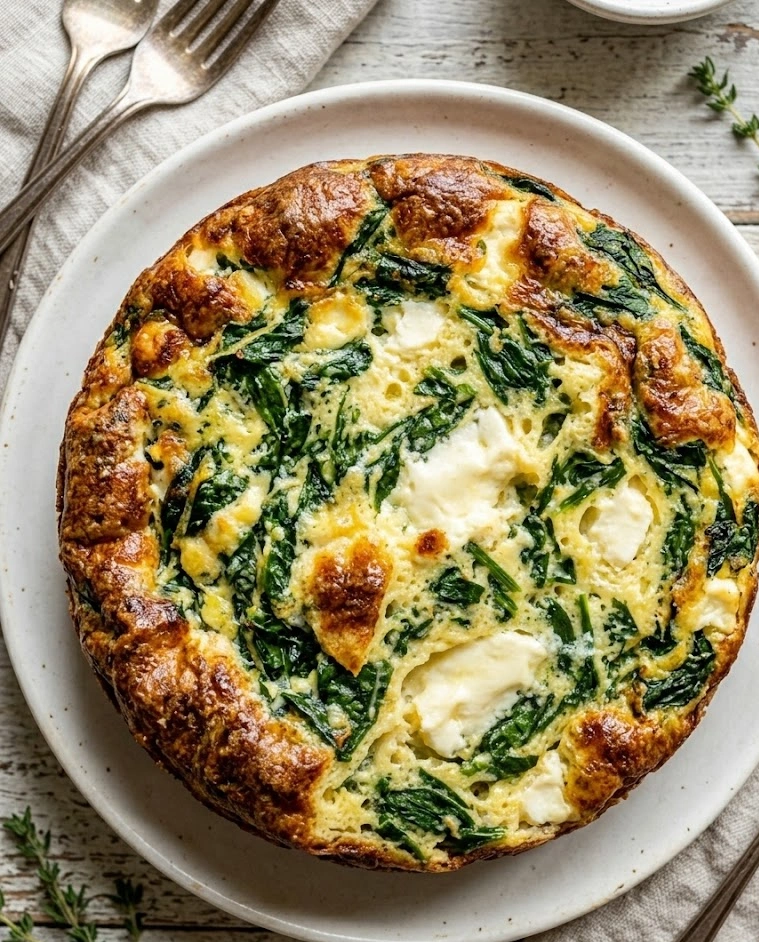
- Rest, finish, and serve. Remove from the oven and scatter the remaining feta, fresh dill, and chives over the top immediately. Allow the frittata to rest in the pan for 3–5 minutes — this rest allows the residual heat to finish the center gently and makes slicing significantly cleaner. Finish with a drizzle of your best olive oil, a pinch of flaky sea salt, and serve directly from the pan with lemon wedges alongside.
Variations & Tips
Add Sun-Dried Tomatoes and Olives: Roughly chop 3 tablespoons of sun-dried tomatoes and scatter them with the feta before baking. Add a handful of halved kalamata olives alongside. This version pushes the flavor squarely into Greek spanakopita territory — deeply savory, briny, and completely irresistible.
Make It a Spring Vegetable Frittata: Add thinly sliced asparagus, halved cherry tomatoes, or blanched peas to the spinach base for a more elaborate spring dinner idea. Sauté the asparagus for 3 minutes before adding the spinach. The cherry tomatoes can go in raw with the egg mixture — they will burst and caramelize slightly in the oven.
Make It Dairy-Free: Replace the milk or cream with unsweetened oat milk or full-fat coconut milk — oat milk produces a lighter result, coconut milk adds a very subtle richness without a coconut flavor at this quantity. Replace the feta with marinated, crumbled firm tofu seasoned with lemon, salt, and a pinch of dried oregano.
Make Individual Frittatas: Divide the egg mixture among a greased 12-cup muffin tin after cooking the spinach base in a pan and distributing it evenly among the cups. Bake at 375°F for 12–15 minutes. Individual frittata cups are perfect for meal prep, lunchboxes, or spring brunch spreads — and they reheat beautifully in a 300°F oven for 5 minutes.
Pro Tip — The Cold Oven Test: If you’re ever unsure whether your pan is oven-safe, place it in a cold oven and turn the oven on. Watch what happens as the temperature rises. A pan that is not oven-safe will make itself known before the temperature gets dangerous. Better to discover this during a test than in the middle of a recipe.
How to Meal Prep Spinach Frittata With Feta Cheese
The frittata is perhaps the most naturally meal-prep-oriented dish in this entire spring dinner ideas collection — it is specifically designed to be made ahead, sliced, stored, and reheated without meaningful loss of quality, which is a property that very few egg dishes share.
Bake, Slice, and Refrigerate: Allow the fully cooked frittata to cool completely in the pan, then slice into 6–8 wedges and transfer to an airtight container. Refrigerated slices keep for up to 4 days. The flavor actually deepens slightly overnight as the herbs continue infusing and the feta distributes more fully through the egg.
Reheat Without Rubbering: The cardinal sin of frittata reheating is the microwave on high power, which causes the egg proteins to tighten further and produces a rubbery, weeping result. Instead, reheat slices in a covered skillet over the lowest possible heat for 3–4 minutes, or in a 300°F oven for 8 minutes. Low and slow reheating keeps the protein network relaxed and the texture close to freshly baked.
Freeze Individual Slices: Individual wedges freeze surprisingly well for up to 2 months. Wrap each slice tightly in parchment paper followed by a layer of aluminum foil, or use a vacuum sealer if you have one. Thaw overnight in the fridge and reheat as above. The texture is slightly more dense after freezing but the flavor remains completely intact — making this one of the most freezer-friendly spring dinner ideas in the collection.
Build a Week of Breakfasts and Dinners Simultaneously: The most efficient use of a frittata is to bake a large one — scaled to a 12-inch pan with 10 eggs — at the start of the week and let it serve double duty as both breakfast and dinner across multiple days. Paired with a simple green salad at dinner or toast and fruit at breakfast, it becomes the most versatile and economical spring dinner idea you can make in a single 25-minute cooking session.
Cultural Context: The Frittata and the Ancient Wisdom of the Egg
The frittata is Italian in name and character but belongs to a family of egg preparations that spans nearly every food culture in the world. The Spanish tortilla, the Persian kuku, the North African eggah, the French omelette — all are variations on the same fundamental idea: eggs, heat, and whatever the cook has on hand, transformed by technique into something greater than the sum of their parts. The egg is the universal ingredient, and the flat, baked egg dish is the universal technique.
The Italian frittata as a distinct preparation has been documented in Italian culinary writing since at least the 14th century, though its roots are considerably older. The word comes from the verb friggere — to fry — reflecting its origins as a stovetop preparation before the widespread use of ovens in domestic kitchens. The combination of stovetop start and oven finish that defines the modern frittata technique evolved as ovens became standard, and it is this evolution that transformed the frittata from a simple fried egg cake into the elegant, custardy dish it is today.
Spinach arrived in Europe from Persia via the Arab world sometime around the 11th century, carried along the same spice and trade routes that brought so many of the ingredients that now feel definitively Mediterranean. By the Renaissance it was firmly established in Italian cooking, where its combination with eggs and cheese became a natural pairing — the mineral bitterness of the green softened by the richness of dairy and the gentle heat of the oven.
Feta’s presence in this dish connects the Italian frittata tradition to the older Greek cooking world — a reminder that the Mediterranean kitchen is not a collection of separate national cuisines but a continuous, overlapping conversation between cultures that have traded ingredients, techniques, and ideas across shared waters for thousands of years.
So when you slide this Spinach Frittata With Feta Cheese onto the table on a spring evening, golden and fragrant and studded with creamy feta and bright green herbs, you are serving something with roots stretching back through centuries of Mediterranean cooking wisdom. For twenty-five minutes of effort and one pan to wash, that is a remarkable thing to put on the table — and one of the most quietly satisfying spring dinner ideas you will ever make.
Spinach Frittata With Feta Cheese
Equipment
- 10-inch oven-safe skillet
- mixing bowl
- whisk
- chef’s knife
- cutting board
Ingredients
- 8 large eggs
- 3 tbsp whole milk or heavy cream
- 1 tbsp cream cheese (optional)
- 1 lemon, zested
- 1/2 tsp salt
- 1/4 tsp black pepper
- pinch nutmeg
- 5 oz fresh baby spinach
- 5 oz block feta cheese, crumbled
- 2 shallots, finely diced
- 3 cloves garlic, thinly sliced
- 2 tbsp extra-virgin olive oil
- 3 tbsp fresh dill, chopped
- 2 tbsp fresh chives, sliced
- 1/4 tsp red pepper flakes
Instructions
- Preheat oven to 375°F and position rack in the center. Ensure your skillet is oven-safe.
- Whisk eggs vigorously for 60 seconds until pale and frothy. Add milk or cream, cream cheese if using, lemon zest, salt, pepper, and nutmeg. Whisk until smooth.
- Heat olive oil in a 10-inch oven-safe skillet over medium heat. Add shallots and cook 3–4 minutes until softened. Add garlic and red pepper flakes and cook 1 minute until fragrant.
- Add spinach in batches, stirring until wilted. Cook 2 additional minutes to drive off excess moisture. Ensure no liquid remains pooled in the pan.
- Reduce heat to medium-low. Pour egg mixture evenly over spinach. Scatter two-thirds of feta and half the herbs over the top.
- Cook undisturbed 4–5 minutes until edges are set but center remains slightly jiggly.
- Transfer skillet to oven and bake 8–11 minutes until edges are fully set and center has a slight wobble.
- Rest 3–5 minutes. Top with remaining feta and herbs. Finish with olive oil drizzle and serve with lemon wedges.