
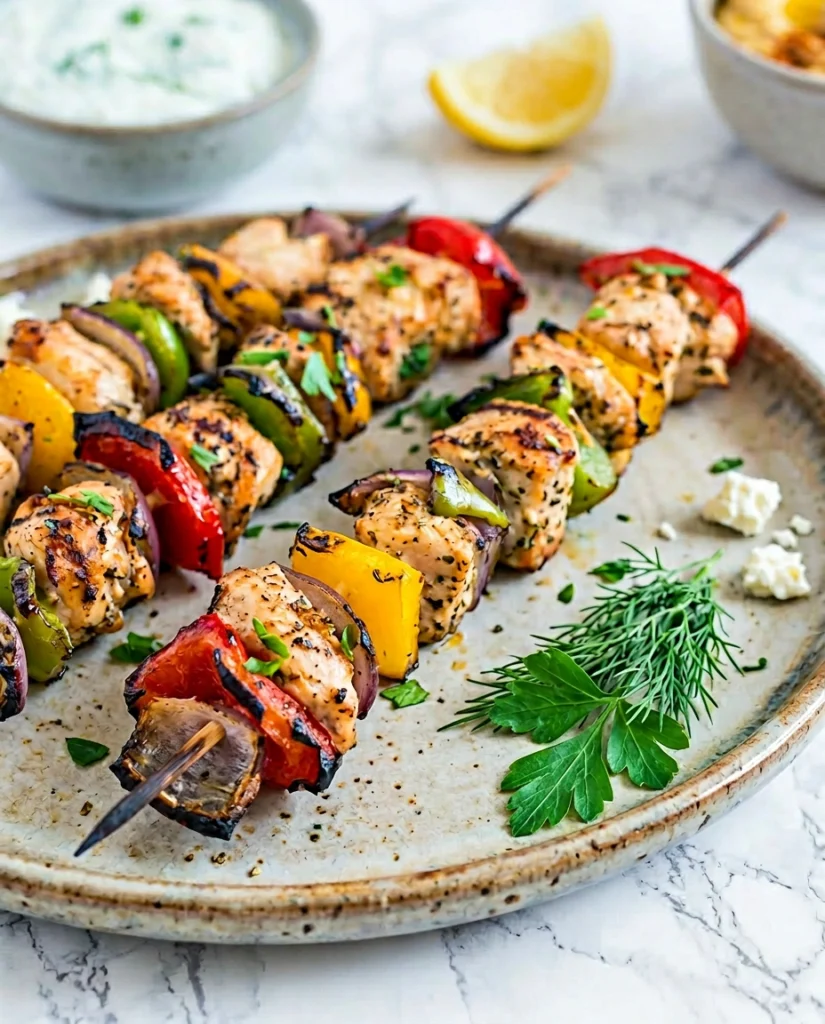
There is a version of grilled chicken that most people have eaten too many times — pale, slightly dry, seasoned with nothing more than salt and optimism, sitting on a plate next to a salad it does not deserve. And then there is this version. These grilled Mediterranean chicken skewers are the corrective to every disappointing grilled chicken experience you have ever had — and they accomplish that correction with nothing more than a great marinade, the right cut of chicken, and a properly preheated grill.
The Mediterranean flavor profile is one of the most perfectly calibrated combinations in the entire grilling recipes for dinner canon. Lemon for brightness and acid. Olive oil for richness and fruitiness. Garlic for savory depth. Dried oregano and fresh thyme for earthy, resinous aromatic complexity. Smoked paprika for color and a whisper of smoke that anticipates and amplifies the char of the grill. Cumin for warm earthiness. Together they create a marinade that penetrates deeply into the chicken, seasons it from the inside out, and produces a grilled result that is simultaneously familiar and completely extraordinary.
This is grilling recipes chicken done exactly right.
Why You’ll Love This Grilling Recipe
It uses chicken thighs — and that matters enormously. Chicken thighs are the single most forgiving, most flavorful, and most grill-appropriate cut of chicken in existence. Their higher fat content means they self-baste as they cook, staying juicy and tender even when the grill runs slightly hotter than intended. Their irregular surface — the valleys and ridges of boneless thigh meat threaded onto a skewer — creates dozens of micro-surfaces that char at different rates, producing an extraordinary complexity of texture and flavor in every single bite. This is one of the core reasons this grilling recipes chicken preparation succeeds where so many breast-based recipes disappoint.
The marinade does the heavy lifting overnight. Unlike grilling recipes easy preparations that rely entirely on the grill for flavor, this recipe builds its flavor foundation during an extended marination period — ideally 4–8 hours, optimally overnight. The lemon acid tenderizes the chicken fibers gently over time. The olive oil carries the aromatic compounds from the herbs and garlic into the meat. The salt draws moisture out and then reabsorbs it back in, seasoning the chicken deeply from the interior outward. By the time the skewers hit the grill, the work is essentially done — the grill only needs to add char and caramelization to an already deeply flavored protein.
It is one of the most versatile grilling recipes for dinner in the Mediterranean tradition. Serve the skewers over a bed of herbed rice pilaf. Slide the chicken off the sticks and tuck into warm pita with tzatziki and fresh tomato. Arrange over a fattoush salad for a complete meal. Pair with grilled halloumi and roasted red peppers for a full Mediterranean grilling recipes side dishes spread. The flavor profile of these skewers is broad and generous enough to work in virtually every Mediterranean-adjacent direction you choose to take it.
Common Mistakes (And How to Avoid Them)
Using chicken breast instead of thigh. Chicken breast on a skewer over high heat is an exercise in timing precision — the margin between perfectly cooked and dry, chalky, and disappointing is measured in seconds rather than minutes. Chicken thigh, by contrast, has an internal fat matrix that keeps it moist and forgiving across a much wider temperature range. For grilling recipes chicken skewers specifically, thigh is not merely a preference — it is the correct technical choice, and substituting breast without adjusting technique produces reliably inferior results.
Under-marinating. Twenty minutes of marinating time produces a chicken skewer with surface seasoning. Eight hours of marinating produces a chicken skewer with deep, penetrating flavor that permeates every fiber of the meat. The Mediterranean marinade in this grilling recipe — built around lemon juice, olive oil, garlic, and dried herbs — requires time to work. The lemon acid needs hours to gently tenderize the muscle fibers. The dried oregano and thyme need hours to fully release their aromatic compounds into the olive oil. Whenever possible, marinate overnight. The result is categorically, unmistakably better.
Cutting the chicken pieces too small. Chicken pieces smaller than 1.5 inches cook through before they develop meaningful char — leaving you with pale, properly cooked interior and virtually no exterior caramelization. Cut boneless chicken thighs into generous 1.5–2 inch pieces. The larger size gives the grill the time it needs to develop deep color and char on the outside while keeping the interior juicy and just cooked through.
Not shaking off excess marinade before grilling. Olive oil-heavy marinades drip through the grates and cause significant flare-ups that char the exterior of the chicken unevenly before the interior has time to cook. Remove the chicken pieces from the marinade and shake each skewer firmly — or use your hand to wipe off excess — before grilling. A thin, even coating of marinade on the surface of the chicken produces far better, more even caramelization than a dripping, oil-heavy skewer.
Rushing the flip. Mediterranean chicken skewers with a proper olive oil and herb marinade will stick initially — and then release cleanly when the crust has formed and the exterior has caramelized properly. Attempting to flip before that crust has formed tears the surface of the meat, disrupts the caramelization, and produces a chicken skewer with uneven texture and appearance. Wait for the release. It always comes — usually around 4 minutes on the first side at high heat — and when it does, the flip is effortless.
Chef’s Notes
The single most impactful addition you can make to a Mediterranean chicken skewer that most grilling recipes chicken preparations overlook entirely is a rest in the marinade with a small amount of yogurt. A tablespoon or two of full-fat Greek yogurt added to the marinade does two things simultaneously — it tenderizes the chicken more aggressively than lemon juice alone through the action of its lactic acid, and it creates a thin, protein-rich coating on the surface of the chicken that chars on the grill into an extraordinarily complex, slightly tangy crust that is characteristic of the best Turkish and Middle Eastern grilled chicken preparations in the world. It is optional in this recipe — the skewers are excellent without it — but it is the upgrade that takes them from excellent to genuinely remarkable.
A word on wooden versus metal skewers for this particular grilling recipe. I recommend flat metal skewers without qualification for Mediterranean chicken. The flat profile prevents the chicken pieces from spinning during flipping. The metal conducts heat into the center of each chicken piece from the inside, accelerating cooking and ensuring the interior reaches temperature at the same time the exterior develops its char. And unlike wooden skewers — which require soaking, occasionally ignite regardless, and must be discarded after use — metal skewers are a permanent investment that pays dividends across the entire grilling season.
Key Ingredients — And Why They Work
Boneless, skinless chicken thighs: The non-negotiable foundation of this grilling recipes chicken preparation. Chicken thighs contain roughly twice the fat of chicken breast — and that fat is distributed throughout the muscle fibers in a way that continuously bastes the meat from the inside as it cooks. On a hot grill where moisture evaporates rapidly, this internal fat matrix is the difference between juicy, satisfying chicken and dry, fibrous disappointment. The irregular, folded surface of boneless thigh meat threaded onto a skewer also creates the textural variety — crispy charred edges, tender interior surfaces, caramelized corners — that makes a great skewer so much more interesting to eat than a perfectly uniform piece of breast meat.
Extra virgin olive oil: The fat carrier and flavor contributor that defines the Mediterranean character of this grilling recipe. A good quality extra virgin olive oil — fruity, slightly peppery, genuinely green in flavor — contributes more than just cooking fat. Its flavor compounds survive the marinade period and the grill’s heat partially intact, lending a characteristic Mediterranean richness and fruitiness to the finished chicken that neutral oil cannot approximate. Use the best olive oil you have — this is one of those preparations where quality of individual ingredients is directly proportional to quality of the final result.
Fresh lemon (juice and zest): The acidic and aromatic backbone of the marinade. Lemon juice provides the tenderizing acid that works on the chicken’s muscle fibers during marination, while simultaneously brightening every other flavor in the marinade. The zest carries the essential oils of the lemon peel — intensely citrusy, slightly floral aromatic compounds that survive the grill’s heat and provide a fragrant brightness that juice alone cannot deliver. Both are essential and neither can substitute for the other.
Dried oregano: The most important single herb in the Mediterranean flavor canon and the non-negotiable aromatic anchor of this grilling recipe. Greek dried oregano specifically — more pungent, more resinous, and more intensely flavored than Mexican or Italian varieties — provides the earthy, slightly bitter, intensely herbal backbone that defines Mediterranean grilled chicken. It holds up to the grill’s heat beautifully because its flavor compounds are concentrated by the drying process — unlike fresh oregano, which can taste slightly flat on the grill, dried oregano blooms under high heat.
Fresh thyme: The aromatic counterpoint to the dried oregano. Where oregano provides earthiness and intensity, fresh thyme provides a lighter, more floral, slightly lemony herbal note that lifts the marinade and prevents it from becoming too heavy or one-dimensional. Fresh thyme’s volatile aromatics are more delicate than dried oregano’s — which is why it belongs in the marinade rather than on top of the grill where it would burn.
Garlic (grated on a microplane): The savory backbone that connects every other flavor in the marinade. Grated garlic — reduced to a fine paste on the microplane — distributes evenly through the olive oil rather than pooling in chunks, ensuring every surface of every chicken piece receives equal garlic exposure during marination. It also prevents the uneven burning that can occur when large pieces of garlic on a skewer contact a hot grill directly.
Smoked paprika: The bridge between the Mediterranean herb profile of the marinade and the char and smoke of the grill. A small amount of smoked paprika adds a whisper of smokiness that the grill will amplify — creating a flavor layering effect where the smoked paprika anticipates and deepens the grill’s own smoke contribution. It also provides the deep, brick-red color that makes these skewers visually spectacular before they even reach the grill.
Ground cumin: The warm, earthy, slightly bitter spice that gives the marinade its depth and positions it in the broader Eastern Mediterranean — Turkish, Lebanese, Israeli — grilling tradition rather than purely Greek. Cumin pairs with oregano in a way that is immediately recognizable as belonging to a specific culinary geography — the eastern edge of the Mediterranean where the herb-based marinades of the Greek tradition meet the spice-forward preparations of the Levant.
Red onion (threaded on the skewer): Not merely a visual element — though the contrast of charred, jammy red onion against the golden chicken is undeniably beautiful. Red onion threaded between chicken pieces on the skewer releases moisture as it cooks, contributing a sweet, caramelized onion vapor that bastes the adjacent chicken pieces from the side. It also softens and chars at a different rate than the chicken, creating textural variety within the skewer itself. Cut into 1.5-inch wedge layers — thick enough to hold on the skewer without falling apart, thin enough to cook through properly.
Bell peppers (optional, threaded on the skewer): Red and yellow bell peppers add color, natural sweetness, and a slight smokiness when charred on the grill. Their high sugar content means they caramelize aggressively under high heat — producing blistered, deeply sweet pieces that provide a striking flavor contrast to the herby, garlicky chicken alongside them on the skewer.
How to Make Grilled Mediterranean Chicken Skewers
Serves: 4 | Prep Time: 20 min (+ 4–8 hrs marinating, ideally overnight) | Cook Time: 12–15 min
Ingredients:
For the skewers:
- 2 lbs boneless, skinless chicken thighs, cut into 1.5–2 inch pieces
- 1 large red onion, cut into 1.5-inch wedge layers
- 1 red bell pepper, cut into 1.5-inch pieces
- 1 yellow bell pepper, cut into 1.5-inch pieces
- Flat metal skewers (preferred) or wooden skewers soaked 30 min
For the Mediterranean marinade:
- 5 tbsp extra virgin olive oil
- Zest and juice of 1 large lemon (approximately 3 tbsp juice)
- 5 cloves garlic, grated on a microplane
- 2 tsp dried Greek oregano
- 1 tbsp fresh thyme leaves
- 1½ tsp smoked paprika
- 1 tsp ground cumin
- ½ tsp ground coriander
- ½ tsp red pepper flakes
- 1 tsp kosher salt
- ½ tsp black pepper
- 1 tbsp full-fat Greek yogurt (optional — the tenderizing and crust upgrade)
For the tzatziki (make ahead):
- 1 cup full-fat Greek yogurt
- 1 medium cucumber, grated and squeezed completely dry
- 2 cloves garlic, grated on a microplane
- 1 tbsp fresh dill, finely chopped
- 1 tbsp fresh mint, finely chopped
- 2 tbsp extra virgin olive oil
- 1 tbsp fresh lemon juice
- ½ tsp kosher salt
- Pinch of white pepper
To finish and serve:
- Fresh flat-leaf parsley, roughly chopped
- Fresh dill fronds
- Flaky sea salt
- Extra lemon wedges
- Warm pita bread or grilled naan
- Tzatziki for serving
- Sliced cherry tomatoes and cucumber for alongside
Suggested grilling recipes side dishes:
- Herbed rice pilaf with toasted pine nuts and currants
- Fattoush salad with pomegranate molasses dressing
- Grilled halloumi with honey and dried oregano
- Roasted red pepper and feta dip with warm pita
- Tabbouleh with extra lemon and fresh mint
Instructions:
- Make the Mediterranean marinade. In a large bowl, combine olive oil, lemon zest and juice, grated garlic, dried oregano, fresh thyme leaves, smoked paprika, ground cumin, ground coriander, red pepper flakes, kosher salt, black pepper, and Greek yogurt if using. Whisk vigorously until fully combined — the marinade should be thick, fragrant, and deeply orange-red in color from the smoked paprika. Taste it on your finger — it should be assertively seasoned, bright with lemon, and intensely herbal. This marinade will mellow significantly during the marination period and on the grill, so boldness at this stage is intentional and necessary.
- Marinate the chicken. Pat the chicken thigh pieces completely dry with paper towels — dry chicken absorbs marinade more effectively than wet. Add to the marinade bowl and toss thoroughly, using your hands to massage the marinade into every surface of every piece. Cover tightly and refrigerate for a minimum of 4 hours — overnight is strongly preferred and produces a categorically better result. Remove from the refrigerator 25 minutes before grilling to return to room temperature.
- Make the tzatziki. Grate the cucumber on the coarse side of a box grater. Place in a clean kitchen towel and squeeze firmly over the sink until virtually no liquid remains — this step determines whether your tzatziki is thick and creamy or watery and flat. Combine squeezed cucumber with Greek yogurt, grated garlic, fresh dill, fresh mint, olive oil, lemon juice, salt, and white pepper. Mix thoroughly, taste, and adjust salt and lemon. Refrigerate for at least 30 minutes before serving — the flavors improve significantly as they meld. Tzatziki can be made up to 2 days in advance.
- Thread the skewers. Remove the chicken from the marinade, shaking each piece firmly to remove excess — you want a thin, even coating rather than dripping marinade that will cause flare-ups. Thread the skewers by alternating chicken pieces with red onion wedges and bell pepper pieces — building a pattern of chicken, onion, red pepper, chicken, onion, yellow pepper, and repeating. Leave a small gap between each ingredient for heat circulation. Do not pack the skewer tightly.
- Preheat the grill. Heat the grill to medium-high — 400–425°F. Mediterranean chicken skewers benefit from slightly lower heat than shrimp or thin fish — the chicken needs time to cook through to 165°F internal temperature without the outside burning before the inside is done. Set up a two-zone fire if possible — direct heat for searing and char, indirect heat for finishing. Clean the grates thoroughly and oil generously immediately before the skewers go on.
- Grill the first side. Place the skewers on the direct heat zone. Close the lid and grill undisturbed for 4–5 minutes. The marinade will begin to caramelize and char at the edges of the chicken and vegetables — you will see color developing and smell the herbs blooming. When the chicken releases cleanly from the grates and the bottom is deeply golden with char marks, it is ready to flip.
- Flip and grill the second side. Flip each skewer and grill for another 4–5 minutes on the second side. At this point the chicken should be deeply colored on both sides with caramelized edges and defined char marks.
- Move to indirect heat and finish. Shift all skewers to the indirect heat zone. Close the lid and allow the chicken to finish cooking through for 3–5 additional minutes, until an instant-read thermometer inserted into the thickest piece reads 165°F. This two-zone approach — direct heat for char and color, indirect heat for cooking through — is the technique that produces Mediterranean chicken skewers with maximum exterior caramelization and perfectly juicy interiors simultaneously.
- Rest the skewers. Remove from the grill and rest on a clean board or platter for 4–5 minutes. Chicken thighs benefit from a longer rest than shrimp or fish — the juices redistribute significantly during this period and the interior temperature evens out, producing a more uniformly juicy result from edge to center.
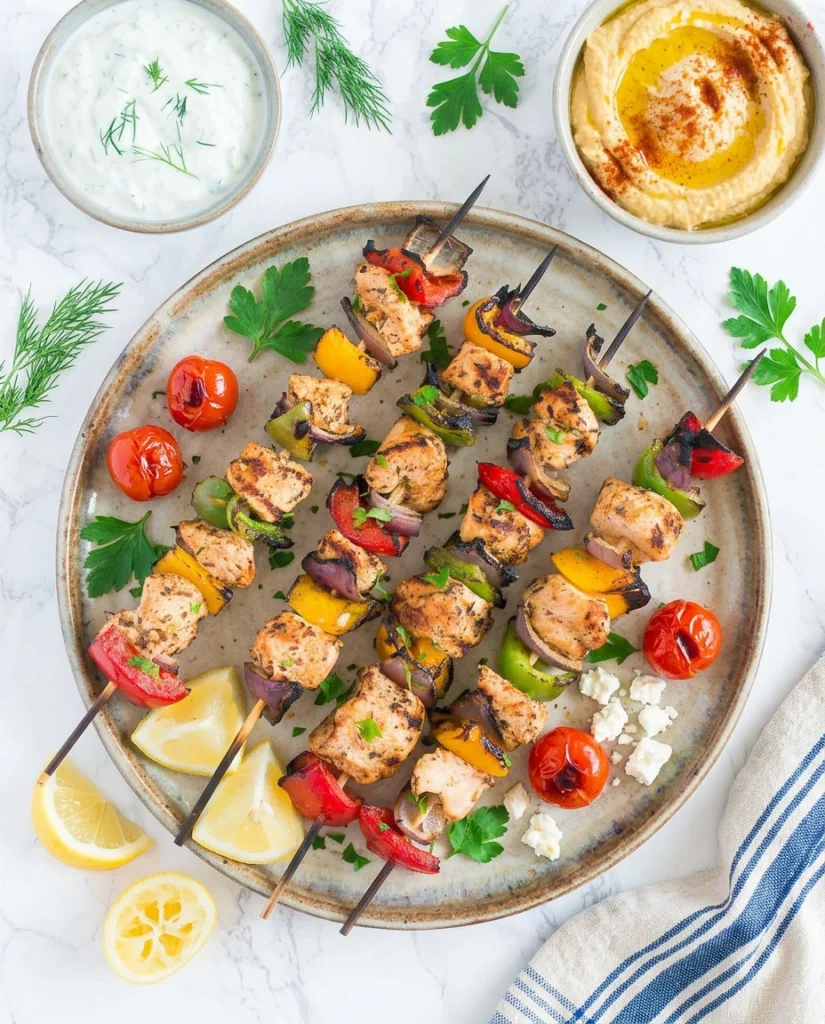
- Finish and serve. Arrange the rested skewers on a serving platter. Scatter fresh flat-leaf parsley and dill fronds generously over everything. Finish with a pinch of flaky sea salt and a generous squeeze of fresh lemon over the entire platter. Serve immediately alongside a generous bowl of tzatziki, warm pita or grilled naan, and your chosen grilling recipes side dishes.
Variations & Tips
Make it a grilling recipes for two dinner: Two generous skewers, a small bowl of tzatziki, two warm pitas, a simple tomato and cucumber salad dressed with olive oil and dried oregano, and a glass of chilled white wine — this is the grilling recipes for two Mediterranean dinner that requires minimal effort and produces a genuinely restaurant-quality experience in your own backyard. Scale the marinade down by half, build two large skewers, and invest the time saved in setting a beautiful table.
Grilling recipes Blackstone Mediterranean chicken: Heat your Blackstone flat top to medium-high and add a generous layer of olive oil to the surface. Cook the marinated chicken pieces — removed from the skewers — directly on the flat top in a single layer, turning every 2–3 minutes until deeply golden on all sides and cooked through to 165°F. The full-surface contact of the Blackstone creates an extraordinarily even, golden-brown sear across every face of every chicken piece simultaneously — no grill marks, but a more uniformly caramelized crust that is its own reward. This grilling recipes Blackstone approach is particularly efficient for large quantities.
Grilling recipes pork souvlaki variation: Replace the chicken thighs with 1.5-inch cubes of pork shoulder or pork tenderloin and use the exact same marinade. This is the traditional souvlaki preparation of Greece — pork is actually the original and most commonly used meat in authentic Greek souvlaki, with chicken being the later, more internationally widespread adaptation. Marinate the grilling recipes pork for 4–6 hours, grill over direct high heat for 3–4 minutes per side, and finish to an internal temperature of 145°F. The result is one of the most authentic Mediterranean grilling recipes pork preparations possible on a home grill.
Grilling recipes healthy bowl version: Slide the grilled chicken and vegetables off the skewers over a base of herbed quinoa or brown rice. Add sliced avocado, halved cherry tomatoes, thinly sliced cucumber, a spoonful of tzatziki, a drizzle of good olive oil, and a scattering of crumbled feta. This grilling recipes healthy bowl delivers complete protein, healthy fats, complex carbohydrates, and a full vegetable serving in a single, deeply satisfying meal that manages to feel simultaneously light and substantial — the best kind of grilling recipes healthy outcome.
Kofta skewer variation: Instead of cubed chicken thighs, use ground chicken thigh meat mixed with grated onion, grated garlic, fresh parsley, dried oregano, cumin, smoked paprika, and a pinch of cinnamon. Form around flat metal skewers into elongated sausage shapes and grill directly over high heat for 3–4 minutes per side. This kofta adaptation uses the same Mediterranean flavor DNA as the marinade in this recipe but produces a completely different — and equally extraordinary — textural and visual result.
Pro tip: For an extra layer of flavor complexity and the characteristic slight smokiness of the best Turkish and Greek grilled chicken preparations, add ½ teaspoon of ground sumac to the marinade. Sumac — a deep burgundy-red ground dried berry widely used across the Levantine and Eastern Mediterranean culinary tradition — provides a tart, fruity, slightly astringent flavor note that is different from lemon in character while performing a similar brightening function. It is the spice that makes experienced diners think “there is something extraordinary happening here that I cannot quite identify” — and that is exactly the response a great grilling recipe should produce.
How to Meal Prep
The Mediterranean marinade is the highest-leverage make-ahead preparation in this grilling recipe and one of the most broadly useful condiment-level preparations in the summer grilling recipes for dinner toolkit. Made in large batches and stored in a sealed jar in the refrigerator for up to 1 week, it functions as a marinade for grilling recipes chicken breasts and thighs, a sauce for grilled fish, a dressing for roasted vegetables, a drizzle for grilling recipes side dishes of grain salads and tabbouleh, and a dipping oil for warm pita. It is the kind of preparation that earns permanent refrigerator residency during grilling season.
The tzatziki improves dramatically with time — made 24–48 hours in advance, the garlic mellows, the cucumber releases a small amount of additional moisture that integrates into the yogurt, and the dill and mint permeate the entire sauce with a depth and integration that a just-made tzatziki cannot achieve. Make it the night before at minimum. It keeps beautifully in the refrigerator for up to 3 days and is useful on virtually every Mediterranean-adjacent grilling recipe in this series — with the halloumi skewers, alongside the tandoori shrimp, spread inside a wrap with leftover grilled salmon.
The chicken can be marinated up to 24 hours in advance — though not significantly longer, as the lemon acid will begin to over-tenderize the exterior of the chicken beyond the 24-hour mark, producing a slightly mushy texture at the surface. Thread the skewers up to 4 hours before grilling and keep them covered in the refrigerator — pulling them out 25 minutes before they go on the grill to return to room temperature.
Leftover grilled Mediterranean chicken — stored in an airtight container for up to 3 days — is one of the most versatile proteins a grilling recipes for dinner session can produce. Slice cold over a fattoush salad with pomegranate molasses dressing for an exceptional next-day lunch. Chop and fold into a warm pita with tzatziki, sliced tomato, and pickled red onion for the best possible sandwich the following morning. Warm gently in a skillet over medium heat with a splash of chicken broth and a squeeze of lemon and serve over orzo with fresh herbs and crumbled feta for a complete, effortless next-day dinner that is genuinely as satisfying as the original grilling recipes for dinner preparation.
Cultural Context
The skewer is one of humanity’s oldest cooking implements — predating written history, appearing independently across virtually every culture that has ever cooked meat over fire, and persisting unchanged in its essential form across thousands of years of culinary evolution. That a sharpened stick threaded with meat and held over an open flame remains one of the most satisfying and effective cooking techniques in existence is not nostalgia — it is a testament to a method so perfectly suited to its purpose that it has resisted every improvement that culinary history has attempted to impose upon it.
In the Greek culinary tradition specifically, souvlaki — from the Greek souvla, meaning skewer — is among the oldest documented preparations in Western culinary history, referenced in texts from ancient Greece and depicted in archaeological findings that place skewered meat over fire in the Aegean world as far back as the Bronze Age. The specific combination of olive oil, lemon, and oregano that defines Greek grilled meat preparations is similarly ancient — these three ingredients formed the foundational flavor vocabulary of Mediterranean coastal cooking long before the modern national boundaries that define the region today were drawn.
What the modern grilling recipes for dinner preparation of Mediterranean chicken skewers carries forward from that ancient tradition is not mere nostalgia or cultural tourism. It is the recognition that a flavor system developed over millennia of live-fire cooking in a specific landscape — the sun-bleached, herb-fragrant, olive-tree-covered hillsides of the eastern Mediterranean — arrived at its current form through the same process of iterative refinement that produces any great culinary tradition. The lemon cuts the richness of the olive oil. The oregano bridges the char of the fire and the brightness of the citrus. The garlic anchors everything in savory depth. It is a system that works not because someone designed it to work, but because thousands of years of cooks standing over fire discovered, through practice and repetition, that this particular combination of flavors produces a result that is greater than the sum of its parts — and then passed that discovery forward, generation by generation, until it reached a backyard grill on a summer evening and tasted, unmistakably and completely, like exactly what it is.
Grilled Mediterranean Chicken Skewers
Equipment
- grill
- metal skewers preferred
- mixing bowls
- whisk
- tongs
Ingredients
- 2 lbs boneless skinless chicken thighs
- 1 large red onion
- 1 red bell pepper
- 1 yellow bell pepper
- 5 tbsp extra virgin olive oil
- 1 large lemon (zest and juice)
- 5 cloves garlic, grated
- 2 tsp dried oregano
- 1 tbsp fresh thyme leaves
- 1.5 tsp smoked paprika
- 1 tsp ground cumin
- 0.5 tsp ground coriander
- 0.5 tsp red pepper flakes
- 1 tsp kosher salt
- 0.5 tsp black pepper
- 1 tbsp Greek yogurt (optional)
- 1 cup Greek yogurt (tzatziki)
- 1 cucumber
- 2 cloves garlic (tzatziki)
- 1 tbsp fresh dill
- 1 tbsp fresh mint
- 2 tbsp olive oil (tzatziki)
- 1 tbsp lemon juice (tzatziki)
- 0.5 tsp salt (tzatziki)
Instructions
- In a bowl, whisk olive oil, lemon zest and juice, garlic, oregano, thyme, paprika, cumin, coriander, chili flakes, salt, pepper, and yogurt.
- Add chicken to the marinade and coat thoroughly. Cover and refrigerate for 4–8 hours or overnight.
- Prepare tzatziki by mixing yogurt, grated cucumber, garlic, herbs, olive oil, lemon juice, and salt. Chill.
- Thread chicken, onion, and peppers onto skewers, removing excess marinade.
- Preheat grill to medium-high heat (400–425°F) and oil grates.
- Grill skewers on direct heat for 4–5 minutes without moving.
- Flip skewers and grill another 4–5 minutes until charred.
- Move skewers to indirect heat and cook 3–5 minutes until internal temp reaches 165°F.
- Remove from grill and let rest for 5 minutes.
- Garnish with herbs, lemon, and serve with tzatziki and pita.