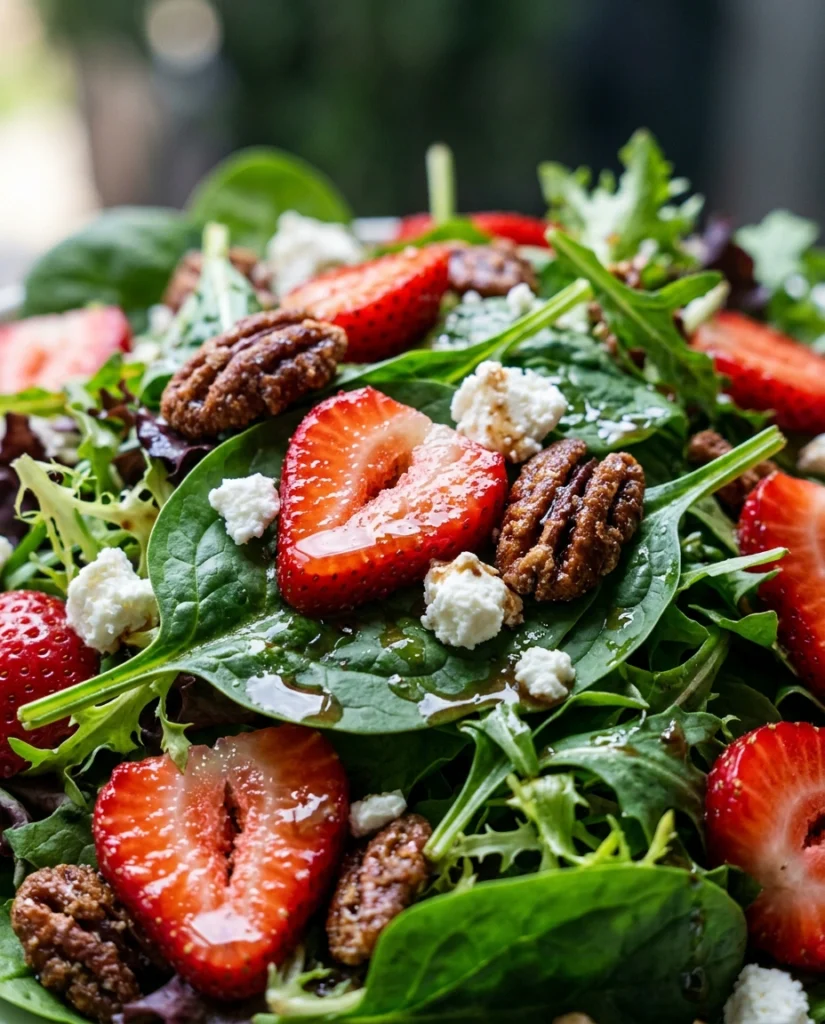
There is a moment every spring — usually sometime in late March or early April — when strawberries finally taste like strawberries again. Not the pale, watery, cottony approximations that sit in supermarket containers through winter, but genuinely ripe, fragrant, deeply red strawberries that smell like the season itself when you slice into them. The moment those strawberries arrive, this salad should be the first thing you make. It is the spring dinner idea that exists specifically for this window of the year, and it is ready in fifteen minutes flat.
The Strawberry Pecan Salad is built on a flavor architecture that is deceptively simple and endlessly satisfying — the kind of combination where every component is doing deliberate, purposeful work and nothing is present by accident. Sweet, juicy strawberries against peppery mixed greens. Rich, buttery candied pecans against creamy, tangy goat cheese. A honey balsamic vinaigrette that bridges every element with its simultaneous sweetness, acidity, and depth. Thinly sliced red onion cutting through the richness with a sharp, vinegary bite.
This is the spring dinner idea that looks like a restaurant starter and eats like a full, satisfying meal — particularly when served alongside grilled chicken, seared salmon, or warm crusty bread. It requires no cooking beyond candying the pecans, which takes six minutes and produces results so dramatically better than store-bought candied nuts that the comparison is almost unfair. Fifteen minutes, one bowl, and the most purely seasonal plate of food you will eat all spring.
Why You’ll Love This Spring Dinner Idea
The first reason is the immediacy of the flavor impact. This salad does not need time to develop or meld — the moment you dress it and toss it, every element is at its absolute peak. The strawberries are cold and juicy. The greens are crisp and peppery. The pecans are warm or at room temperature, slightly crunchy from their caramelized sugar coating. The goat cheese is creamy and tangy. Everything is vivid and present simultaneously, which is a quality that slow-cooked, braised, or baked dishes build toward gradually but that a great fresh salad delivers instantly.
The second reason is its extraordinary versatility as a spring dinner idea. Serve it as a light standalone dinner with warm flatbread. Build it into a full meal by adding sliced grilled chicken, seared shrimp, or pan-seared salmon on top. Bring it to a spring potluck where it will outshine every other dish on the table through sheer visual beauty alone. Use it as a first course for a spring dinner party where its freshness and elegance set exactly the right tone for everything that follows.
The third reason is what it represents about spring eating at its most honest. This salad does not hide behind technique or complexity. It asks the ingredients to be excellent — the strawberries genuinely ripe, the greens genuinely fresh, the pecans genuinely well candied, the vinaigrette genuinely balanced — and then it gets out of their way. Cooking like this, at its best, is a form of confidence. And the reward for that confidence is a spring dinner idea that tastes more purely and more completely of the season than almost anything else you will make.
Common Mistakes — And How to Avoid Them
Mistake 1: Using Underripe Strawberries
This is the mistake that cannot be corrected after the fact and the one that most dramatically affects the finished salad. An underripe strawberry is bland, slightly starchy, and contributes nothing to the flavor balance of the dish — it is just a red shape in the bowl. A ripe strawberry is sweet, slightly acidic, and deeply fragrant in a way that its underripe counterpart simply is not. Choose strawberries that are uniformly red all the way to the stem with no white shoulders, that yield very slightly to pressure, and that smell noticeably fruity when you hold them close. If they do not smell like strawberries, they will not taste like strawberries.
Mistake 2: Dressing the Salad Too Early
A dressed salad begins wilting within minutes of the vinaigrette making contact with the greens. For a salad this simple — where the texture and freshness of every component is the entire point — wilted greens are not an aesthetic problem, they are a flavor problem. The slightly bitter, peppery quality of arugula and mixed greens that makes them such a perfect counterpoint to the sweet strawberries is present only when the greens are crisp and properly cold. Dress immediately before serving — not before transporting, not before guests arrive, not five minutes in advance. Immediately before.
Mistake 3: Rushing the Candied Pecans
The candied pecans can be made in six minutes in a dry skillet, and that six minutes requires your complete, undivided attention. The window between perfectly caramelized and burnt is measured in seconds rather than minutes — sugar goes from amber to acrid with almost no warning. Do not walk away, do not check your phone, do not stir anything else on the stove simultaneously. Stir constantly, watch the color, and pull the pan the moment the sugar coating turns a deep, glossy amber. They will firm up as they cool on parchment — resist eating them all before the salad is assembled.
Mistake 4: Over-dressing the Salad
A salad this light and fresh needs a coating of vinaigrette, not a bath in it. Over-dressing is the most common salad mistake in home kitchens and it is particularly damaging here — too much vinaigrette makes the greens soggy, overwhelms the delicate strawberry flavor, and turns what should be a bright, fresh spring dinner idea into something heavy and acidic. Start with less than you think you need, toss, and taste. Add more in small increments. The vinaigrette should be noticeable but the ingredients should remain the primary flavor story.
Mistake 5: Skipping the Goat Cheese
The goat cheese is not a garnish and its function is not purely textural. It provides the creamy, tangy dairy element that rounds the acidity of the balsamic vinaigrette and the brightness of the strawberries — without it the salad is sharp and one-dimensional in a way that is difficult to articulate but immediately perceptible when eating. If goat cheese is genuinely unavailable or disliked, crumbled feta is the closest substitute — it provides a similar salty tang, though with less creaminess. Blue cheese works for those who enjoy its intensity. But goat cheese is the right choice and worth seeking out.
Chef’s Notes
The honey balsamic vinaigrette in this recipe is doing more sophisticated flavor work than its short ingredient list suggests, and understanding why helps you use it beyond this salad. Balsamic vinegar — true aged balsamic from Modena — is not simply acidic. It is simultaneously sweet, tart, and deeply savory, with a complexity built over years of aging in progressively smaller wooden barrels that imparts flavors of wood, dried fruit, and something almost wine-like into the vinegar. When you whisk it with honey, the sweetness amplifies and the acidity softens. When you add Dijon mustard — an emulsifier — the oil and vinegar stop separating and become a cohesive, clingy dressing that coats every leaf rather than pooling at the bottom of the bowl.
The mustard in a vinaigrette is misunderstood by most home cooks as a flavoring agent when its primary function is actually structural. A teaspoon of Dijon contains enough of the protein compounds that act as emulsifiers to hold a vinaigrette together for hours — dramatically longer than an un-emulsified dressing that separates within minutes. This is why restaurant vinaigrettes always seem to coat the greens more evenly than homemade ones — the professional kitchen never skips the emulsifier.
For the candied pecans, the technique I want you to use is the dry skillet method rather than the oven method — not because it produces superior results in terms of flavor, but because it produces results in six minutes rather than twenty, and it requires ingredients you already have in the marinade bowl. Granulated sugar, a pinch of salt, a pinch of cayenne — that is the entire coating. The cayenne is optional but I strongly recommend it. A barely perceptible heat in the finished nut against the sweet strawberry and the tangy goat cheese creates a complexity that makes people ask what is in the salad and never quite be able to identify it. That is the goal of a good finishing element — to make the dish taste more interesting without being identifiable as its own thing.
Key Ingredients & Why They Matter
Fresh Ripe Strawberries are the seasonal anchor of this spring dinner idea and the ingredient most responsible for the dish’s character. Their flavor when properly ripe is a combination of sweetness, acidity, and fragrant volatile compounds — including furaneol, the molecule most responsible for the characteristic strawberry aroma — that makes them one of spring’s most irreplaceable fruits. Slice them in varied thicknesses for a more interesting presentation — some quarters, some halves, some thin rounds — and allow them to sit at room temperature for ten minutes before assembling so their flavor is fully present.
Mixed Baby Greens or Arugula provide the peppery, slightly bitter green backdrop against which the sweet strawberries and rich pecans become more vivid by contrast. Arugula is the more assertive choice — its pronounced peppery bitterness creates a sharper contrast with the sweet elements and makes the salad taste more complex. Mixed baby greens are milder and more approachable. A combination of both is the ideal solution — the arugula providing backbone, the mixed greens providing volume and gentleness.
Candied Pecans contribute richness, crunch, and a caramelized sweetness that bridges the fresh fruit and the savory greens. Pecans specifically — rather than walnuts or almonds — are the correct choice here because their natural butteriness and mild flavor allow the caramelized sugar coating to dominate without competing with the strawberry or the vinaigrette. Their large, irregular pieces also create a dramatic visual texture in the assembled salad.
Fresh Goat Cheese provides the creamy, lactic tang that rounds and balances every other flavor in the bowl. Its soft, crumbly texture creates creamy pockets throughout the salad that melt slightly against the cold strawberries and the vinaigrette, distributing their flavor into every forkful. Log-style fresh goat cheese — chèvre — is the correct format here rather than aged or coated varieties.
Honey Balsamic Vinaigrette is the flavor thread that connects every component of the salad. Aged balsamic provides sweetness and depth. Honey amplifies the sweetness and adds floral complexity. Dijon emulsifies and adds a faint mustard sharpness. Extra-virgin olive oil provides the fat that carries all the flavor compounds and coats the greens. Together they create a dressing that is simultaneously sweet, tart, rich, and bright — the only dressing that could serve all the competing flavors in this bowl equally well.
Thinly Sliced Red Onion provides the sharp, pungent counterpoint that keeps the salad from tipping into sweetness overload. Its bite cuts through the goat cheese richness, the caramelized pecans, and the honey in the vinaigrette — providing the savory, slightly aggressive note that makes all the sweeter elements taste more vivid by contrast. Soak in cold water for ten minutes before using to tame the harshest sulfur compounds while preserving the color and flavor.
Fresh Mint Leaves are the finishing herb that most naturally complements fresh strawberries — a pairing rooted in the shared aromatic quality of their volatile compounds. A modest scatter of torn fresh mint over the finished salad adds a cool, bright herbal note that makes the whole bowl taste more purely and unmistakably of spring.
How to Make Strawberry Pecan Salad
Ingredients
For the Candied Pecans:
- 1 cup raw pecan halves
- 3 tbsp granulated sugar
- ¼ tsp salt
- ¼ tsp cayenne pepper (optional but recommended)
- ½ tsp pure vanilla extract
For the Honey Balsamic Vinaigrette:
- 3 tbsp aged balsamic vinegar
- 1 tbsp honey
- 1 tsp Dijon mustard
- 1 small clove garlic, finely grated
- 5 tbsp extra-virgin olive oil
- ¼ tsp salt
- ¼ tsp black pepper
- Pinch of red pepper flakes (optional)
For the Salad:
- 6 oz mixed baby greens and arugula
- 1½ cups fresh ripe strawberries, hulled and sliced in varied thicknesses
- ½ small red onion, very thinly sliced (soaked 10 minutes in cold water, drained)
- 4 oz fresh goat cheese (chèvre), crumbled
- ¼ cup fresh mint leaves, roughly torn
- Flaky sea salt for finishing
- Make the candied pecans. Place the raw pecans in a single layer in a dry skillet over medium heat. Toast, stirring constantly, for 2 minutes until they smell fragrant and nutty. Add the granulated sugar, salt, and cayenne to the pan and stir continuously — the sugar will first clump around the pecans, then begin to melt. Keep stirring as the sugar melts and coats the pecans, approximately 3–4 minutes total, until the coating turns a deep amber and the pecans look glossy and caramelized. Add the vanilla extract — it will sizzle dramatically — stir for 15 more seconds and immediately transfer to a sheet of parchment paper in a single layer. Do not touch them — the sugar is extremely hot. Allow to cool completely, about 8–10 minutes, then break apart any clusters.
- Make the vinaigrette. In a small jar or bowl, combine the balsamic vinegar, honey, Dijon mustard, and grated garlic. Whisk or shake until combined. Add the olive oil in a slow, steady stream while whisking continuously — or add all at once to the jar, seal, and shake vigorously for 30 seconds — until the dressing is fully emulsified, glossy, and slightly thickened. Season with salt, pepper, and red pepper flakes if using. Taste and adjust — it should be sweet, tangy, and slightly more assertive than feels right at this stage. It will mellow once it meets the greens and cheese.
- Prepare the strawberries. Hull and slice the strawberries in varied thicknesses — some cut into quarters lengthwise, some halved, some cut into thin rounds for visual variety. Place in a bowl and allow to sit at room temperature for 10 minutes to fully develop their aroma and flavor.
- Prepare the red onion. Drain the cold-water-soaked red onion slices thoroughly and pat dry with a paper towel. Excess water from the soaking will dilute the vinaigrette on contact — drying them first prevents this.
- Assemble the base. Place the mixed greens and arugula in a large, wide salad bowl. Drizzle roughly two-thirds of the vinaigrette over the greens and toss gently with your hands or salad tongs until every leaf is lightly but evenly coated. The greens should glisten but not be wet.
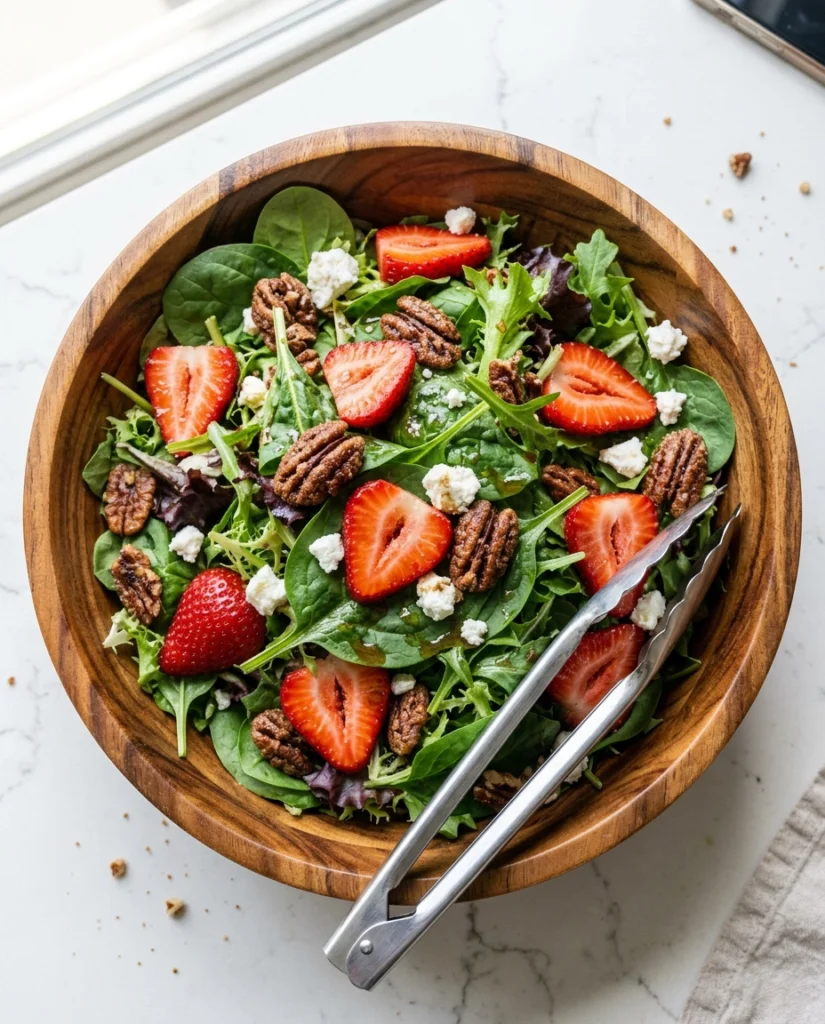
- Add the components. Arrange the sliced strawberries over the dressed greens in an even, generous distribution — not clustered in one area. Scatter the drained red onion slices throughout. Add the candied pecans, distributing them evenly so every serving will include several pieces.
- Add the goat cheese. Crumble the fresh goat cheese over the top in generous, irregular pieces — not fine crumbles. You want visible, distinct creamy white pieces distributed throughout the salad rather than a uniform dusting of tiny particles.
- Finish and dress. Drizzle the remaining vinaigrette over the assembled salad, focusing on the strawberries and pecans rather than the greens which are already dressed. Scatter the torn fresh mint leaves over everything. Finish with a pinch of flaky sea salt — the contrast of the flaky salt crystals against the sweet strawberry and creamy goat cheese is one of the salad’s best moments.
- Serve immediately. Bring the bowl to the table and serve within 5 minutes of dressing — this salad waits for no one and rewards those who eat it at its peak.
Variations & Tips
Add Grilled Chicken for a Complete Spring Dinner: Slice a grilled chicken breast or thigh — seasoned simply with olive oil, salt, pepper, and lemon zest — over the assembled salad. The warm chicken against the cold, dressed greens creates a temperature contrast that makes the whole bowl feel more substantial and satisfying without changing a single other element. This is the version that turns the Strawberry Pecan Salad from a starter or side into a genuinely complete spring dinner idea.
Add Avocado for Richness: Thinly slice one ripe avocado and fan the slices over the assembled salad alongside the strawberries. Avocado adds a buttery, neutral richness that complements the goat cheese without competing with it, and its green color adds another visual layer to an already beautiful bowl. Dress it with an extra squeeze of lemon immediately after slicing to prevent browning.
Swap the Cheese: Blue cheese — particularly a mild Gorgonzola dolce — creates a bolder, more assertive version of this salad that pairs particularly well with the candied pecans and balsamic vinegar. Feta adds a saltier, more Mediterranean character. Fresh burrata, torn and placed in the center of the assembled salad, turns it into something genuinely spectacular for a spring dinner party — the contrast of the burrata’s cream interior against the sweet strawberries is extraordinary.
Make It Vegan: Replace the goat cheese with roughly chopped, marinated white beans — tossed with lemon, olive oil, salt, and a pinch of dried thyme — which provide a creamy, protein-rich element without dairy. Replace the honey in the vinaigrette with maple syrup, which provides a similar sweetness with a slightly deeper, more complex flavor note.
Pro Tip — The Torn Herb Technique: Always tear fresh mint rather than chopping it for this application. Chopping with a knife bruises the herb and causes it to oxidize rapidly, turning the cut edges dark and releasing the volatile aromatic compounds into the air rather than preserving them in the leaf. Torn mint releases its aroma more slowly and stays visually fresh considerably longer — an important consideration in a salad that depends on looking as beautiful as it tastes.
How to Meal Prep Strawberry Pecan Salad
Fresh salads present a unique meal prep challenge compared to the grain-based and cooked dishes elsewhere in this spring dinner ideas collection — the greens and dressed components do not hold the way cooked grains, proteins, and roasted vegetables do. The solution is component-based prep that enables fast, fresh assembly rather than fully assembled make-ahead storage.
Make the Vinaigrette in Bulk: The honey balsamic vinaigrette keeps in a sealed jar in the refrigerator for up to two weeks. A doubled or tripled batch made at the start of the week serves the Strawberry Pecan Salad multiple times and works equally well as a dressing for the Greek Orzo Pasta Salad, a marinade for grilled chicken, and a finishing drizzle for roasted asparagus or broccolini. It is one of the most versatile and useful prep items in the entire spring dinner ideas collection.
Make the Candied Pecans in Bulk: A double or triple batch of candied pecans stores in an airtight container at room temperature for up to two weeks without losing their crunch or their caramelized coating. Make a large batch at the beginning of the week and use them across multiple meals — on salads, on oatmeal, as a snack, or as a garnish for the Spinach Frittata With Feta Cheese served as a weekend brunch. The six-minute investment yields returns all week.
Prep the Components Separately: Wash and dry the greens thoroughly — a salad spinner is the most effective tool — and store them in a container lined with paper towels in the refrigerator for up to three days. Hull and slice the strawberries and store separately in an airtight container for up to two days. Soak, drain, dry, and refrigerate the red onion separately. Crumble and store the goat cheese. When dinner arrives, assembly takes three minutes and produces a salad that tastes completely freshly made.
Build a Mason Jar Salad for Lunch: Layer the components in a large mason jar in the correct order — vinaigrette at the bottom, then red onion, then strawberries, then pecans, then goat cheese, then greens on top. The greens stay away from the dressing until the jar is inverted and shaken just before eating, keeping everything crisp and undressed until the moment of consumption. Mason jar salads built this way keep for up to two days in the refrigerator — a genuinely practical spring dinner ideas lunch option that requires zero morning prep.
Cultural Context: Strawberries, Pecans, and the American Salad Tradition
The composed American salad — built from a combination of fresh greens, fruit, nuts, cheese, and a made-from-scratch vinaigrette — is a relatively modern culinary form, emerging in its current expression primarily in the latter half of the 20th century as California cuisine redefined what restaurant and home salads could aspire to be. Before the California food revolution of the 1970s and 1980s, American salads were largely iceberg lettuce with bottled dressing, or composed molded gelatin constructions that would be unrecognizable on a contemporary table. Alice Waters at Chez Panisse in Berkeley, and the broader movement she inspired, introduced the principle that a salad built from genuinely exceptional, seasonally appropriate ingredients needed nothing more than olive oil, acid, and salt to be extraordinary.
The strawberry has been cultivated in North America since before European contact — indigenous peoples across the continent ate wild strawberries and used them in ceremonies, medicines, and food preparations for thousands of years. The cultivated garden strawberry as we know it today is a hybrid developed in Brittany, France in the 18th century from two American wild strawberry species — one from Virginia, one from Chile — brought together by a French botanist named Amédée-François Frézier. The strawberry is therefore simultaneously one of North America’s most ancient native fruits and one of Europe’s most interesting botanical creations — a genuinely transatlantic ingredient.
The pecan is one of the only major tree nuts native exclusively to North America, with its natural range covering the river bottoms and valleys of the central and southern United States and northern Mexico. Indigenous peoples of the Mississippi Valley and the Gulf Coast cultivated and traded pecans for centuries before European contact, and the nut became a significant agricultural crop in the American South during the 19th century. The candied pecan — coated in caramelized sugar and toasted until glossy — is a specifically American confectionery tradition with roots in the praline-making culture of New Orleans, where French sugar-coating techniques met the native American nut in one of food history’s most successful flavor marriages.
Goat cheese arrived in American kitchens largely through the farm-to-table movement of the 1980s, when small-scale American artisan cheesemakers began producing fresh chèvre inspired by the Loire Valley tradition — bringing a European ingredient into the American seasonal cooking vocabulary in a way that has now become entirely naturalized. Its pairing with strawberries and balsamic is a product of that same California cuisine moment — the instinct to combine sweet fruit, tangy cheese, and aged acid in a salad format that is elegant, seasonal, and entirely greater than the sum of its parts.
So when you toss this Strawberry Pecan Salad together on a spring evening — ripe strawberries from a local farm, pecans candied in a pan that belonged to your grandmother’s kitchen, goat cheese crumbled with the same casual confidence of a cook who knows exactly what they are doing — you are participating in one of American cooking’s most genuinely original contributions to the global salad tradition. It takes fifteen minutes. It tastes like the season. It is, without qualification, one of the finest spring dinner ideas you will make all year.
Strawberry Pecan Salad
Equipment
- large salad bowl
- skillet for candied pecans
- whisk
- parchment paper
Ingredients
- 1 cup raw pecan halves
- 3 tbsp granulated sugar
- 1/4 tsp salt (for pecans)
- 1/4 tsp cayenne pepper (optional)
- 1/2 tsp pure vanilla extract
- 3 tbsp aged balsamic vinegar
- 1 tbsp honey
- 1 tsp Dijon mustard
- 1 small clove garlic, grated
- 5 tbsp extra-virgin olive oil
- 1/4 tsp salt (for vinaigrette)
- 1/4 tsp black pepper
- 6 oz mixed baby greens and arugula
- 1 1/2 cups fresh strawberries, sliced
- 1/2 small red onion, thinly sliced
- 4 oz fresh goat cheese, crumbled
- 1/4 cup fresh mint leaves, torn
- flaky sea salt for finishing
Instructions
- Toast pecans in a dry skillet over medium heat for 2 minutes until fragrant. Add sugar, salt, and cayenne and stir constantly until sugar melts and coats pecans in amber caramel. Stir in vanilla and transfer to parchment to cool.
- Whisk balsamic vinegar, honey, Dijon, and garlic together. Slowly whisk in olive oil until emulsified. Season with salt and pepper.
- Place mixed greens in a large bowl and toss with two-thirds of the vinaigrette until lightly coated.
- Arrange strawberries, red onion, and candied pecans evenly over the greens.
- Scatter goat cheese and torn mint over the salad. Drizzle remaining vinaigrette lightly over top.
- Sprinkle with flaky sea salt and serve immediately.