Some recipes exist purely to be convenient. This is not one of them. This Mediterranean pasta salad is the kind of dish that starts with practical intentions — quick to make, good for meal prep, easy to bring to a potluck — and then completely overdelivers on flavor in a way you did not see coming.
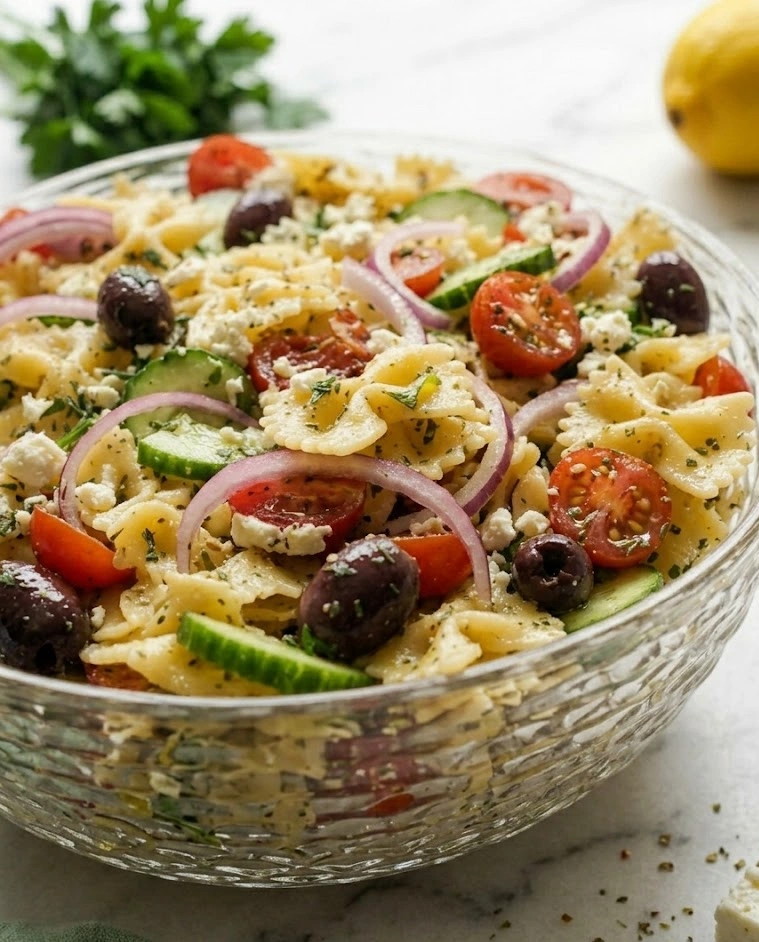
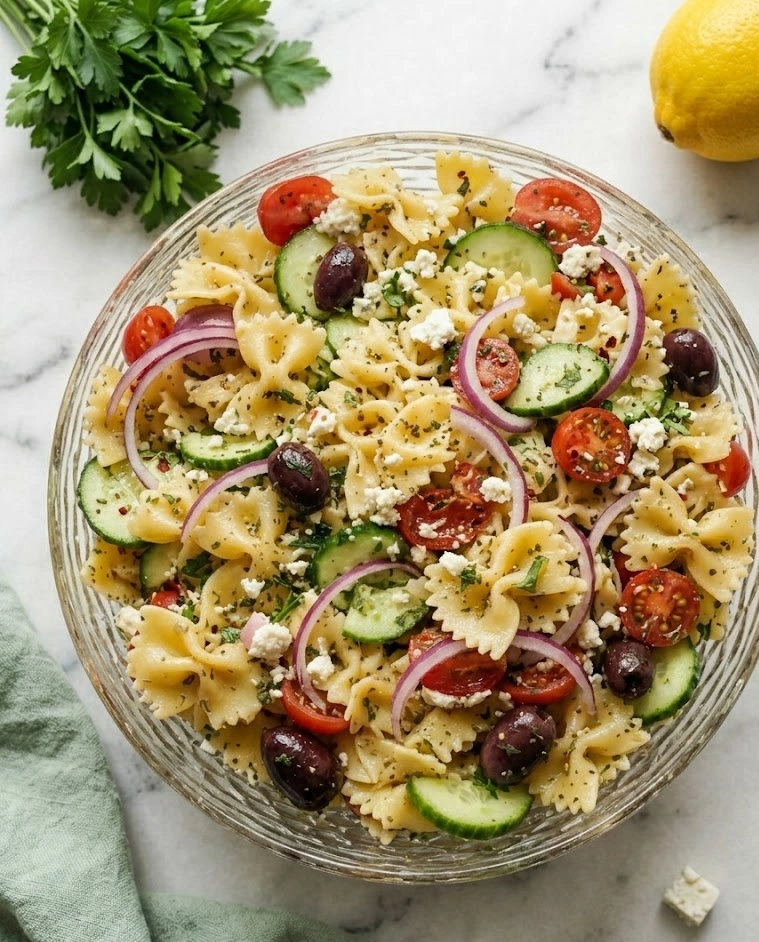
The foundation is simple: rotini pasta, crisp cucumber, juicy cherry tomatoes, briny kalamata olives, sharp red onion, and crumbled feta. What makes it irresistible is the homemade red wine vinaigrette — a bold, garlicky, herb-forward dressing built with extra-virgin olive oil, red wine vinegar, fresh lemon juice, pressed garlic, dried oregano, honey, and a pinch of red pepper flakes. It is the kind of dressing that tastes like summer in the Mediterranean, and it coats every spiral of pasta with a flavor you will find yourself thinking about later.
This is a healthy pasta salad recipe that earns that label honestly. No mayo. No cream. Just clean, bright, honest ingredients assembled in the right proportions and given enough time to become something genuinely special.
Why You’ll Love This Pasta Salad
This pasta salad recipe is one of the most reliably crowd-pleasing dishes you can bring to any table, and it requires almost no effort to pull off. The entire thing comes together in about 30 minutes, and most of that time is pasta water coming to a boil.
It is also one of those rare pasta salad ideas where the leftovers are genuinely better than the original. After a few hours in the refrigerator, the pasta absorbs the vinaigrette deeply, the garlic mellows and integrates, the feta softens slightly into the dressing, and the whole salad becomes more cohesive and more flavorful than it was fresh. Making it the night before is not just acceptable — it is the actual recommendation.
And because this is a pasta salad with Italian dressing logic at its core — vinegar-based, herb-forward, no dairy in the dressing itself — it holds up beautifully across four days of refrigerator storage without turning soggy, oily, or dull. That makes it one of the most practical pasta salad recipes in your repertoire, week in and week out.
Common Mistakes — And How to Avoid Them
Not salting the pasta water properly. This comes up in every pasta salad recipe for a reason: it is the most consistently skipped step and it has the most significant impact on the final dish. Your pasta water should taste noticeably, aggressively salty — closer to mild seawater than to cooking water. The pasta absorbs that seasoning as it cooks, and no amount of dressing applied afterward will compensate for pasta that is bland at its core.
Rinsing the pasta for too long. A brief cold rinse — twenty to thirty seconds — is correct for pasta salad. It stops the cooking, removes the excess surface starch that causes clumping, and cools the pasta down enough to handle. But an extended rinse strips the pasta of the residual warmth that helps it absorb the dressing. Rinse briefly, drain thoroughly, then dress immediately while the pasta is still slightly warm.
Adding all the dressing upfront and calling it done. Pasta is remarkably absorbent, particularly as it cools in the refrigerator. If you use every drop of dressing at the beginning, you will find the salad looking dry and under-dressed by the time you serve it. Reserve about a quarter of the dressing in a small container on the side and add it right before the salad goes on the table. This single habit produces a consistently better result.
Skipping the resting time. This pasta salad needs at least one hour in the refrigerator before serving, and ideally several hours or overnight. The resting period is not about chilling the salad — it is about flavor development. The garlic, oregano, and vinegar need time to infuse the oil and penetrate the pasta. A pasta salad served immediately after assembly tastes like individual components sitting next to each other. After an hour, it tastes like a unified dish.
Not tasting before serving. Cold temperatures suppress salt and acid perception substantially. A pasta salad that was perfectly seasoned at room temperature will taste flat and under-seasoned straight from the refrigerator. Always taste right before serving and adjust — typically a pinch more salt, an extra squeeze of lemon juice, or another drizzle of olive oil is all that is needed to bring it fully back to life.
Chef’s Notes
Make the dressing first, before you even put the pasta water on. This gives the garlic, oregano, and red pepper flakes time to begin infusing the oil while everything else comes together. A vinaigrette that has rested for even five or ten minutes is noticeably more cohesive and flavorful than one whisked and used immediately.
Press the garlic rather than mincing it. A garlic press gives you a finer, more uniform texture that distributes through the dressing without any sharp raw chunks. If you only have a knife, mince the garlic as finely as you can and then work a pinch of salt into it with the flat of the blade until it becomes a paste. This achieves a similar result.
The honey in the dressing is not there for sweetness — you should not be able to taste it as sweet. One teaspoon of honey in a dressing built around red wine vinegar and lemon juice functions as a balancing agent, rounding off the sharpest edges of the acidity without pulling the flavor toward sweet. Do not skip it, but do not increase it either.
On feta: buy it in a block if you can and crumble it yourself. Block feta stored in brine is creamier, saltier, and more intensely flavored than pre-crumbled feta, which tends to be drier and milder. The texture of hand-crumbled feta is also more varied and interesting in a salad — irregular pieces rather than uniform powder.
If you want to push this pasta salad toward a more substantial healthy pasta salad, add one can of drained chickpeas when you assemble the vegetables. They absorb the vinaigrette beautifully and add protein and body without changing the flavor profile at all.
Key Ingredients
Rotini or penne pasta. Fourteen ounces of short pasta is the foundation. Rotini spirals are the first choice here because their tight coils physically trap dressing, olive pieces, and crumbled feta — you get flavor in every single bite rather than just the ones where a good piece of cheese happened to land. Penne with ridges is a strong second option. Farfalle works well too and makes the salad particularly visually appealing.
Cherry tomatoes. Eighteen ounces — nearly two pints — sounds like a lot until you eat this salad and realize how essential the tomato-to-pasta ratio is. Cherry tomatoes add juiciness, acidity, and sweetness that balances the brine of the olives and the sharpness of the vinaigrette. Halve them rather than quarter them so they retain their juice and hold their shape through tossing.
Kalamata olives. Three-quarters of a cup of sliced kalamata olives provides the brine and depth that makes this unmistakably Mediterranean. Kalamata olives are meatier, more complex, and less one-dimensional than standard black olives. If you can find them whole, slice them yourself — the texture is better. If you are short on time, pre-sliced work perfectly well.
Feta cheese. Five ounces of crumbled feta is the creamy, salty anchor of the whole salad. It does not just add flavor on top — as it sits in the vinaigrette, it softens slightly and releases a little of its brine into the dressing, making the entire salad saltier and more complex over time.
Cucumber. One large cucumber, peeled and sliced into half-moon pieces, adds the crunch and cooling freshness that keeps this salad from feeling heavy despite the olive oil dressing. Peel it — the skin is bitter and slightly tough in a cold salad where texture matters.
Red onion. Half a red onion, thinly sliced, adds sharpness and color. If raw red onion feels too aggressive, soak the slices in cold water for ten minutes before adding them. This removes the harsh bite while preserving the flavor and the beautiful purple color.
The vinaigrette. One-third cup extra-virgin olive oil, four tablespoons red wine vinegar, one tablespoon lemon juice, three pressed garlic cloves, two teaspoons dried oregano, one teaspoon honey, and red pepper flakes for warmth. This is a dressing worth memorizing — it works on almost any Mediterranean-style salad and keeps in the refrigerator for up to a week.
How to Make Mediterranean Pasta Salad
Step 1: Make the vinaigrette. Before you put the pasta water on, combine one-third cup of extra-virgin olive oil, four tablespoons of red wine vinegar, one tablespoon of lemon juice, one teaspoon of honey, three freshly pressed garlic cloves, two teaspoons of dried oregano, half a teaspoon of salt, a quarter teaspoon of black pepper, and a quarter teaspoon of red pepper flakes in a small bowl or jar. Whisk until emulsified. Set aside to let the flavors infuse while you prepare everything else.
Step 2: Cook the pasta and prep the vegetables. Bring a large pot of heavily salted water to a rolling boil. Cook fourteen ounces of rotini or penne according to package directions until al dente. While the pasta cooks, peel and slice the cucumber into half-inch half-moons, halve eighteen ounces of cherry tomatoes, thinly slice half a red onion, and chop a quarter cup of fresh parsley. Have three-quarters cup of sliced kalamata olives and five ounces of crumbled feta ready to go.
Step 3: Rinse and dress the pasta. Drain the cooked pasta and rinse briefly under cold water for twenty to thirty seconds. Drain thoroughly. Transfer the still-slightly-warm pasta to a large mixing bowl and immediately pour about three-quarters of the vinaigrette over the top. Toss well until every piece of pasta is evenly coated. The residual warmth helps the pasta absorb the dressing from the inside rather than just being coated on the surface.
Step 4: Assemble the salad. Add the prepared cucumber, cherry tomatoes, kalamata olives, red onion, and fresh parsley to the dressed pasta. Toss gently but thoroughly until everything is evenly distributed. Add the crumbled feta last and fold it in carefully so the pieces stay intact rather than breaking down into the dressing.
Step 5: Chill and finish. Taste for seasoning and adjust with salt or a small squeeze of lemon if needed. Cover and refrigerate for at least one hour before serving — longer is better. Right before serving, give the salad a good stir, taste again, and drizzle the reserved vinaigrette over the top. Serve cold.
Variations and Tips
Make it a complete meal. Add one can of drained chickpeas, or top each serving with grilled chicken breast sliced thin. Either addition takes this from a side dish to a standalone healthy pasta salad that holds up as lunch on its own.
Add roasted red peppers. A jar of drained and roughly chopped roasted red peppers folds in beautifully and adds sweetness, smokiness, and extra color. They pair particularly well with the kalamata olives and feta.
Make it with artichoke hearts. Drained and quartered marinated artichoke hearts add a briny, slightly acidic element that amplifies the Mediterranean character of the whole dish. Use them in addition to or instead of the olives.
Make it gluten-free. Substitute chickpea pasta or your preferred gluten-free short pasta. Cook it carefully since gluten-free pasta can overcook quickly, and make sure to rinse it thoroughly to remove excess starch.
Add sun-dried tomatoes. A quarter cup of oil-packed sun-dried tomatoes, drained and roughly chopped, adds an intense concentrated tomato flavor that complements the fresh cherry tomatoes without competing with them. Use the oil from the jar in place of some of the olive oil in the dressing for even more depth.
Swap the herb. Fresh mint stirred in just before serving adds an unexpected brightness that works beautifully with the feta and cucumber. Use it alongside or instead of the parsley for a slightly different but equally excellent result.
How to Meal Prep This Pasta Salad
Mediterranean pasta salad is one of the most straightforward meal prep recipes you can have on hand, precisely because it requires almost no special handling to keep it fresh across an entire week.
Make the full batch on Sunday. Dress the pasta with three-quarters of the vinaigrette while it is still slightly warm and let it absorb fully before refrigerating. Store the assembled salad in a large airtight container and keep the reserved dressing in a small separate jar. The salad will hold perfectly for up to four days, with the flavor improving noticeably between day one and day two as the garlic and herbs fully infuse.
Before each serving, stir the salad, drizzle a small amount of the reserved vinaigrette over the top, and taste for seasoning. A few drops of fresh lemon juice and a small pinch of flaky salt is often all it needs after a day in the fridge to taste exactly as good as it did freshly made.
If you want to add feta but are worried about it breaking down over multiple days, keep it separate and crumble it fresh over each portion before eating. It stays creamier and more textually interesting this way, and the visual appeal of fresh white feta against the colorful salad is genuinely worth the extra thirty seconds of effort.
This is the pasta salad dressing that also holds extremely well on its own — make a double batch of the vinaigrette and keep the extra in the refrigerator for up to a week to dress grain bowls, green salads, or grilled vegetables throughout the week.
Cultural Context
Mediterranean cuisine is not a single tradition but a collection of overlapping ones — Greek, Italian, Turkish, Lebanese, Spanish, and North African cooking sharing a coastline, a climate, and a set of core ingredients that appear across all of them: olive oil, tomatoes, cucumbers, olives, legumes, fresh herbs, and sharp cheeses.
The red wine vinaigrette at the heart of this pasta salad draws most directly from Greek and Italian culinary traditions. Red wine vinegar, oregano, garlic, and olive oil appear together throughout both cuisines as a fundamental dressing logic — acidic, herbal, and clean, designed to let fresh vegetables and good olive oil speak clearly rather than obscuring them under cream or mayo.
Feta cheese specifically is Greek — protected by European law as a designation of origin product that can only be produced in certain regions of Greece using milk from local sheep and goats. The characteristic tangy, briny, crumbly quality of authentic feta comes from its production method and the specific character of Greek dairy, which is shaped by the herbs and grasses the animals graze on. It is worth seeking out genuine Greek feta rather than generic white cheese sold under the same name, because the flavor difference in a simple salad like this one — where the cheese is a central ingredient rather than a garnish — is real and worth the small additional cost.
The cold pasta salad format, as always, is an American adaptation — taking beloved Mediterranean flavors and applying them to the cold pasta dish that has become a staple of American home cooking. In this case, the translation is particularly successful, because the acidity and freshness of Mediterranean flavors are naturally well-suited to a cold application where they stay bright and clean rather than dulling the way heavier, creamier dressings sometimes do.
Mediterranean Pasta Salad
Equipment
- large pot
- colander
- Large Mixing Bowl
- whisk
- knife
- cutting board
Ingredients
- 14 oz rotini or penne pasta
- 18 oz cherry tomatoes, halved
- 1 cucumber, peeled and sliced
- 0.5 red onion, thinly sliced
- 0.75 cup kalamata olives, sliced
- 5 oz feta cheese, crumbled
- 0.25 cup fresh parsley, chopped
- 1/3 cup olive oil
- 4 tbsp red wine vinegar
- 1 tbsp lemon juice
- 3 cloves garlic, pressed
- 2 tsp dried oregano
- 1 tsp honey
- 0.25 tsp red pepper flakes
- 0.5 tsp salt
- 0.25 tsp black pepper
Instructions
- In a small bowl, whisk together olive oil, red wine vinegar, lemon juice, honey, garlic, oregano, salt, pepper, and red pepper flakes until emulsified. Set aside.
- Bring a large pot of salted water to a boil. Cook pasta until al dente. While cooking, prep vegetables and herbs.
- Drain pasta and rinse briefly under cold water. Transfer slightly warm pasta to a bowl and toss with three-quarters of the dressing.
- Add cucumber, tomatoes, olives, red onion, and parsley. Toss gently to combine.
- Fold in feta cheese gently. Chill for at least 1 hour. Before serving, toss and add remaining dressing if needed.