
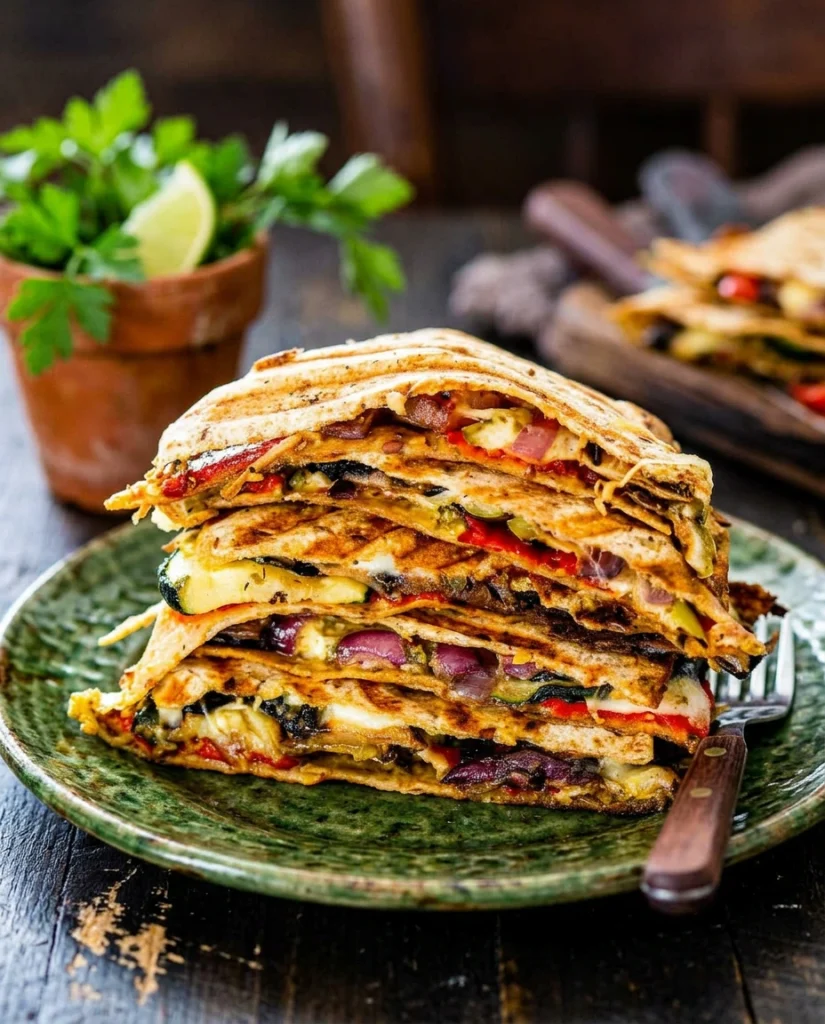
There is a version of the quesadilla that most people have made — a flour tortilla folded around shredded cheese, pressed in a skillet on a stovetop, cut into triangles, and served with sour cream and jarred salsa. It is fine. It is perfectly adequate. It is not this.
This is the grilled vegetable quesadilla — and the grill changes everything about it.
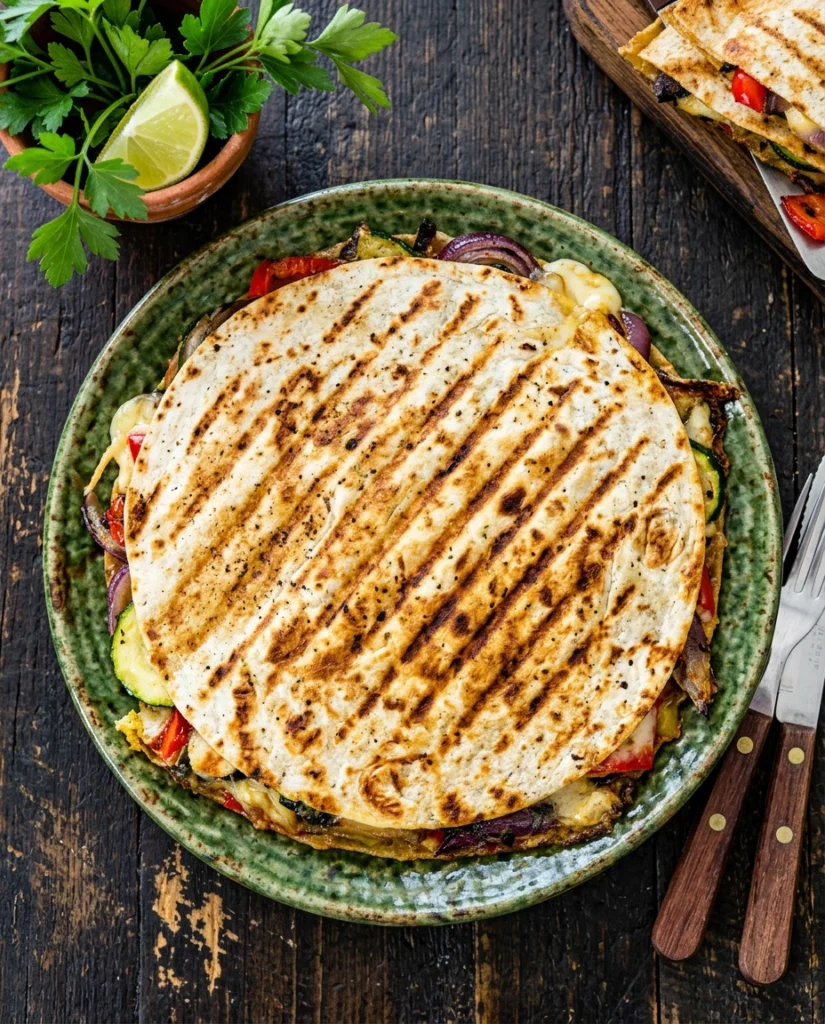
When a quesadilla goes directly onto a hot grill grate, the tortilla develops a char and crispiness that no skillet or panini press has ever replicated. The grill’s direct flame blisters the surface of the tortilla into irregular, crackling, slightly smoky bubbles while the interior fills with melting cheese and vegetables that were themselves grilled moments before — smoky, caramelized, and deeply flavored in a way that raw or sautéed vegetables cannot approach.
This is one of those grilling recipes easy preparations that reveals what the grill can do to even the most familiar and humble ingredients — transforming them into something that is recognizable in name but entirely different in character.
Why You’ll Love This Grilling Recipe
The grill does what no stovetop can. The combination of direct flame char on the tortilla exterior and the residual heat of just-grilled vegetables melting the cheese from the inside creates a quesadilla with a structural and textural complexity that stovetop versions cannot replicate. The tortilla chars in irregular patterns. The cheese melts completely and begins to crisp at the edges where it contacts the hot tortilla surface. The grilled vegetables release their concentrated juices into the cheese as it melts — creating a filling that is simultaneously creamy, smoky, and deeply savory.
It is the most versatile grilling recipes side dish or main in the summer rotation. Serve these quesadillas as a grilling recipes side dish alongside grilled proteins — they complement grilled chicken, grilled shrimp, and grilled fish with equal enthusiasm. Serve them as the main event for a vegetarian grilling recipes for dinner that requires no apology and no supplementation. Cut them into wedges and serve as a grilling recipes appetizer alongside guacamole and salsa at a cookout. The quesadilla’s inherent adaptability makes it one of the most broadly useful preparations in the entire grilling recipes for dinner toolkit.
It is a genuinely healthy grilling recipe without feeling like one. Grilled vegetables provide fiber, vitamins, and phytonutrients. Whole wheat or corn tortillas provide complex carbohydrates. A moderate amount of quality melting cheese provides complete protein and calcium. The entire preparation requires minimal oil and produces a result that is nutritionally substantive and completely satisfying — one of the best grilling recipes healthy options in the collection that tastes like an indulgence.
Common Mistakes (And How to Avoid Them)
Grilling the quesadillas assembled with raw vegetables. This is the foundational error that produces a quesadilla with raw, watery vegetables, unmelted cheese, and a burnt tortilla — the grill cooks the tortilla exterior in 2–3 minutes, which is nowhere near enough time for raw vegetables to cook through, release their moisture, and develop flavor. Always grill the vegetables separately first, allow them to cool slightly, then assemble and grill the filled quesadilla as a second operation. The two-step process is the entire technique — and it is what separates a great grilled vegetable quesadilla from a disappointing one.
Overfilling the quesadilla. The single most reliable path to a structural collapse on the grill is too much filling. An overfilled quesadilla cannot be flipped without half its contents sliding onto the grates. The cheese and vegetable filling must be distributed in a thin, even layer — generous enough to taste everything in every bite but restrained enough to allow the two tortilla halves to grip each other through the melting cheese and flip as a cohesive unit. Approximately ⅓ cup of filling per quesadilla half — not more.
Using the wrong cheese. Not all cheeses melt on a grill. Hard, aged cheeses like parmesan and aged cheddar melt poorly and slowly — producing a grainy, oily result rather than the smooth, creamy, pull-apart melt that defines a great quesadilla. The correct cheeses for this grilling recipe are those with high moisture content and excellent melting properties — Oaxacan cheese (the traditional choice), Monterey Jack, low-moisture mozzarella, or a good quality pepper jack. Use a single excellent melting cheese or a blend of two — never more than two, as different melting rates produce an uneven, inconsistent result.
Not closing the grill lid during cooking. The grill lid is a critical tool in this preparation. Closing the lid creates a convection oven environment above the quesadilla — the trapped heat from the grill circulates around and above the quesadilla, melting the cheese from above while the direct grate heat crisps the tortilla from below. An open grill lid produces a crispy bottom but unmelted cheese — the classic failure mode of grilled quesadillas. Close the lid for the entire first phase of cooking and only open it to flip.
Flipping too aggressively. A quesadilla on a grill is more fragile than most proteins — the two tortilla halves are held together only by the adhesive power of the melting cheese, which requires sufficient heat exposure to become properly molten and grippy. Flip too early and the cheese is still cold and solid, providing no structural integrity — the quesadilla will fold, buckle, and spill its contents onto the grates. Flip too aggressively — using a single spatula and a sharp rotation — and the same result occurs. Always use two spatulas simultaneously for the flip, supporting the full length and width of the quesadilla from both ends and rotating it slowly and horizontally.
Chef’s Notes
The cheese-to-vegetable ratio in a grilled vegetable quesadilla is a subject that deserves careful thought because it determines the structural and flavor integrity of the entire preparation. Too much cheese overwhelms the smoky, complex flavor of the grilled vegetables and produces a rich, heavy quesadilla that satisfies without delighting. Too little cheese and the quesadilla has no structural cohesion — the vegetables slide around, the tortilla does not seal, and the flip becomes an exercise in damage control. The correct ratio is approximately equal volumes of cheese and grilled vegetables — enough cheese to melt fully and bind the filling, enough vegetables to taste in every bite as the primary flavor rather than a background note.
For a grilling recipes for two presentation that is genuinely elegant, make smaller quesadillas using 8-inch tortillas rather than the standard 10-inch, cut each into four wedges rather than six, and arrange them in a fan on a wooden board alongside small ramekins of smoked chipotle crema, fresh guacamole, and charred tomato salsa. Add a cold Mexican beer or a chilled margarita. This grilling recipes for two setup requires zero additional effort beyond the scaling down and the plating — and produces a shared meal that feels considered and celebratory rather than merely convenient.
The single most impactful finishing move for this grilling recipe is a squeeze of fresh lime directly onto the cut surfaces of the quesadilla wedges the moment they come off the grill — before any topping, before any sauce, before anything else. The acid of the lime cuts through the richness of the melted cheese, activates the smokiness of the grilled vegetables, and brightens the entire quesadilla with a tropical acidity that makes every subsequent bite more vivid and alive. It takes two seconds and costs nothing.
Key Ingredients — And Why They Work
Large flour tortillas (10-inch): Flour tortillas are the correct choice for grilled quesadillas for structural reasons that go beyond preference. Flour tortillas have a higher gluten content than corn tortillas — which gives them the elasticity and flexibility to fold without cracking, the strength to hold a generous filling without tearing, and the ability to develop an irregular, bubbly, crackling char on the grill surface without disintegrating. Corn tortillas, while superior in flavor for tacos and enchiladas, are too fragile and brittle for the two-spatula grill flip that this preparation requires. Whole wheat flour tortillas are an excellent grilling recipes healthy compromise — the nutty, slightly earthy flavor of whole wheat pairs beautifully with grilled vegetables and provides more fiber and complex carbohydrates than standard flour tortillas.
Oaxacan cheese (or Monterey Jack): Oaxacan cheese — a stretched-curd, string-style Mexican cheese — is the traditional and technically superior choice for quesadillas. It melts in long, even, pull-apart strings that create the dramatic cheese stretch that defines a great quesadilla, has a mild, slightly tangy, milky flavor that does not overwhelm the vegetables, and holds together as it melts rather than breaking into greasy pools the way some cheddar varieties can. Monterey Jack is the most accessible substitute — nearly identical in melting behavior and only slightly milder in flavor. Pepper Jack adds a welcome heat that complements the smoky grilled vegetables particularly well.
Zucchini: The foundational grilling vegetable of this quesadilla for practical as well as flavor reasons. Zucchini grills in 3–4 minutes per side, developing beautiful char marks while remaining tender and slightly juicy at the center. Its mild, slightly sweet flavor absorbs the smoky char of the grill without asserting itself too strongly — playing a supporting role to the more flavor-dominant vegetables in the mix. Sliced lengthwise into ¼-inch planks for grilling, then cut into smaller pieces for the quesadilla filling.
Red and yellow bell peppers: The sweetness and color providers. Bell peppers caramelize aggressively on a hot grill, their natural sugars concentrating and darkening into a deep, jammy sweetness that is completely different from raw pepper — and spectacular inside a quesadilla where that sweetness contrasts with the slightly bitter char of the tortilla and the richness of the melted cheese. Use both red and yellow for color diversity — the visual appeal of a quesadilla with orange-red pepper pieces, green zucchini, and purple-red onion against the golden cheese is genuinely beautiful when the quesadilla is cut and the cross-section is revealed.
Red onion: The pungent, sweet, slightly acidic counterpoint to the milder vegetables. Red onion on a hot grill transforms in the same way it always does — its harsh raw bite caramelizing into a deep, jammy, almost balsamic sweetness at the charred edges while retaining a slight vegetal sharpness at the center. Cut into thick rings or wedges for grilling — thin slices will fall through the grates and burn before they caramelize. Separate the rings after grilling and incorporate into the quesadilla filling.
Corn (grilled directly on the cob, then cut off): The textural and flavor wildcard that elevates this grilling recipe from good to extraordinary. Grilled corn kernels — cut directly from a cob that has been charred on the grill — have a smoky sweetness and slight chewiness that no canned or frozen corn can replicate. They dot the quesadilla filling with pops of sweetness and texture that make every bite more interesting. One ear of corn yields enough kernels for two generous quesadillas — grill the cob first, before the other vegetables, while the grill is at its hottest.
Jalapeño (grilled): A whole jalapeño placed directly on the hottest part of the grill until completely blistered and charred on all sides — then peeled, seeded, and roughly chopped — provides a completely different heat character than raw jalapeño. The grilling process mellows and sweetens the jalapeño’s sharp raw heat while adding a smoky, roasted complexity that integrates into the quesadilla filling as a warmth that builds gently rather than biting immediately. For a milder result, use half the grilled jalapeño. For guests who prefer no heat, omit entirely.
Fresh cilantro: Added to the quesadilla filling after the vegetables have cooled slightly — just before assembly — fresh cilantro provides a bright, herbaceous counterpoint to the smoky richness of the grilled vegetables and cheese. Its volatile aromatic compounds would burn off completely if placed inside a quesadilla that goes onto the grill — which is why it is added after grilling the vegetables and before assembling, where it is protected from direct heat by the surrounding filling.
Chipotle powder (in the seasoning): A small amount of chipotle powder in the vegetable seasoning adds a smoky, slightly spicy, deeply complex flavor that echoes and amplifies the char of the grill — the same flavor-stacking technique used throughout this grilling recipes series. Chipotle is a smoked dried jalapeño — its flavor is simultaneously spicy, smoky, and fruity, contributing more complexity in a single spice than most blends achieve with five.
Lime zest (in the seasoning): Added to the oil-based seasoning that coats the vegetables before grilling, lime zest carries its aromatic citrus oils directly onto the vegetable surface during the marinating period — infusing every piece with a citrus brightness that survives the grill’s heat partially intact and makes the finished vegetables taste more vivid and complex than unseasoned grilled vegetables.
How to Make Grilled Vegetable Quesadillas
Serves: 4 | Prep Time: 20 min | Cook Time: 20–25 min
Ingredients:
For the grilled vegetables:
- 2 medium zucchini, sliced lengthwise into ¼-inch planks
- 1 large red bell pepper, halved and seeded
- 1 large yellow bell pepper, halved and seeded
- 1 large red onion, cut into ½-inch rings (secured with toothpicks to prevent falling apart)
- 1 ear of corn, husked
- 1–2 jalapeños, whole
- 2 tbsp olive oil
- 1 tsp chipotle powder
- 1 tsp garlic powder
- ½ tsp smoked paprika
- Zest of 1 lime
- ½ tsp kosher salt
- ¼ tsp black pepper
For the quesadilla assembly:
- 4 large flour tortillas (10-inch) or 8 medium (8-inch) for grilling recipes for two portions
- 2½ cups Oaxacan cheese or Monterey Jack, shredded (approximately 10 oz)
- ¼ cup fresh cilantro, roughly chopped
- 2 tbsp fresh lime juice (for tossing with the grilled vegetables)
For the chipotle crema:
- ½ cup sour cream or Mexican crema
- 1–2 chipotle peppers in adobo, finely minced
- 1 tsp adobo sauce
- 1 tbsp fresh lime juice
- Pinch of kosher salt
For the charred tomato salsa (quick version):
- 4 Roma tomatoes, halved
- 3 cloves garlic, unpeeled
- ½ white onion, cut into thick slices
- 1 jalapeño, whole
- 1 tbsp olive oil
- Juice of 1 lime
- ½ cup fresh cilantro
- Salt to taste
To finish and serve:
- Fresh lime wedges
- Fresh avocado or guacamole
- Extra cilantro leaves
- Flaky sea salt
- Hot sauce for serving
Suggested grilling recipes side dishes:
- Mexican street corn salad (esquites) with cotija and lime
- Black bean and avocado salad with cumin dressing
- Cilantro lime rice
- Simple jicama slaw with lime and chili
- Grilled pineapple with chili and lime
- Watermelon and cucumber salad with mint and lime
Instructions:
- Make the chipotle crema. Whisk together sour cream, minced chipotle peppers, adobo sauce, lime juice, and salt until smooth and fully combined. Taste and adjust heat by adding more chipotle or adobo if desired. Transfer to a squeeze bottle or small serving bowl. Refrigerate until needed — the crema improves as the chipotle flavor integrates into the cream base.
- Make the charred tomato salsa. Place the halved Roma tomatoes cut-side down, unpeeled garlic cloves, onion slices, and whole jalapeño directly on the grill over high heat. Grill undisturbed for 4–5 minutes until deeply charred and blistered — the tomatoes should be blackened in spots on the cut surface, the onion charred at the edges, and the jalapeño blistered on all sides. Remove everything from the grill and let cool for 5 minutes. Peel the garlic. Remove the stem from the jalapeño and discard the seeds if you want milder heat. Transfer everything to a blender with lime juice, cilantro, and salt. Pulse 4–6 times — you want a chunky, rustic salsa with visible texture, not a smooth purée. Taste and adjust salt. Set aside.
- Season the vegetables. In a large bowl, whisk together olive oil, chipotle powder, garlic powder, smoked paprika, lime zest, kosher salt, and black pepper. Add the zucchini planks, bell pepper halves, red onion rings, corn cob, and whole jalapeños. Toss thoroughly to coat every surface of every vegetable — use your hands for the most even coating. Let the vegetables sit in the seasoning for 10 minutes while the grill heats.
- Preheat the grill. Heat the grill to high — 425–450°F. Clean the grates meticulously and oil generously — twice — immediately before the vegetables go on. A clean, well-oiled grate is especially important for the zucchini planks and bell pepper halves, which have large flat surfaces that will stick to any residue.
- Grill all the vegetables. Working in this order — corn first, then peppers and onion, then zucchini and jalapeño: Place the corn cob on direct heat and grill, turning every 2 minutes, for 8–10 minutes total until kernels are charred in spots and deeply golden all over. Remove and set aside. Place the bell pepper halves cut-side down and onion rings on direct heat. Grill for 3–4 minutes per side until charred and softened. Place the zucchini planks and whole jalapeños on direct heat. Grill for 2–3 minutes per side until char marks develop and the zucchini is tender. Remove all vegetables from the grill and let cool for 5 minutes.
- Prepare the filling. Cut the corn kernels from the cob directly into a large bowl. Roughly chop the grilled zucchini, bell peppers, and red onion into ½-inch pieces — you want recognizable pieces, not a finely chopped hash. Peel, seed, and roughly chop the grilled jalapeño. Add all the chopped vegetables to the bowl with the corn. Toss with fresh lime juice and fresh cilantro. Taste and adjust salt — the filling should be boldly seasoned, as the tortilla and cheese will dilute its intensity slightly.
- Reduce grill to medium. Lower the grill temperature to medium — approximately 375°F. The vegetable grilling phase requires high heat for proper char. The quesadilla phase requires medium heat to allow the cheese to melt completely before the tortilla burns. This temperature transition is the most important technical step in the grilling recipe.
- Assemble the quesadillas. Working one at a time — because assembled quesadillas must go immediately onto the grill before the filling makes the tortilla soggy: Lay a tortilla flat on a clean work surface. Spread approximately ⅓ cup of shredded cheese in an even layer over the entire surface. Distribute approximately ½ cup of the grilled vegetable filling evenly over one half of the tortilla only — leaving the other half as a cheese-only surface that will fold over the filling. Scatter a few extra pieces of cheese over the top of the vegetable filling — this additional cheese layer between the filling and the top tortilla surface acts as an additional adhesive. Fold the cheese-only half over the filled half to create a half-moon shape. Press firmly and evenly with your hand to compact slightly.
- Grill the quesadillas. Carry the assembled quesadilla carefully to the grill — supporting it fully from beneath — and lay it gently on the medium-heat grates. Close the lid immediately. Grill undisturbed for 2–3 minutes — the lid-closed convection environment is what melts the cheese from above while the grates crisp the tortilla from below. Open the lid — the bottom should be golden with char marks and the cheese should be beginning to melt visibly at the edges.
- Flip carefully and finish. Position one wide spatula under each end of the quesadilla simultaneously — supporting the full length from both ends. In a single, smooth, horizontal motion, flip the quesadilla away from you onto the second side. Close the lid and grill for another 2 minutes until the second side is equally golden and charred and the cheese is completely melted throughout. Remove from the grill and transfer to a cutting board.
- Rest, cut, and serve. Let each quesadilla rest for 60 seconds before cutting — this allows the melted cheese to set slightly, which prevents the filling from sliding out when the quesadilla is cut. Using a sharp knife or pizza wheel, cut each quesadilla into 3–4 wedges. Finish with a squeeze of fresh lime over the cut surfaces immediately. Arrange on a platter or individual plates alongside chipotle crema, charred tomato salsa, and fresh guacamole.
Variations & Tips
Make it a grilling recipes for two dinner: Two 8-inch quesadillas, a small bowl of chipotle crema, a ramekin of charred tomato salsa, sliced avocado alongside, and a cold Mexican beer or margarita — this grilling recipes for two setup is one of the most relaxed, most satisfying, and most visually appealing quick dinners in the summer grilling recipes for dinner collection. Scale the vegetable grilling to half quantities, make smaller quesadillas, and invest the time saved in a proper presentation on a wooden board.
Add grilling recipes chicken: Slice 1–2 grilled chicken thighs — from the Mediterranean chicken skewers recipe or the lemon rosemary thighs — into thin strips and add to the vegetable filling before assembly. The combination of smoky grilled chicken and grilled vegetables inside a charred, cheesy quesadilla is one of the most satisfying grilling recipes chicken applications imaginable — and the perfect way to use leftover grilled protein from an earlier meal in the week’s grilling recipes for dinner rotation.
Grilling recipes Blackstone quesadillas: The Blackstone flat top is arguably the superior tool for quesadillas compared to traditional grill grates — the flat, even surface makes flipping effortless, eliminates any risk of filling falling through the grates, and creates a perfectly even, golden-brown crust across the entire surface of the tortilla rather than just at the grill mark contact points. Heat the Blackstone to medium, add a very thin layer of neutral oil to the surface, assemble the quesadilla directly on the flat top, press gently with a large spatula or grill press, and flip at the same timing intervals as above. This grilling recipes Blackstone approach is the most consistent and foolproof method for achieving a perfectly crispy, evenly browned quesadilla every single time.
Grilling recipes pork carnitas quesadilla: Add shredded grilled pork shoulder — rubbed with cumin, chili powder, and orange zest, slow-grilled over indirect heat until falling apart, then briefly crisped over direct heat — to the vegetable filling for an extraordinary grilling recipes pork quesadilla that bridges the backyard grill and the taqueria with complete authenticity. The combination of smoky grilled pork, charred vegetables, and melted Oaxacan cheese is one of the most deeply satisfying flavor combinations in the Mexican culinary tradition.
Grilling recipes healthy whole wheat version: Use whole wheat flour tortillas and replace half the cheese with a generous spread of black bean purée — blend one can of black beans with garlic, cumin, lime juice, and salt until smooth — applied directly to the tortilla surface before the cheese and vegetables. The black bean purée adds protein, fiber, and a creamy, savory depth while reducing the overall cheese quantity significantly. The result is a grilling recipes healthy quesadilla that is nutritionally substantial and completely satisfying.
Pro tip: For extra crispiness on the tortilla exterior without increasing the grill temperature — which risks burning the cheese before it melts — brush the outer surface of each assembled quesadilla with a very thin layer of neutral oil immediately before it goes on the grill. The oil creates direct contact between the tortilla and the grate heat, accelerating browning and producing a crispier, more evenly golden exterior than an un-oiled tortilla can achieve at medium grill temperature.
How to Meal Prep
The grilled vegetables are the highest-leverage make-ahead component of this grilling recipe — and one of the most broadly useful preparations in the summer grilling recipes for dinner rotation. Grilled in large batches and stored in airtight containers in the refrigerator for up to 4 days, they function as quesadilla filling, grain bowl toppings, pasta additions, taco fillings, sandwich components, and grilling recipes side dishes accompaniments to virtually every protein-based grilling recipe in this series. Grilling a large quantity of vegetables once at the beginning of the week and deploying them across multiple meals is the single most efficient preparation strategy for weeknight grilling recipes easy cooking.
The charred tomato salsa keeps beautifully in the refrigerator for up to 5 days and improves significantly after 24 hours as the charred flavors meld and deepen. Make a large batch — it serves as a dipping sauce, a taco topping, a breakfast egg sauce, a marinade base, and a finishing sauce for grilled fish and chicken throughout the week. The chipotle crema keeps for up to 1 week in the refrigerator and is equally useful across the entire grilling recipes for dinner collection — as a dipping sauce for the Cajun shrimp foil packets, a drizzle for the blackened mahi-mahi tacos, and a finishing element for virtually any spiced grilling recipe that benefits from a cool, creamy counterpoint.
Leftover assembled and grilled quesadillas — stored in the refrigerator for up to 2 days — reheat extraordinarily well in a 375°F oven for 8–10 minutes or in a dry skillet over medium heat for 2 minutes per side. Both methods re-crisp the tortilla effectively without over-drying the filling — the oven is superior for larger quantities, the skillet for individual portions. Avoid the microwave entirely — it produces a soft, steamed tortilla that is the textural opposite of what makes a grilled quesadilla worth making in the first place. Cut the reheated quesadillas into fresh wedges, apply a new squeeze of lime, and serve with fresh crema and salsa — and they are virtually indistinguishable from the just-off-the-grill original.
Cultural Context
The quesadilla is one of the oldest continuously prepared foods in the Mexican culinary tradition — its origins traceable to the pre-Columbian Mesoamerican practice of cooking corn masa flatbreads on a comal, the flat clay griddle that has been the central cooking implement of Mexican and Central American cuisine for at least 3,000 years. The word quesadilla derives from the Spanish queso — cheese — reflecting the arrival of European dairy culture in the Americas following the Spanish conquest, when cheese was introduced to the corn-based flatbread tradition and the combination proved immediately and enduringly compelling.
The regional variation within the quesadilla tradition across Mexico is extraordinary and largely invisible to the outside world. In Mexico City and central Mexico, quesadillas are made with masa — raw or prepared corn dough — rather than pre-made tortillas, stuffed with any number of fillings including huitlacoche (corn fungus), flor de calabaza (squash blossom), and chicharrón, and cooked on a comal without necessarily including cheese at all — a fact that surprises most non-Mexican cooks who consider cheese definitionally essential to the preparation. In northern Mexico and across the American Southwest, the flour tortilla quesadilla with melted cheese became the dominant form — the version most familiar to the international audience and the one this grilling recipe works within and elevates.
What the grill brings to this ancient preparation is the closest modern approximation of the comal’s original cooking environment — direct, intense, dry heat applied to a flat masa-based bread from below, producing the char, the blistering, and the smokiness that defines properly cooked Mexican flatbreads across their entire history. The pre-Hispanic comal over an open wood fire and the 21st-century gas grill grate at 375°F are separated by three millennia of culinary history and virtually no meaningful distance in the fundamental physics of how they cook a tortilla — both applying direct, dry heat to a flat bread surface until it chars, blisters, and becomes something more complex, more flavorful, and more compelling than its ingredients alone would suggest.
Grilled Vegetable Quesadillas
Equipment
- grill
- tongs
- spatulas (2) for flipping quesadillas
- mixing bowls
- knife and cutting board
- blender for salsa
Ingredients
- 2 medium zucchini, sliced lengthwise
- 1 large red bell pepper, halved and seeded
- 1 large yellow bell pepper, halved and seeded
- 1 large red onion, cut into rings
- 1 ear of corn, husked
- 1-2 jalapeños
- 2 tbsp olive oil
- 1 tsp chipotle powder
- 1 tsp garlic powder
- 0.5 tsp smoked paprika
- 1 lime zest
- 0.5 tsp kosher salt
- 0.25 tsp black pepper
- 4 large flour tortillas
- 2.5 cups Oaxacan or Monterey Jack cheese, shredded
- 0.25 cup fresh cilantro, chopped
- 2 tbsp fresh lime juice
- 0.5 cup sour cream or Mexican crema
- 1-2 chipotle peppers in adobo, minced
- 1 tsp adobo sauce
- 1 tbsp lime juice (for crema)
- 4 Roma tomatoes
- 3 cloves garlic
- 0.5 white onion
- 1 jalapeño (for salsa)
- 1 tbsp olive oil (for salsa)
Instructions
- Whisk together sour cream, chipotle peppers, adobo sauce, lime juice, and salt until smooth. Refrigerate until ready to serve.
- Grill tomatoes, garlic, onion, and jalapeño until charred. Blend with lime juice, cilantro, and salt into a chunky salsa.
- Mix الزيت الزيتون with chipotle powder, garlic powder, paprika, lime zest, salt, and pepper. Toss all vegetables to coat evenly.
- Preheat grill to high heat and oil grates well.
- Grill corn, peppers, onion, zucchini, and jalapeños until tender and charred. Let cool slightly.
- Chop grilled vegetables and combine with corn, cilantro, and lime juice. Season to taste.
- Reduce grill heat to medium.
- Layer cheese and vegetable filling onto tortillas, fold in half, and press gently.
- Grill quesadillas with lid closed for 2–3 minutes until golden and cheese begins to melt.
- Flip carefully and cook another 2 minutes until crispy and fully melted.
- Rest briefly, slice into wedges, squeeze lime juice on top, and serve with crema and salsa.