
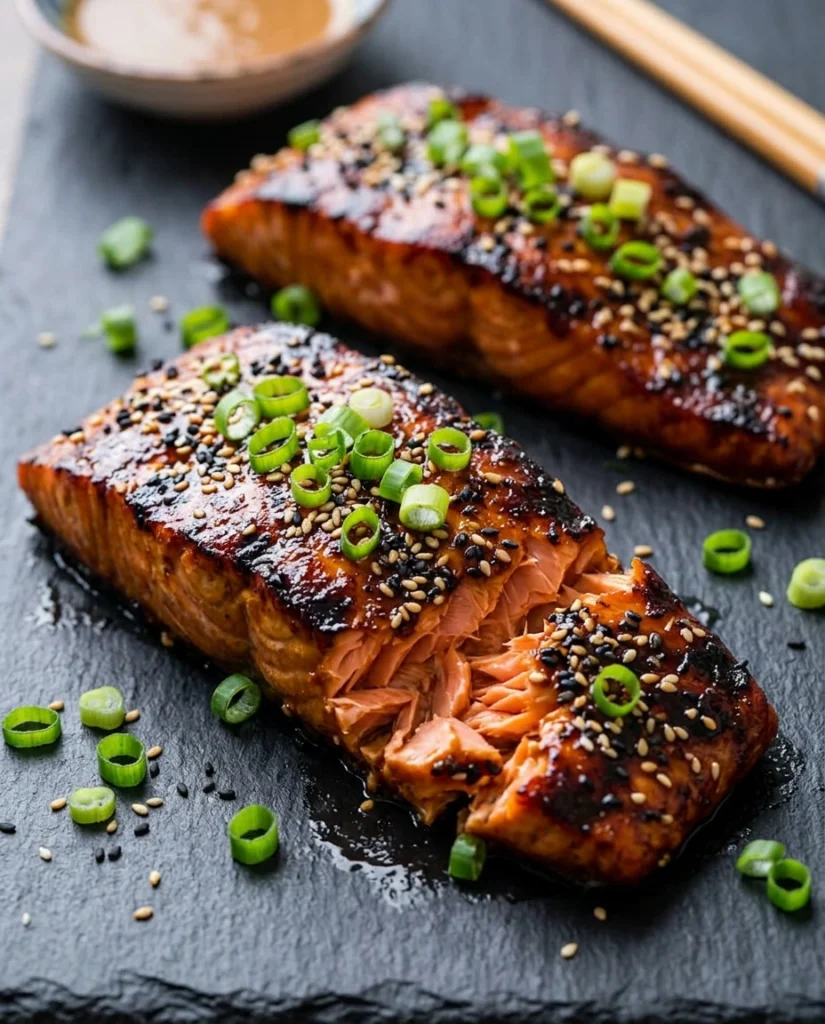
There is a category of grilling recipes for dinner that transcends the table — dishes so universally appealing, so deeply satisfying, so perfectly balanced between familiar and exciting that they do not merely feed people, they convert them. Grilled teriyaki salmon is that dish.
The person who insists they do not like fish will eat two portions of this. The person who thinks salmon is too rich will clean their plate. The person who has never attempted a grilling recipes easy fish preparation will make this on a Wednesday and feel like a professional chef by Thursday morning.
This is not an accident. Teriyaki is one of the most perfectly engineered flavor systems in the history of cooking — soy for umami and salt, mirin and sake for subtle sweetness and complexity, sugar for caramelization and glaze, ginger and garlic for aromatic warmth. Applied to salmon — a fish rich enough in natural fat to lacquer magnificently under high heat — and finished on a hot grill where the sugars char at the edges into something approaching culinary perfection, it produces a result that is greater than the sum of its already extraordinary parts.
Why You’ll Love This Grilling Recipe
Homemade teriyaki demolishes the bottled version entirely. Store-bought teriyaki sauce is flat, aggressively sweet, and one-dimensional. A homemade teriyaki glaze takes eight minutes on the stovetop and delivers a depth — the savory complexity of reduced soy, the subtle wine notes of mirin and sake, the caramel edges of properly reduced sugar — that no bottle has ever replicated. This is one of those grilling recipes easy preparations where the homemade component requires minimal effort and produces maximum reward.
Salmon is the ideal grilling recipes healthy protein. Wild-caught salmon is among the most nutritionally dense foods on earth — extraordinary levels of omega-3 fatty acids, complete protein, vitamin D, selenium, and B vitamins in a single fillet. This is a grilling recipes healthy dinner that genuinely nourishes at every biological level while tasting like a complete indulgence.
The caramelization is spectacular. The natural sugars in the teriyaki glaze, combined with the natural sugars in the salmon’s flesh, create a caramelization event on the grill surface that produces deep, mahogany-lacquered edges where the glaze chars slightly and concentrates into something that is simultaneously sweet, salty, smoky, and complex. This is the flavor that makes grilling recipes for dinner feel worth every minute of preparation.
Common Mistakes (And How to Avoid Them)
Using thin salmon fillets. A thin fillet — under ¾ of an inch — will cook through before the teriyaki glaze has time to caramelize and lacquer properly. You end up with overcooked, dry salmon and a pale, unset glaze simultaneously. Target fillets that are 1–1.25 inches thick at the center. The thickness gives you the cooking window you need to build multiple layers of glaze while keeping the interior silky and just barely cooked through.
Applying the teriyaki glaze too early in the cooking process. The sugars in teriyaki — from both the added sugar and the natural sugars in mirin and sake — burn aggressively over direct high heat. Applying the glaze in the first half of the cook is a reliable route to a bitter, acrid-tasting crust rather than the sticky, caramelized lacquer you are after. Begin glazing only in the final 3–4 minutes of cooking, applying in multiple thin layers rather than one thick coat.
Not reducing the teriyaki sauce enough. A properly made teriyaki glaze should coat the back of a spoon and hold its shape when you drag a finger through it — not run off immediately like water. An under-reduced glaze will not adhere to the salmon, will create excessive steam on the grill, and will produce a pale, watery result instead of a deep, sticky lacquer. Reduce patiently until you reach the right consistency — it will continue to thicken slightly as it cools.
Forcing the salmon off the grill. Salmon has a tendency to stick, particularly as the skin begins to render and the sugars in the glaze make contact with the grates. If your salmon resists when you try to flip, it is not ready — the crust has not fully formed and the fish will tear. Give it one more minute of uninterrupted contact with the hot grates and it will release cleanly on its own timeline, not yours.
Chef’s Notes
Skin-on versus skinless is one of the most debated questions in salmon grilling recipes, and I come down firmly on the side of skin-on. The skin acts as a natural barrier between the delicate flesh and the direct heat of the grill, protecting the bottom of the fillet from overcooking while the top cooks through from residual heat and the indirect warmth of the closed lid. It also renders on the grill into a crispy, savory, deeply flavored chip that is — when properly executed — one of the most delicious bites the entire grilling recipes for dinner table has to offer.
The single most transformative finishing touch for this grilling recipe is a final brush of fresh, uncooked teriyaki glaze applied the moment the salmon leaves the grill — before the residual heat has a chance to set the surface completely. This fresh glaze over the caramelized cooked glaze creates a double-layer effect — deep, complex caramelized flavor underneath, bright and glossy fresh teriyaki on top — that is the difference between a good grilled salmon and an extraordinary one.
Key Ingredients — And Why They Work
Salmon fillets (skin-on, 1–1.25 inches thick, wild-caught preferred): Wild-caught salmon — particularly sockeye or king — has a deeper, more complex flavor, a firmer texture, and a more vivid color than farmed Atlantic salmon. Its higher natural fat content means it can withstand the high heat of the grill without drying out, self-basting from the inside as its fat renders under heat. It is one of the most forgiving proteins in grilling recipes precisely because of that fat content — a slightly overcooked wild salmon is still infinitely more palatable than a slightly overcooked lean fish.
Soy sauce: The umami and salt foundation of the teriyaki glaze. Soy sauce contains glutamates — the amino acids responsible for the savory, mouth-filling quality called umami — in concentrated form. When reduced in the glaze, those glutamates concentrate further, creating a depth of savory flavor that is the structural backbone of everything teriyaki. Use a good quality, naturally brewed soy sauce — the difference between naturally brewed and chemically produced soy sauce is significant in a preparation where soy is the primary ingredient.
Mirin: A sweet Japanese rice wine with a lower alcohol content than sake and a higher natural sugar content. In the teriyaki glaze, mirin does three jobs simultaneously — it provides sweetness that is more nuanced and complex than plain sugar, it adds a subtle fermented wine note that gives the glaze depth, and its sugar content is precisely calibrated for the caramelization temperature of a grill, creating that characteristic teriyaki shine and lacquer.
Sake: Dry Japanese rice wine that adds a subtle complexity and slight acidity to the glaze. When it reduces with the soy and mirin, its alcohol content cooks off completely and leaves behind a concentrated umami and mineral note that separates a truly excellent teriyaki glaze from a merely good one. Dry sherry is an acceptable substitute if sake is unavailable.
Brown sugar: Provides the caramelization fuel for the glaze. Brown sugar’s molasses content — absent in white sugar — adds a deep, slightly bitter caramel note that gives the charred edges of the teriyaki glaze their extraordinary complexity. It also lowers the caramelization temperature slightly compared to white sugar, meaning the glaze begins to char and lacquer at grill temperatures that would leave white sugar still liquid.
Fresh ginger (grated): One of the most important aromatic elements of authentic teriyaki. Fresh ginger provides a bright, warm, slightly citrusy heat that cuts through the richness of both the salmon and the glaze without competing with the soy-mirin-sake combination. Bottled ginger paste is an acceptable weeknight substitute but fresh ginger on a microplane delivers a more vibrant, less processed result.
Garlic (grated): Adds savory depth to the glaze that pure soy-mirin-sake combinations lack. In traditional Japanese teriyaki, garlic is sometimes omitted — the sauce relies on the depth of the soy and the complexity of the rice wines. In this grilling recipes for dinner version, a small amount of garlic adds a Western-influenced savory foundation that makes the glaze more immediately appealing to a broad audience without compromising its essential character.
Sesame oil (added off heat): Finishing oil that contributes a deep, nutty, toasty aromatic note to the completed glaze. Added after the glaze has been removed from heat — sesame oil’s low smoke point makes it unsuitable for cooking — it provides the final aromatic flourish that makes the teriyaki glaze smell as extraordinary as it tastes.
Rice vinegar (small amount): A small addition that provides just enough acidity to prevent the glaze from tasting flat or cloying. Teriyaki is a sweet preparation and without an acidic counterpoint it risks becoming one-dimensional. Rice vinegar is mild enough to integrate invisibly while performing its essential balancing function.
How to Make Grilled Teriyaki Salmon
Serves: 4 | Prep Time: 15 min (+ 20 min marinating) | Cook Time: 10–12 min
Ingredients:
For the salmon:
- 4 salmon fillets, skin-on (6–8 oz each, 1–1.25 inches thick)
- 1 tbsp neutral oil for brushing
- Salt and white pepper to season lightly before marinating
For the homemade teriyaki glaze:
- ½ cup soy sauce (use tamari for gluten-free)
- ¼ cup mirin
- ¼ cup sake (or dry sherry)
- 3 tbsp brown sugar
- 1 tbsp fresh ginger, grated on a microplane
- 3 cloves garlic, grated on a microplane
- 1 tsp rice vinegar
- 1 tsp sesame oil (added off heat after reducing)
- 1 tsp cornstarch mixed with 1 tbsp cold water (optional, for extra thickness)
To finish and serve:
- 1 tbsp toasted sesame seeds
- 3 green onions, thinly sliced on the diagonal
- 1 tsp toasted sesame oil for drizzling
- Fresh lime wedges
- Steamed jasmine or brown rice for serving
- Quick-pickled cucumber (optional — recipe in Chef’s Notes)
Instructions:
- Make the teriyaki glaze. Combine soy sauce, mirin, sake, brown sugar, grated ginger, and grated garlic in a small saucepan over medium heat. Stir to dissolve the sugar. Bring to a gentle simmer and cook, stirring occasionally, for 8–10 minutes until the glaze has reduced by approximately one-third and coats the back of a spoon. If you want a thicker glaze, whisk in the cornstarch slurry and cook for one additional minute until glossy and thick. Remove from heat, stir in rice vinegar and sesame oil. Divide — reserve roughly one-third of the glaze in a separate small bowl for finishing and serving. The remainder is your glazing portion for the grill.
- Marinate the salmon briefly. Place the salmon fillets in a shallow dish or zip-lock bag. Pour half of the glazing portion of the teriyaki over the fillets, turning to coat both sides. Let marinate for 20 minutes at room temperature — no longer. The soy sauce will begin to cure the surface of the salmon if left too long, changing its texture from silky to slightly firm and chewy at the exterior.
- Prepare the salmon for grilling. Remove the fillets from the marinade and pat the flesh side lightly with a paper towel — you want to remove the bulk of the liquid marinade while leaving a thin coating. Season lightly with white pepper only — the teriyaki glaze provides ample salt. Brush both sides lightly with neutral oil.
- Preheat and prepare the grill. Heat your grill to medium-high — 375–400°F. Note this is slightly lower than most grilling recipes in this series — teriyaki’s high sugar content makes it prone to burning at very high temperatures. Clean the grates thoroughly. Oil them generously and repeatedly — salmon skin sticks more readily than most proteins, and a well-oiled grate is your primary defense.
- Grill skin-side down first. Place the salmon fillets skin-side down on the grill. Close the lid and grill undisturbed for 4–5 minutes. The skin will render and crisp against the hot grates. Watch for the flesh turning from translucent deep red to opaque pink — when the color change has crept approximately halfway up the side of the fillet, it is approaching time to flip.
- Flip once and begin glazing. Flip the salmon carefully to flesh-side down. Immediately brush the skin side generously with the teriyaki glazing portion. Close the lid and cook for 2 minutes.
- Build the glaze layers. Flip back to skin-side down. Brush the flesh side generously with glaze. Close the lid for 90 seconds. Brush again with another layer of glaze — you are building layers of lacquer, not applying one thick coat. The glaze should begin to caramelize and char slightly at the edges of the fillet. Total flesh-side cooking time across both skin-up phases should be 3–4 minutes.
- Check for doneness. The salmon is perfectly cooked at an internal temperature of 125–130°F for medium — a center that is still slightly translucent and silky, yielding like warm butter when pressed. At 140°F the salmon is fully cooked through but beginning to dry. Pull it at 125–130°F and let carry-over cooking bring it to your preferred doneness during the rest.
- Rest and apply finishing glaze. Remove the salmon from the grill and let rest on a clean board for 3 minutes. Immediately brush the reserved finishing glaze — the uncooked portion — over the flesh side. The residual heat will set it into a glossy, lacquered surface without cooking the fresh glaze into bitterness.
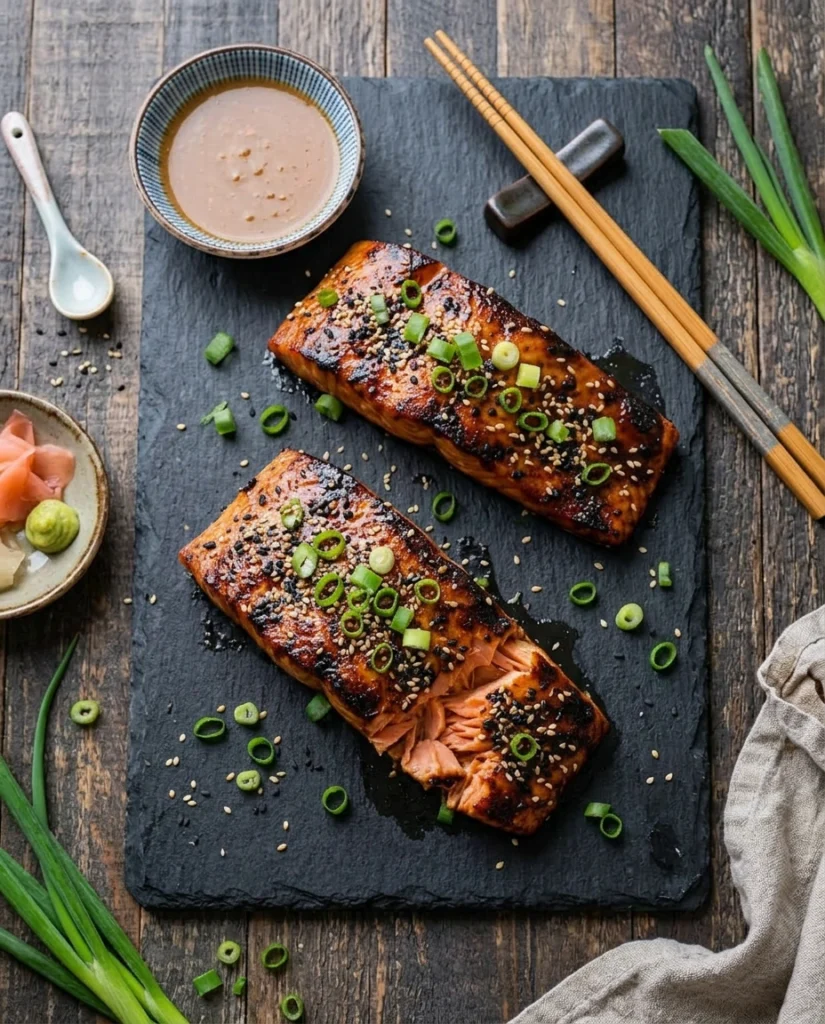
- Plate and serve. Serve each fillet over steamed jasmine or brown rice. Drizzle with a small amount of toasted sesame oil. Scatter toasted sesame seeds and diagonally sliced green onions generously over the top. Serve with fresh lime wedges and the remaining reserved teriyaki glaze as a dipping or drizzling sauce at the table.
Variations & Tips
Make it a grilling recipes for two dinner: Two fillets, a single batch of glaze, and a simple side of steamed edamame and jasmine rice transforms this into one of the most elegant and effortless grilling recipes for two weeknight dinners imaginable. The intimacy of a shared plate of perfectly lacquered salmon — sesame seeds scattered, green onions piled, lime wedges alongside — requires zero additional effort and produces genuinely restaurant-quality results.
Teriyaki grilled chicken thighs: This identical glaze is arguably the most celebrated grilling recipes chicken teriyaki application in Japanese-American cooking. Use boneless, skin-on chicken thighs, marinate for 2–4 hours, and grill over two-zone heat — direct for searing and char, indirect for cooking through to 165°F internal temperature. The glaze caramelizes on chicken thigh skin in a way that is equally spectacular to the salmon version and possibly even more crowd-pleasing at a mixed-preference grilling recipes dinner table.
Grilling recipes Blackstone teriyaki salmon: Heat your Blackstone flat top to medium-high and add a thin layer of neutral oil. Cook the marinated salmon fillets flesh-side down for 3–4 minutes until deeply golden, flip to skin side for 3 minutes, then glaze repeatedly exactly as described above. The flat top’s full-surface contact creates an extraordinarily even sear with none of the sticking concerns of traditional grill grates — making this one of the most successful grilling recipes Blackstone fish preparations possible.
Teriyaki grilled pork tenderloin: Slice pork tenderloin into 1-inch medallions and marinate in the teriyaki glaze for 1–2 hours. Grill over direct high heat for 3–4 minutes per side until caramelized and cooked to 145°F internal temperature. This grilling recipes pork adaptation is one of the most underrated teriyaki applications — the pork’s mild sweetness harmonizes with the glaze even more naturally than chicken, creating a grilling recipes pork dinner that is quietly extraordinary.
Grilling recipes healthy bowl version: Flake the grilled teriyaki salmon over a bowl of brown rice or cauliflower rice with steamed edamame, shredded purple cabbage, sliced avocado, pickled ginger, and a drizzle of extra teriyaki and sesame oil. This grilling recipes healthy bowl approach is nutritionally exceptional — complete protein, omega-3s, fiber, and healthy fats in a single satisfying meal that feels indulgent and nourishing simultaneously.
Quick-pickled cucumber side: Thinly slice one English cucumber and toss with 2 tbsp rice vinegar, 1 tsp sugar, ½ tsp salt, and a pinch of red chili flakes. Let sit for 15 minutes. The bright, tangy crunch is the perfect grilling recipes side dishes companion to the rich, sweet teriyaki salmon — cutting through the glaze’s richness and refreshing the palate between bites.
Pro tip: For an extra layer of flavor complexity, add 1 tablespoon of white or yellow miso paste to the teriyaki glaze while reducing. The fermented soybean paste adds an extraordinary depth — funky, umami-rich, and slightly sweet — that elevates the glaze from excellent to genuinely remarkable and positions this grilling recipe firmly in the category of dishes people talk about long after dinner is finished.
How to Meal Prep
The homemade teriyaki glaze is the most valuable make-ahead component of this grilling recipe and one of the most versatile preparations in the entire grilling recipes for dinner toolkit. Made in large batches and stored in a sealed jar in the refrigerator, it keeps for up to 3 weeks and functions as a marinade, a dipping sauce, a stir-fry sauce, a grilling recipes chicken glaze, a grilling recipes pork finishing sauce, and a grilling recipes side dishes drizzle for grilled vegetables and rice bowls. Having a jar in the refrigerator during grilling season is the single highest-return-on-investment preparation a home cook can make.
The salmon itself is best grilled fresh — but it can be portioned, seasoned, and marinated up to 24 hours in advance, covered in the refrigerator. Pull it from the fridge 20 minutes before grilling to return it to room temperature, which ensures even cooking from edge to center. This makes the active preparation window on a busy weeknight virtually zero — pull, grill, glaze, plate, eat.
Leftover grilled teriyaki salmon — stored in an airtight container for up to 2 days — is one of the most versatile next-day proteins a grilling recipes dinner can produce. Flake it cold over a Japanese-inspired salad of shredded cabbage, edamame, mandarin orange segments, and sesame dressing. Fold it into onigiri rice balls with a dab of wasabi and a strip of nori. Warm it gently in a skillet and serve over ramen with a soft-boiled egg and sliced green onions. A grilled teriyaki salmon dinner is, in this way, not one meal but three — and every iteration is worth making.
Cultural Context
Teriyaki is one of the most linguistically transparent cooking terms in the global culinary vocabulary — the word itself describes the technique with complete precision. Teri (照り) means luster or gloss — the visual quality of the caramelized glaze on the surface of the food. Yaki (焼き) means grilled, broiled, or pan-fried — the application of direct heat. Teriyaki, therefore, is not a sauce. It is a cooking method: the act of applying heat to food coated in a sweet, soy-based glaze until it achieves a glossy, caramelized surface.
The technique developed in Japan during the Edo period (1603–1868), initially applied primarily to fish — yellowtail, mackerel, and tuna — which were glazed with soy sauce and mirin and grilled over charcoal in a method that is essentially identical to what we practice today. The application to chicken and other proteins was largely a later development, influenced significantly by Japanese-American cooking in Hawaii, where teriyaki culture took hold among Japanese immigrant communities in the early 20th century and eventually developed into the beloved plate lunch tradition that spread across the American mainland from the 1960s onward.
What makes teriyaki such a perfect grilling recipes for dinner technique for the modern home cook is the same quality that made it indispensable in the Edo period — it is a method built around the specific thermal properties of live-fire cooking. The combination of soy, mirin, and sugar was engineered — intuitively, over centuries of refinement — to caramelize at precisely the temperatures generated by charcoal and wood fire. The modern gas or charcoal grill produces that same thermal environment, which is why teriyaki salmon grilled in a backyard in the 21st century tastes fundamentally correct — because the technique and the tool have been matched for centuries, and some combinations are simply, permanently, right.
Grilled Teriyaki Salmon
Equipment
- grill
- saucepan
- brush
- tongs
- mixing bowl
Ingredients
- 4 salmon fillets, skin-on (6–8 oz each)
- 1 tbsp neutral oil
- salt, to taste
- white pepper, to taste
- 1/2 cup soy sauce
- 1/4 cup mirin
- 1/4 cup sake or dry sherry
- 3 tbsp brown sugar
- 1 tbsp fresh ginger, grated
- 3 cloves garlic, grated
- 1 tsp rice vinegar
- 1 tsp sesame oil
- 1 tsp cornstarch (optional)
- 1 tbsp cold water (for slurry)
- 1 tbsp toasted sesame seeds
- 3 green onions, sliced
- lime wedges, for serving
- steamed rice, for serving
Instructions
- In a saucepan, combine soy sauce, mirin, sake, brown sugar, ginger, and garlic. Simmer for 8–10 minutes until reduced and slightly thickened. Stir in rice vinegar and sesame oil. Optionally thicken with cornstarch slurry. Reserve one-third for finishing.
- Marinate salmon in half of the glaze for 20 minutes at room temperature.
- Remove salmon, pat lightly dry, and brush with oil. Season lightly with white pepper.
- Preheat grill to 375–400°F and oil grates היט.
- Place salmon skin-side down and grill for 4–5 minutes until halfway cooked.
- Flip and brush with glaze. Grill for 2 minutes.
- Flip back, brush again with glaze, and cook another 1–2 minutes to build layers.
- Remove salmon at 125–130°F internal temperature and rest for 3 minutes.
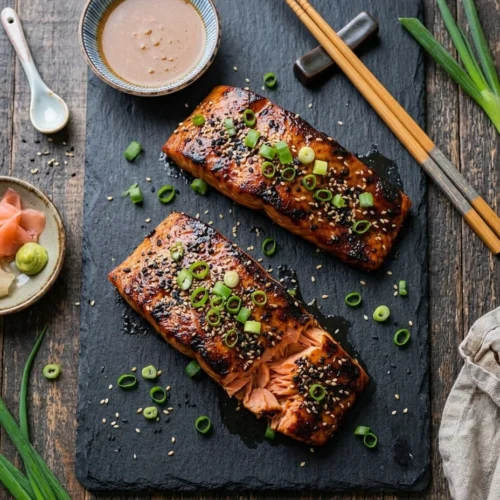
- Brush with reserved fresh glaze and garnish with sesame seeds and green onions.
- Serve immediately with rice and lime wedges.