
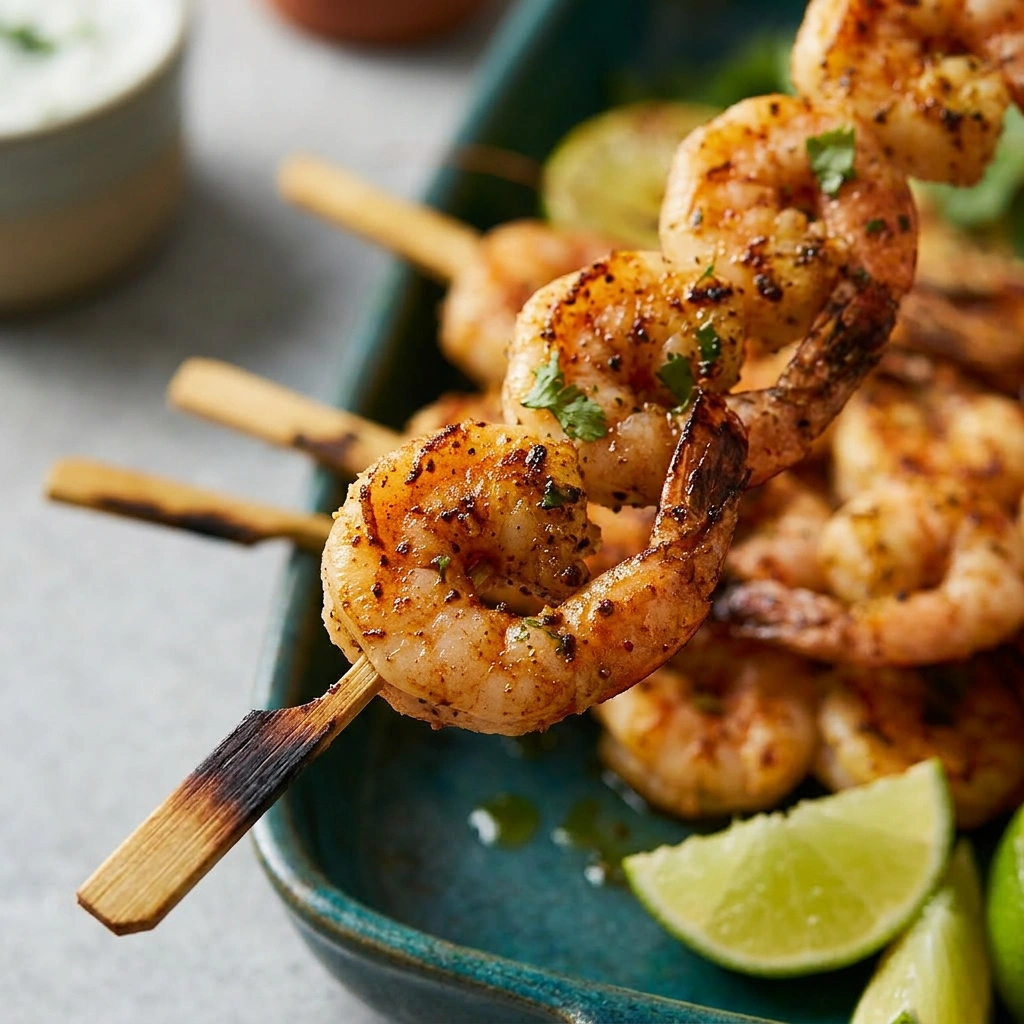
There is a particular kind of magic that happens when yogurt-marinated shrimp hits a screaming-hot grill. The yogurt chars at the edges, the tandoori spices bloom and caramelize, and the shrimp — just barely cooked through at the center — curl into that perfect C-shape that every grill cook recognizes as the universal signal of a perfectly executed shrimp.
These tandoori grilled shrimp skewers are one of the most rewarding grilling recipes easy enough to make on a Tuesday night and impressive enough to anchor a dinner party spread. The marinade does all the heavy lifting. The grill does the rest. And the result is a grilling recipes for dinner centerpiece that is smoky, spiced, tangy, and deeply, completely delicious.
This is the grilling recipe that quietly becomes everyone’s most-requested dish of the summer.
Why You’ll Love This Grilling Recipe
The tandoori marinade is a flavor delivery system unlike anything else in grilling recipes. Yogurt tenderizes the shrimp while creating a coating that chars magnificently on the grill. The spice blend underneath it — cumin, coriander, smoked paprika, garam masala, ginger, and cayenne — creates a layered complexity that builds from the first bite through to a warm, lingering finish.
It is one of the fastest grilling recipes for dinner in existence. Shrimp cook in 2–3 minutes per side. The marinade needs just 30 minutes. From opening your refrigerator to sitting down at the table, you are looking at under an hour — and most of that is hands-off marinating time. This is grilling recipes easy in its purest, most satisfying form.
It is a genuinely healthy grilling recipe. Shrimp are extraordinarily high in protein and low in calories and fat. The yogurt-based marinade adds probiotics and calcium without significant caloric cost. The spice blend is built entirely from anti-inflammatory aromatics. This is a grilling recipes healthy option that tastes like an indulgence without functioning like one.
Common Mistakes (And How to Avoid Them)
Marinating the shrimp too long. This is the counterintuitive danger of this grilling recipe — unlike beef or pork where longer marination generally means more flavor, shrimp marinated for more than 2 hours in a yogurt and spice mixture begin to break down texturally. The proteins in the yogurt and the acidity from the lemon juice gently denature the shrimp’s delicate muscle fibers, and what should be firm and juicy becomes soft and slightly mushy before it ever reaches the grill. Thirty minutes is the sweet spot — 1 hour maximum.
Using small or medium shrimp. For skewers on a grill, size is everything. Small shrimp overcook in seconds at the temperatures required for proper tandoori char — by the time the marinade caramelizes on the exterior, the interior is already rubbery and overdone. Use large (21–25 count) or jumbo (16–20 count) shrimp exclusively. The extra size gives you the time window you need to develop color on the outside while keeping the center perfectly tender.
Skipping the double-skewer technique. A single skewer through the center of a shrimp allows it to spin freely when you try to flip — every piece rotating independently rather than the entire skewer turning as a unit, which makes flipping an exercise in frustration. Thread each shrimp through two parallel skewers simultaneously — one through the tail end and one through the thick end. The shrimp is locked in place, flips cleanly as a unit, and cooks evenly on both sides.
Not shaking off excess marinade before grilling. A thick coating of yogurt marinade on the grill is not your friend — it drips, causes flare-ups, steams rather than chars, and can create an unpleasant, slightly sour cooked-yogurt flavor at the surface. Shake each skewer firmly after removing from the marinade to remove the bulk of the yogurt while leaving a thin, even coating that will char beautifully without burning.
Chef’s Notes
The color of great tandoori cooking comes not just from the spices but historically from the addition of red food coloring — a practice used in commercial tandoori restaurants to achieve that vivid, fire-engine red finish. At home, we achieve a deeply beautiful, natural orange-red color through a combination of smoked paprika, Kashmiri chili powder, and turmeric — no artificial coloring required, and arguably a more complex, nuanced result than the artificial version.
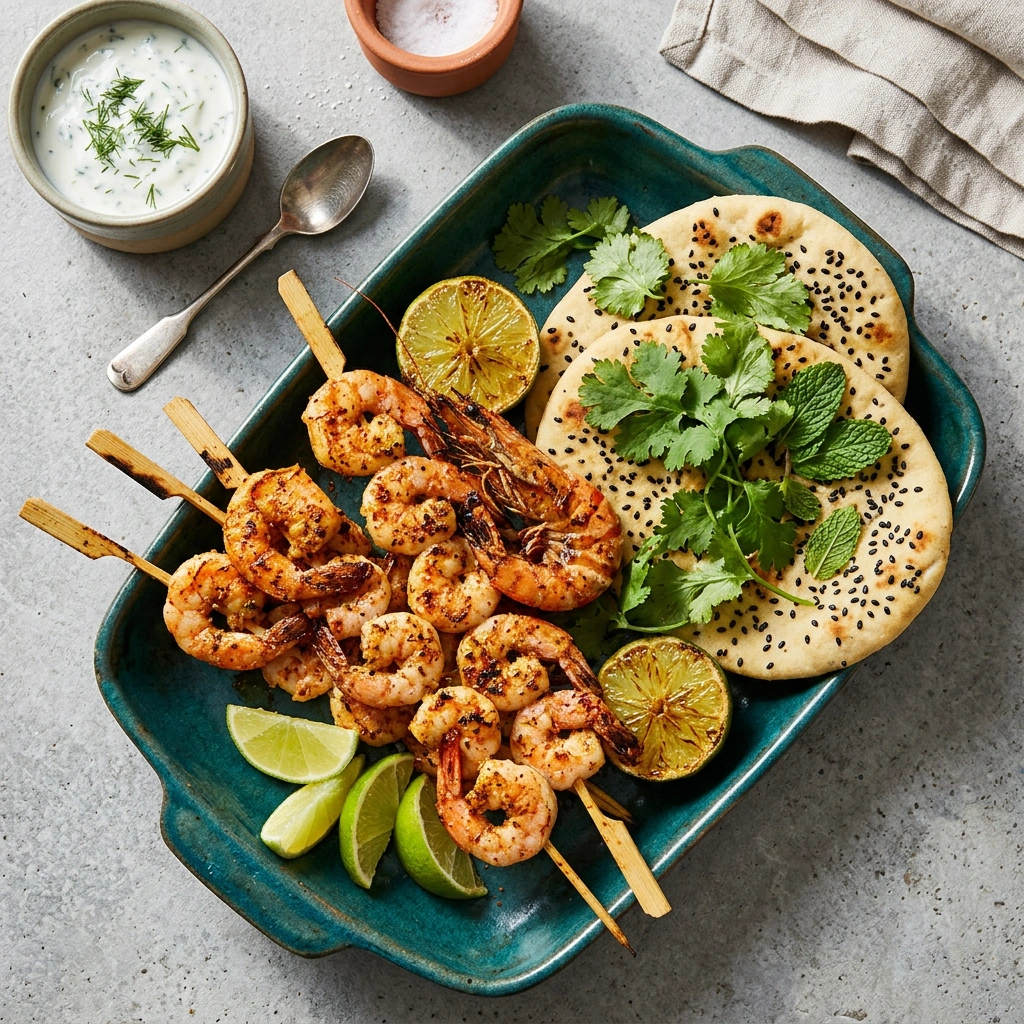
If you want to take this grilling recipes for dinner preparation further, serve the finished skewers over a cooling base of cucumber raita — grated cucumber, full-fat Greek yogurt, fresh mint, a pinch of cumin, and salt. The cold, creamy raita against the hot, charred, spiced shrimp is one of the most instinctively satisfying flavor and temperature contrasts in cooking. It also makes this naturally into one of the most elegant grilling recipes for two presentations imaginable — two skewers over raita, a piece of grilled naan on the side, a squeeze of lime.
Key Ingredients — And Why They Work
Large shrimp (21–25 count, peeled and deveined, tails on): Tails on is not merely aesthetic — the tail shell contains flavor compounds that release into the surrounding marinade and char during grilling, adding a subtle shellfish sweetness to the edges of the shrimp that peeled-only shrimp cannot replicate. The 21–25 count designation means 21 to 25 shrimp per pound — large enough to grill properly, small enough to cook through before the exterior burns.
Full-fat Greek yogurt: The structural foundation of the tandoori marinade and the element that makes this grilling recipe unlike any other shrimp preparation. Full-fat yogurt is critical — low-fat or non-fat yogurt has a higher water content that dilutes the marinade, prevents proper charring, and increases flare-up risk on the grill. The fat in full-fat yogurt emulsifies the oil-soluble spice compounds and carries them directly onto the surface of the shrimp, while the yogurt’s lactic acid gently tenderizes the protein. It is doing three jobs simultaneously.
Kashmiri chili powder: This is the non-negotiable specialty ingredient in this grilling recipe. Kashmiri chili is a mild, deeply flavored dried chili from northern India with a brilliantly vivid red color and a fruity, earthy flavor that is genuinely different from any Western chili powder or cayenne substitute. It provides the characteristic red-orange color of tandoori cooking and a warmth that is present but never aggressive. Find it at any South Asian grocery store or order it online — the difference it makes is significant enough to justify the effort.
Garam masala: A complex, pre-blended spice mixture whose name translates from Hindi as “warming spice blend.” Unlike individual spices that each contribute a single note, garam masala contributes an entire chord — cinnamon, clove, cardamom, black pepper, cumin, coriander — in a single measured spoonful. It is the aromatic backbone that gives tandoori cooking its characteristic warmth and complexity.
Ground cumin and coriander: The savory-earthy duo that forms the foundational base of virtually every Indian-influenced spice blend. Cumin is warm, slightly bitter, and intensely aromatic — it blooms magnificently under the heat of the grill. Coriander is citrusy, floral, and lighter — it provides brightness and lift that prevents the heavier spices from becoming too dense.
Fresh ginger and garlic (grated): In tandoori cooking, these two aromatics are typically used in equal proportion and considered a single compound flavor element — the garlic-ginger paste that appears in the base of virtually every marinade in North Indian cuisine. Together they provide a sharp, warm, spicy foundation that is categorically different from either ingredient used alone. Grate them on a microplane for maximum surface area and flavor release into the yogurt.
Turmeric: Provides golden color, a faintly bitter earthiness, and powerful anti-inflammatory compounds that make this one of the most nutritionally distinguished grilling recipes healthy options on the table. Its flavor contribution is subtle — primarily supporting the other spices rather than leading — but its color impact on the final marinade and the grilled shrimp is unmistakable.
Mustard oil or neutral oil: A small amount of oil in the marinade serves as the fat-soluble carrier for the oil-soluble aromatic compounds in the spice blend. Mustard oil — traditional in North Indian cooking — adds a sharp, pungent, slightly horseradish-like note that is completely unique. If unavailable, any neutral high-smoke-point oil works perfectly for this grilling recipe.
Lemon juice: Provides the acidic component that, combined with the lactic acid in the yogurt, creates the marinade’s tenderizing effect. It also brightens the entire spice blend and is critical as a finishing squeeze at the table — fresh lemon over hot, charred tandoori shrimp is one of the most electrifying simple flavor combinations in grilling recipes for dinner.
How to Make Tandoori Grilled Shrimp Skewers
Serves: 4 | Prep Time: 15 min (+ 30 min marinating) | Cook Time: 6–8 min
Ingredients:
For the shrimp:
- 2 lbs large shrimp (21–25 count), peeled and deveined, tails on
- Metal skewers or wooden skewers soaked 30 min (use two per skewer set)
For the tandoori marinade:
- ¾ cup full-fat Greek yogurt
- 2 tbsp Kashmiri chili powder (or 1 tbsp smoked paprika + 1 tbsp mild chili powder)
- 1 tbsp neutral oil or mustard oil
- 1½ tsp garam masala
- 1 tsp ground cumin
- 1 tsp ground coriander
- ½ tsp turmeric
- ½ tsp cayenne pepper (adjust to heat preference)
- 1 tsp kosher salt
- 1 tbsp fresh lemon juice
- 1 tbsp fresh ginger, grated on a microplane
- 4 cloves garlic, grated on a microplane
- ½ tsp black pepper
For the cucumber raita:
- 1 cup full-fat Greek yogurt
- 1 medium cucumber, grated and squeezed completely dry
- 2 tbsp fresh mint, finely chopped
- 1 tbsp fresh cilantro, finely chopped
- ½ tsp ground cumin
- ½ tsp kosher salt
- 1 tbsp fresh lemon juice
To finish and serve:
- Fresh lemon or lime wedges
- Thinly sliced red onion rings
- Fresh cilantro leaves
- Chaat masala for finishing (optional but extraordinary)
- Grilled naan or flatbread for serving
Instructions:
- Make the tandoori marinade. In a large bowl, combine Greek yogurt, Kashmiri chili powder, oil, garam masala, cumin, coriander, turmeric, cayenne, salt, lemon juice, grated ginger, grated garlic, and black pepper. Whisk vigorously until completely smooth and uniform — the marinade should be a vivid, deep orange-red with a thick, creamy consistency. Taste it — it should be intensely spiced, slightly tangy, and assertively flavored. This marinade needs to be bold because the grill will mellow its intensity.
- Prepare and marinate the shrimp. Pat the shrimp completely dry with paper towels — surface moisture dilutes the marinade and prevents proper adhesion. Add the shrimp to the marinade bowl and toss thoroughly to coat every surface. Cover and refrigerate for 30 minutes minimum, 1 hour maximum. Set a timer — do not over-marinate.
- Make the cucumber raita. Grate the cucumber on the coarse side of a box grater. Place the grated cucumber in a clean kitchen towel and squeeze firmly over the sink until virtually no liquid remains — this step is critical to prevent the raita from becoming watery. Combine the squeezed cucumber with Greek yogurt, mint, cilantro, cumin, salt, and lemon juice. Mix well, taste, and adjust salt. Refrigerate until needed — it improves as it sits.
- Thread the skewers. Remove shrimp from the marinade and shake each piece firmly to remove excess yogurt coating — you want a thin, even layer, not a thick clump. Using the double-skewer technique, thread each shrimp through two parallel skewers simultaneously — inserting one skewer near the tail and one through the thicker body section. Aim for 5–6 shrimp per double-skewer set. The shrimp should lie flat and parallel to the skewers, locked in place.
- Preheat and prepare the grill. Heat the grill to high — 425–450°F. Clean the grates thoroughly and oil them generously immediately before the skewers go on. For a grilling recipes Blackstone flat top application, heat the surface to high and apply a thin layer of high-smoke-point oil to the griddle — the flat top creates full-surface contact and an even, beautiful char across every piece of shrimp simultaneously.
- Grill the first side. Lay the skewers on the hot grates. Close the lid and grill undisturbed for 2–3 minutes. Watch for the marinade to char at the edges — the yogurt coating will develop dark, blistered spots while the shrimp turns pink and opaque from the bottom up. When the bottom is charred and the shrimp releases cleanly, it is ready to flip.
- Flip and finish. Flip each double-skewer set cleanly as a single unit — the double-skewer technique makes this effortless. Grill the second side for 2–3 minutes. The shrimp is perfectly cooked when it has curled into a firm C-shape, is completely pink and opaque throughout, and the marinade is charred and caramelized on both sides. Do not cook to a tight O-shape — that is the visual signal of an overcooked, rubbery shrimp.
- Rest briefly and finish. Remove skewers from the grill and let rest for 90 seconds — even shrimp benefits from a brief rest. Immediately squeeze fresh lemon juice generously over the entire platter. Finish with a scattering of fresh cilantro, thinly sliced red onion rings, and a dusting of chaat masala if using — this tart, funky, slightly sulfurous spice blend is what restaurant tandoori dishes use as a finishing element and it is transformative.
- Serve immediately. Plate the skewers over a generous pool of cucumber raita, or serve the raita alongside for dipping. Accompany with grilled naan, extra lemon wedges, and sliced red onion. This is a dish that demands to be eaten the moment it leaves the grill.
Variations & Tips
Make it a grilling recipes for two dinner: Halve the shrimp quantity and build two generous, restaurant-style plates — four skewers over raita, grilled naan alongside, a simple cucumber and tomato salad dressed with lemon and olive oil. Light candles. Open wine. This grilling recipes for two presentation is one of the most effortlessly elegant weeknight dinners imaginable.
Tandoori grilled chicken variation: This exact marinade — one of the most celebrated grilling recipes chicken preparations in the world — works magnificently on bone-in chicken thighs and drumsticks. Marinate for 4–6 hours or overnight, grill over two-zone heat (direct to char, indirect to cook through), and finish with an internal temperature of 165°F. The grilling recipes chicken result is arguably even more spectacular than the shrimp version.
Tandoori grilled pork skewers: Cut pork tenderloin into 1.5-inch cubes, marinate in the same tandoori mixture for 2–4 hours, and skewer with red onion and bell pepper pieces. Grill over direct high heat for 3–4 minutes per side. The pork absorbs the spice blend beautifully — making this grilling recipes pork adaptation one of the most flavorful and underrated variations on the tandoori theme.
Make it a Blackstone grilling recipe: Heat your Blackstone to high, add a thin layer of oil, and cook the marinated shrimp directly on the flat top in a single layer — no skewers required. The full-surface contact creates an even, golden-brown sear across the entire surface of every shrimp simultaneously. This grilling recipes Blackstone approach is particularly effective for large quantities — no skewer threading, no flipping individual sticks, just shrimp in and shrimp out.
Grilling recipes healthy bowl option: Serve the tandoori shrimp over cauliflower rice or brown basmati with a generous spoonful of raita, sliced avocado, cherry tomatoes, and a drizzle of mint chutney. This grilling recipes healthy bowl is high protein, anti-inflammatory, and genuinely satisfying without being calorie-dense — one of the most nutritionally complete grilling recipes dinner options in this entire series.
Pro tip: If your shrimp are releasing excess liquid onto the grill and steaming rather than charring, your grill is not hot enough or you have too much yogurt marinade on the shrimp. Both problems have the same fix — higher heat and a more vigorous shake-off of excess marinade before skewering.
How to Meal Prep
The tandoori marinade is the make-ahead workhorse of this grilling recipe and one of the most versatile preparations in the grilling recipes for dinner toolkit. Make a double or triple batch and store it in an airtight jar in the refrigerator for up to 5 days — it works as a marinade for grilling recipes chicken thighs, grilling recipes pork tenderloin, paneer cubes, cauliflower steaks, and portobello mushrooms with equal brilliance. Having it ready in the refrigerator transforms weeknight grilling from a planning exercise into a spontaneous pleasure.
The cucumber raita keeps beautifully in the refrigerator for up to 3 days and actually improves as the flavors meld — make it the night before for a more integrated, deeply flavored result. It doubles as a dip for raw vegetables, a sauce for grilled flatbread, and a cooling counterpoint to any spiced grilling recipe on the menu.
Leftover grilled tandoori shrimp — stored in an airtight container for up to 2 days — makes an outstanding addition to a grain bowl with basmati rice, chickpeas, and mint chutney the following day. Chop and fold into a wrap with raita and shredded lettuce for one of the best packed lunches a grilling recipes dinner can produce. Reheat gently in a skillet over medium heat for 60–90 seconds — just enough to warm through without continuing to cook the already-perfect shrimp.
Cultural Context
Tandoori cooking is one of the oldest and most technically sophisticated live-fire cooking traditions on earth. The tandoor — a cylindrical clay oven that dates back at least 5,000 years to the Indus Valley Civilization — operates at temperatures between 480°F and 900°F, generating a cooking environment of simultaneous radiant heat from the clay walls, convective heat from the superheated air column, and direct conductive heat where food contacts the oven surface. It is, in purely technical terms, one of the most thermally complex cooking vessels ever developed by any culture.
Tandoori cooking as the world knows it today was shaped significantly by the Partition of India in 1947, when the mass migration of populations across the newly drawn borders between India and Pakistan brought Punjabi tandoori cooking traditions — previously concentrated in the northwest — into Delhi, Bombay, and eventually the entire Indian subcontinent. Restaurants in Delhi’s Daryaganj neighborhood, most famously Moti Mahal, are credited with popularizing tandoori chicken as a restaurant dish in the 1950s, from which it spread globally through the Indian diaspora.
What makes tandoori marinades so perfectly suited to modern grilling recipes for dinner is the fundamental thermal logic they were designed around — extreme heat, short cooking times, and a yogurt-spice coating engineered specifically to char magnificently under live-fire conditions. The backyard grill, particularly when pushed to its maximum temperature, is the closest Western approximation of the tandoor’s intense, enveloping heat. These tandoori grilled shrimp skewers are not an approximation or an adaptation of the tradition — they are the tradition, expressed through the tools and ingredients available to a home cook in a backyard, on a summer evening, feeding people they love.
Tandoori Grilled Shrimp Skewers
Equipment
- grill
- mixing bowl
- whisk
- skewers double skewers recommended
- tongs
Ingredients
- 2 lbs large shrimp (21–25 count), peeled and deveined, tails on
- 3/4 cup full-fat Greek yogurt
- 2 tbsp Kashmiri chili powder
- 1 tbsp neutral oil or mustard oil
- 1 1/2 tsp garam masala
- 1 tsp ground cumin
- 1 tsp ground coriander
- 1/2 tsp turmeric
- 1/2 tsp cayenne pepper
- 1 tsp kosher salt
- 1 tbsp fresh lemon juice
- 1 tbsp fresh ginger, grated
- 4 cloves garlic, grated
- 1/2 tsp black pepper
- 1 cup full-fat Greek yogurt (for raita)
- 1 medium cucumber, grated and squeezed dry
- 2 tbsp fresh mint, chopped
- 1 tbsp fresh cilantro, chopped
- 1/2 tsp ground cumin (for raita)
- 1/2 tsp kosher salt (for raita)
- 1 tbsp lemon juice (for raita)
- lemon or lime wedges, for serving
- red onion slices, for serving
- fresh cilantro leaves, for garnish
- chaat masala (optional)
- grilled naan or flatbread, for serving
Instructions
- In a large bowl, whisk together yogurt, chili powder, oil, garam masala, cumin, coriander, turmeric, cayenne, salt, lemon juice, ginger, garlic, and black pepper until smooth.
- Pat shrimp dry, add to marinade, and toss to coat evenly. Refrigerate for 30 minutes (up to 1 hour max).
- Combine yogurt, grated cucumber, mint, cilantro, cumin, salt, and lemon juice to make raita. Chill until ready.
- Thread shrimp onto double skewers, shaking off excess marinade for even coating.
- Preheat grill to 425–450°F and oil the grates well.
- Grill shrimp for 2–3 minutes on the first side until charred and opaque.
- Flip skewers and grill for another 2–3 minutes until fully cooked and charred.
- Remove from grill, rest briefly, then squeeze fresh lemon juice over the top and garnish with cilantro and onion.
- Serve immediately with cucumber raita, naan, and extra lemon wedges.